Making Jumpgate: the devlog
Every version of a game I'm making with Claude, from the first message to version 8.18: my notes in my own words, what changed, and screenshots.
I'm designing this game and playtesting it as it's built; Claude, Anthropic's AI, writes all the code. Each entry below is one round: my notes in my own words (trimmed, never reworded), what Claude proposed or built, and what changed. Times are New York time. The screenshots of versions 1 and 2 were rebuilt from the build saved with each version; the version 3 ones are from that build, and the newest ones (versions 5 to 8.3) are from the version 8.3 build and the Chapter Two to Four ones from the version 8.6 build and the Chapter Six to Ten ones from the version 8.12 build and the morning's from the version 8.18 build, using its chapter starts, played by the test bot. Design talk has no screenshots because nothing was built yet.
- The ideaOct 15, 10:39 am to 10:42 am
- First five minutesOct 15, 10:45 am to 11:25 am
- Geometric AI shipOct 15, 11:27 am to 12:06 pm
- Chapter OneOct 15, 12:07 pm to 1:04 pm
- Design talk after version 3Oct 15, 1:14 pm to 1:32 pm
- Version 4: the awakeningOct 15, 2:10 pm to 2:51 pm
- The opening, and just getting byOct 15, 3:45 pm to 5:00 pm
- One inventory, one droneOct 15, 5:41 pm to 10:09 pm
- Modules, readouts and the first burnOct 15, 10:41 pm to 11:18 pm
- Resources on demand, and a drone that's never strandedOct 15, 11:29 pm to Oct 16, 12:08 am
- First Flight, and the chapters afterOct 16, 12:13 am to 12:33 am
- Chapters Two to FourOct 16, 12:45 am to 12:56 am
- Chapters Five to Ten, overnightOct 16, 1:13 am to 2:03 am
- Morning: fixes, choices and the lookOct 16, 7:52 am to 8:47 am
The idea
Oct 15, 10:39 am to 10:42 am
A probe, drones, an asteroid belt and a gate for the humans who sent it. Kraig described it in one breath; the first decisions followed within minutes: drones as the whole logistics system, a main base with far outposts.
design
The idea: a probe, a drone swarm and a gate
“I like the idea of a factory automation resource collection base building game set. In space, and I want the idea to start simple. A probe is sent out with the most fundamental building blocks to start, a new colony. And it's all drone-based, and it has to start with just its simple little package. Once it finds resources, in like an asteroid belt, And it has to like build up a base big enough to build like a jump gate where the actual humans are able to come in through. So the idea is like humans sent tiny probes out very far distances for a very long time. And then once they find a location, they build a gate so that the humans can join them.”Kraig, 10:36 am
Claude: Claude boiled it down to one line: a tiny probe arrives at an asteroid belt with a minimal seed package; drones mine, process and build; the base grows into a factory able to build a jump gate; the goal is the gate opening so humans can come through. Jumpgate is the working title.
- Set in space, in an asteroid belt: factory automation, resource collection and base building.
- Start simple: one probe with a minimal package, and everything done by drones.
- The goal is to build the jump gate for the humans who sent the probe.
- The process, from the lesson of the first game: one topic at a time, the smallest playable and fun core first, and story only after the core loop is fun.
designmechanic
Drones are the logistics
“I like the idea of building more drones, but also upgrading the drones to work as the logistics network. And I want them to be available and idle to work on anything And we have requester chests and active provider chests similar to Factorio. In the mid-game, and the system is also kind of similar to the drones that can do different work in the crust.”Kraig, 10:38 am
Claude: No belts. One pool of general-purpose drones sits idle until any job needs them (mine, haul, build, repair), as in The Crust. The swarm grows two ways: build more drones, and upgrade them for speed, cargo and range. Mid-game unlocks Factorio-style logistic chests that the drones serve automatically.
- One pool of drones, each doing whatever job is waiting.
- Two ways to grow the swarm: more drones, or better drones.
- Requester and active-provider chests come mid-game.
design
One main base, far satellite outposts
“I picture building one main base with satellite outposts that are far distance and need like a special kind of high-speed high-capacity transport between them because you could do like logistics with the drones between those stations but it would take forever and not be efficient”Kraig, 10:41 am
Claude: Drones handle local logistics. Between the main base and distant outposts, a dedicated long-haul link (high speed, high capacity) is unlocked later. The form of that link is still open.
- Local logistics by drones; a special high-capacity link for long distances, later.
First five minutes
Oct 15, 10:45 am to 11:25 am · v1–v1
Every building requests and provides. Claude built the first five minutes right away and Kraig played it: a textured asteroid, two smelters and a drone bay. His first note was that he didn't want a tile-based game, and the world became continuous.
designmechanic
Requests and provides on every building, from the start
“I feel like the provider chests and requester chests need to be in it from the start. I don't know if they should be attached to each building. Maybe they should. And they, they serve as like storage. And they request a certain number and drones can bring you know they have some inventory so they can bring over um and fulfill the requests yeah let's start building like the first five minutes of the game”Kraig, 10:44 am
Claude: Every building gets its own small store that requests a set amount of each input and provides its outputs; drones, each with a little cargo space, carry from providers to requesters on their own. Plain storage chests provide what's in them. The start: the probe lands with 2 drones, mines iron and silicon, places a smelter, and its plates build more drones. Claude built the first five minutes next.
- Each building requests what it needs and provides what it makes.
- The opening goal: six drones and twenty plates in the first five minutes.
designmechanic
No tiles
“i don't want a tile based game”Kraig, 11:12 am
Claude: The first prototype was built on tile-like positions. Everything became continuous: positions in metres, buildings placed anywhere on the rock with simple circle collision, an organic asteroid drawn as a smooth rocky body, and ore deposits as clusters of rocks at free positions.
- No grid anywhere: free placement with circle collision, an organic asteroid, drones flying straight between points.
v1milestone
Version 1: the first five minutes
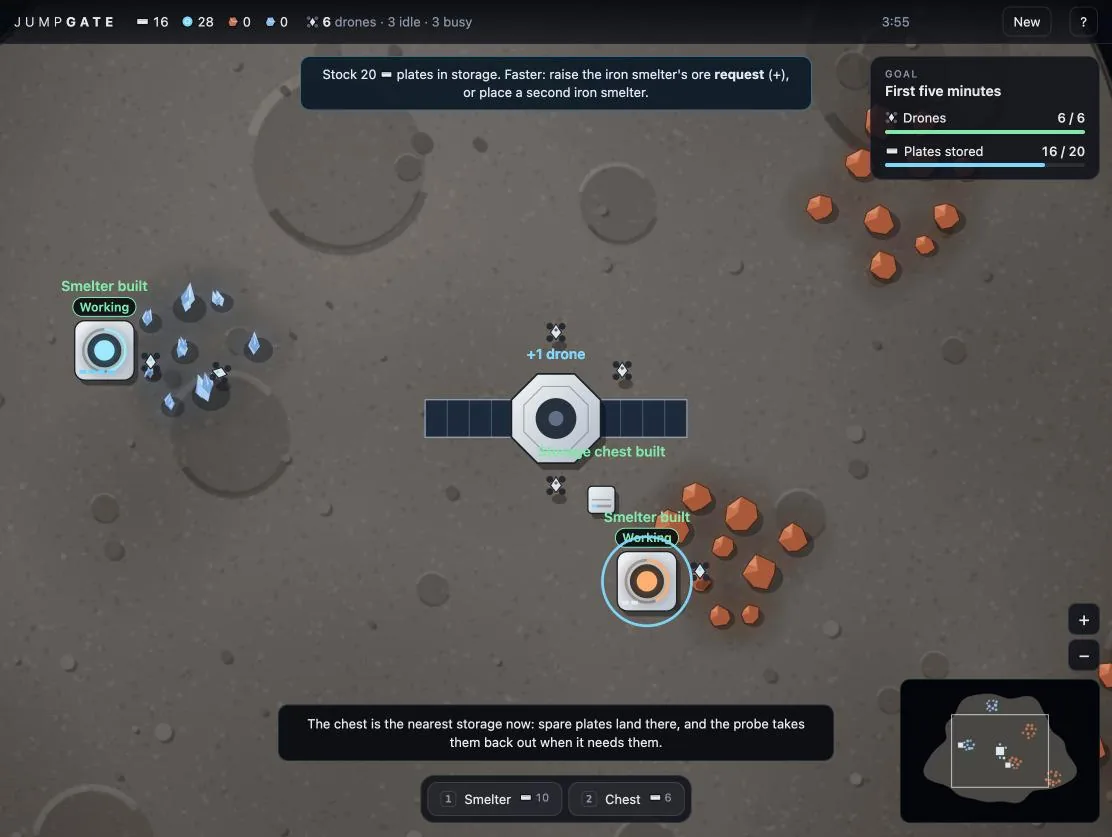
Claude: The first playable build, written in about half an hour after the design talk: the rules first, with a test player that plays the opening without graphics, then the drawing and the interface. You land on a textured asteroid with two drones, mine iron and silicon, place smelters and storage chests, and make plates that build more drones.
- Core: stores that request and provide, a drone dispatcher, smelters and a drone bay on the probe.
- Drawn: space, a rocky asteroid, ore deposits, machines, and drones carrying cargo.
- Interface: panels, a pulsing hint ring, a goal card, item cards, a playtest recorder, and phone layout fixes.
- Placement snaps beside the ore deposits.
 (open full size)
Version 1 at 3:55: six drones, two smelters and a chest on the asteroid. Published as “v1 First five minutes”
design
Peaceful, for now
“1”Kraig, 11:24 am
Claude: Claude offered options for whether there should be enemies. Kraig picked option 1, no enemies: the challenge is the factory puzzle and the long build toward the gate, which fits the feeling of a lonely probe. Pressure, if any, comes later from the environment: impacts, storms and limited power.
- No enemies for now; the difficulty is the factory and the distance.
Geometric AI ship
Oct 15, 11:27 am to 12:06 pm · v2–v2
Simplify to Asteroids-style shapes and one slow factory ship, vast and sparse and bleak, with modules docked on it like habs. The core became the AI, a mining hab replaced mining drones, and version 2 appeared within the hour.
designart
Geometric shapes, and one moving factory ship
“i want to simplify the game to just geometric shapes for now. like the game asteroids. i want this to be a mix of homeworld and factorio. i picture having one satellite factory that can slowly move between objectives and resource patches”Kraig, 11:26 am
Claude: The look became simple vector geometry like Asteroids: outlines and few colours. The player's base is one slow factory satellite that travels between objectives and resource patches, like Homeworld's mothership, running Factorio-style production. This replaced the base sitting on a big asteroid.
- Asteroids-style vector look instead of textured rock.
- One moving factory ship, Homeworld by way of Factorio.
design
Vast, sparse and bleak
“i want the play area to be vast and sparse. i want the start to be desolate and bleak. like there are barely any resources and we need to make due with the little we find”Kraig, 11:27 am
Claude: A huge, mostly empty play area with few resources, far apart, so scarcity is the early challenge: make do with little, choose carefully what to build, and travel to find more.
- Resources are few and far apart at the start.
designmechanic
Modules on the ship, one per job
“yes, i say we build one module for each job and just upgrade it to increase throughput and processing ability. we move material and do active/requester chest logistics with drones and can increase to a few but it's limited by AI compute. i like the idea of modules as like attached habs on the main probe”Kraig, 11:29 am
Claude: Every job gets one module (smelter, assembler, storage) attached to the hull like habs, and you upgrade it instead of building a second one. Drones move all material, and how many you can run is capped by the AI's compute.
- One upgradable module per job, docked on the main ship.
- The drone count is capped by compute, not just by plates.
mechanic
A mining building
“we should have a mining building. stores a small amount and provides ore”Kraig, 11:46 am
Claude: A miner hab, one per ship like the other modules: a thin beam reaches rocks in range, ore collects in a small store and is provided like any provider. Drones no longer mine; they are pure logistics. Claude had the probe arrive with a level 1 miner already attached, so the first thing you see is the beam on the lone rock.
- Mining is a module with a beam, a small store and upgrades for rate and range.
- Drones carry only; they don't mine.
designmechanic
The core becomes the AI, and keeps a reserve
“instead of probe. let's just call it the AI. it's the brain and controls everything”Kraig, 11:50 am
“the AI ship stores a small amount of all resources needed to build things. the player can adjust that amount within the total storage for the ship which can be upgraded eventually. the logistic drone network only pulls from the ship once a certain amount is stored in the ship”Kraig, 11:53 am
Claude: Everywhere the player reads it, the hexagon core is now "the AI": habs attach to the AI, you move the AI, and the drone cap is its own compute. The opening line became "AI-7 online. 4,212 years out. Nothing here. Find enough to build the gate." The reserve: the AI holds a total storage and, for each building resource, an amount the player sets aside; drones only take what is above it, and the reserve is spent only on building.
- The core is the AI: the player is the ship's mind.
- A reserve per building resource, set on the AI's panel and fitted inside its total storage.
v2milestoneart
Version 2: the geometric AI ship
Claude: One moving hexagon, the AI, with small habs docked round it. Self-sustaining is the goal: three drones, a level 2 smelter, a storage hab and a stock of plates, which the test player reaches in about 5 minutes.
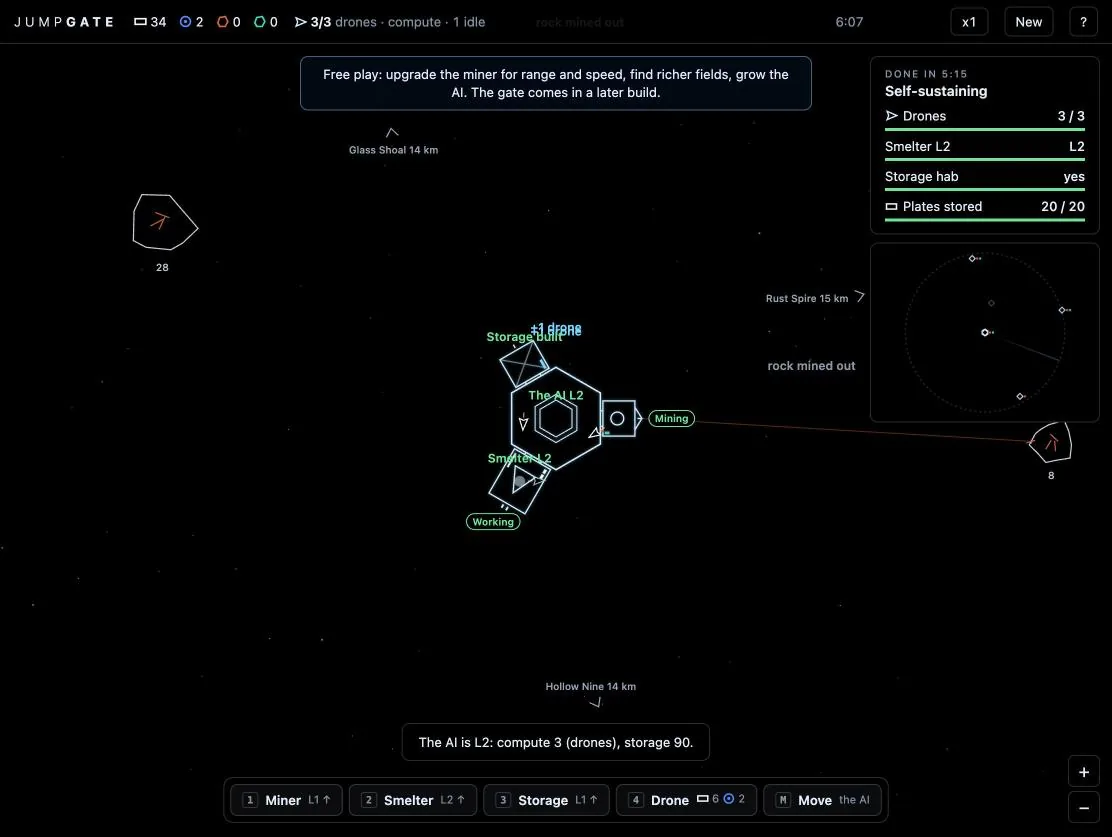
- Asteroids-style vector drawing: the AI hexagon with docked habs, a mining beam, drones, rotating rocks, a scanner, edge markers and dust streaks while drifting.
- Interface: the AI's reserve panel, a Move flow, and a phone layout with larger touch targets.
- Core: one moving ship with docked modules (miner, smelter, storage), upgrades, the AI's compute cap, sparse fields and drone range.
 (open full size)
Version 2: the AI with a miner, a smelter and storage docked, mining a distant rock. 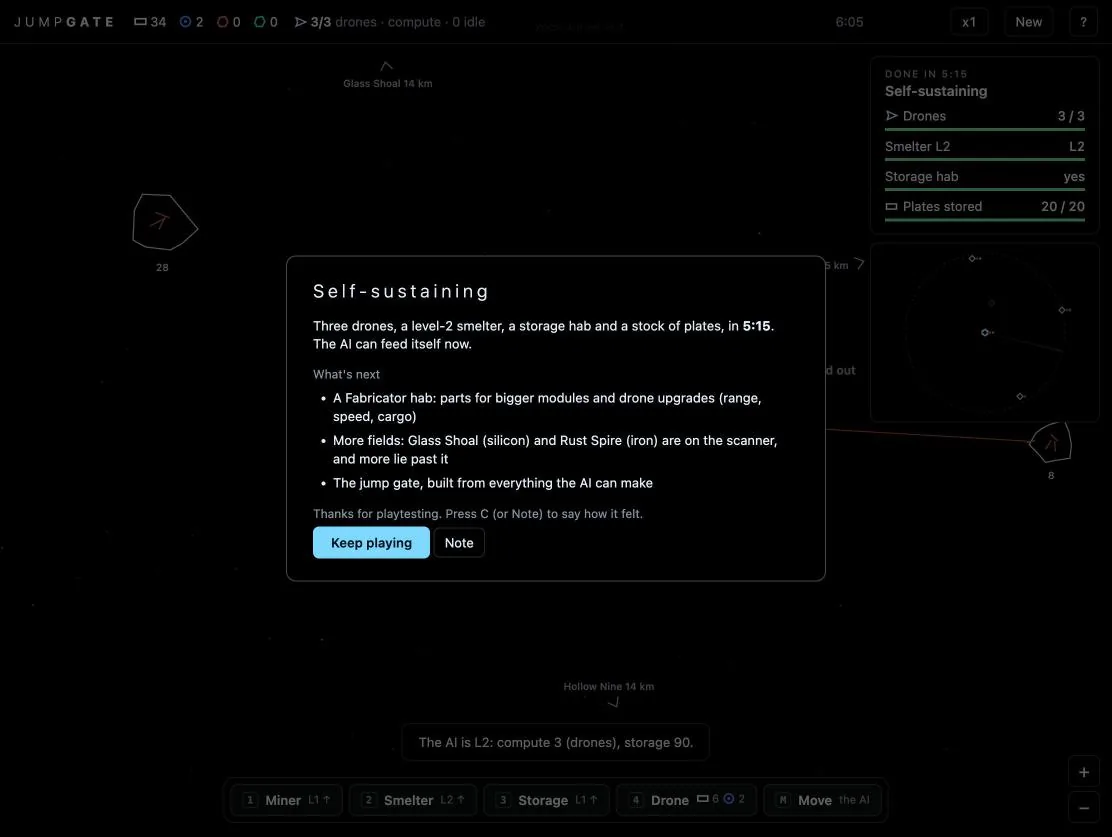 (open full size)
The first objective card: the AI can feed itself in 5:15. Published as “v2 Geometric AI ship”
Chapter One
Oct 15, 12:07 pm to 1:04 pm · v3–v3
After playing version 2 Kraig asked for it to be slower, more distant and sparser, with phases of mining and travel, power from burning what you don't need, and a slow guided tutorial ending at a derelict. Version 3 is that chapter, 17 objectives long.
design
Homeworld with factory logistics; rivals later
“it's homeworld, but with factory logistics set in space. Eventually there will be enemies who also build their own factories and compete for resources. But that'll be later. We can just focus on the core loop.”Kraig, 12:06 pm
Claude: "Peaceful" holds for now only. Later, rival factory AIs build their own factories and compete for the same scarce fields. Nothing for them in the build yet: the core loop comes first.
- Rival factory AIs are planned, not built.
designmechanic
Two phases: mine, then travel
“I think it looks great so far. My notes are to keep things distant and sparse and slow at first. And I like the idea of like phases kind of, like the resources are so distant and you have to move with your entire factory that it's almost like a phase of mining resource extraction, but everything can happen at the same time, the factory is still running, but then you have to travel to another location with your entire satellite. And that takes time and you can't really mine resources, you kind of spend resources at that time. I like those two phases kind of. And also it seems like you're kind of mining one resource at a time mostly. Like obviously we could have dual resources or different different scenarios, but like if we're near an iron patch, like and we mine all the iron, like next we'll probably go to coal and not or copper, not another iron patch, you know.”Kraig, 12:10 pm
Claude: The rhythm became an extraction phase (parked at a field, mining and processing) then a travel phase, when the whole ship moves slowly, can't mine, and the factory keeps running on what it stored. Fields are mostly a single resource, so finishing the iron means going to copper, not to more iron.
- Extraction phase, then travel phase, with the factory running through both.
- Mostly single-resource fields; mixed fields are the exception.
designmechanic
Power: burn what you don't need
“And then obviously there's going to be power. And the thing about like space is that solar is the way to go. It's constant and abundant. And it makes it so there's no reason for batteries. Like I was thinking maybe like, I don't know, asteroid shadow or something, but I guess we can't really do night daytime phases, which is fine. We'll just make upgrading or building and upgrading solar like more costly and not a beginning phase thing. At the beginning, I picture we can burn excess resources as like fuel, but it's very inefficient and it's bad and costly, but it's how we like propel ourselves in the beginning game. And like anytime we have excess resources like ore or plates that we don't want, we can and we can't store anymore. Like we should have the option for like anything spilling over, I guess, can become like consumed in a processor to like make some amount of fuel that can be used to charge or be used for power.”Kraig, 12:14 pm
“Well, it's more so like fuel. I don't know, like just any material, like salvage, I guess we can call it, should be able to like convert into energy somehow. And I feel like burning as fuel makes sense. Like I said, it's inefficient. And I could picture an interesting scenario where we're transporting between locations and we run out of energy or like our energy is super low so the engines don't work as well and we run out of fuel and we have to like scrap some of our space station to make the journey. Like the worst case scenario, like we have to sacrifice something expensive to put it into that super inefficient fuel burner to generate some kind of propulsion just to get to the next resource area. But that's like a weird case scenario.”Kraig, 12:17 pm
Claude: Early on a burner turns surplus into energy, very inefficiently. Any item counts as salvage, and in an emergency you can scrap a drone or a hab into the burner to limp to the next field. Low energy slows the engines but never stops them. Solar comes later and costs a lot.
- Every item can be burned for energy.
- Low energy weakens the engines instead of stopping them.
- Scrapping something expensive is the worst-case way to make a trip.
designtutorial
Chapter One: a slow, guided tutorial
“I do want to focus on this first chapter of the game, which serves as like a slow, deliberate, guided tutorial. So everything has to be slow, just so that the player can like focus their attention and learn what they need to, and nothing's over complicated. And they're guided through like a source of objectives. And I just, I want things to start slow. I want this game to feel distant and sparse and things take time and you can get stuck between the emptiness of space. Like there will be, we're gonna populate the play area and I want it to be like generative. So like if you move to the map, it just keeps going. Like if that's possible.”Kraig, 12:24 pm
“what ends chapter one of the tutorial phase, I think is the ship is finally able to leave the area and like reach, go towards the next objective. But like, I want this to be open world and I will have like missions and story and side quests and there will be enemies eventually. But like I do truly want like an open sandbox, open world in any direction type of game.”Kraig, 12:26 pm
“I think all of those are good. There should be like repairing. There should be getting like just enough systems up to sustain ourselves. There should be collecting enough fuel for the trip or power or whatever we need. And getting like a far distance away from that starting point, I think is like the first objective. And then after like we've reached a certain distance, it should like trigger the first storyline, which might be like, we finally found another pocket of resources, but ... I do want the, the story to be like a slow burn, so like introducing some kind of ruins or indication that there are enemies, but we don't see them yet, would probably be the first step.”Kraig, 12:27 pm
Claude: Chapter One is an ordered list of objectives, one active at a time, each teaching one thing and slow on purpose. The arc: repair the drive, get just enough systems to sustain yourself, upgrade the scanner to find somewhere worth going, stock up for the crossing, make it, and at a set distance a slow-burn story beat fires: a new pocket of resources and a derelict with one line hinting that someone else was here. The map has no edges: seeded cells generate fields as the AI travels and scans.
- Nothing is unlocked or shown before its objective.
- A generative, endless map from a seed: mostly empty, mostly single-resource fields.
- The chapter ends at the derelict, with no enemies shown.
design
You are the AI; escorts, combat and the gate
“I would say you're like AI remote view, like Factorio, where you can, can just control everything with AI. You're the AI. I also like the idea of like eventually ... a fleet of smaller ships, but like with their own modules and systems that kind of just stay close to the satellite, not really attached, but just like kind of escort it. And at first we don't need to control these. They can just be like upgraded and built. and those are like the defense and offense. So like if we're going to attack an enemy, we would, we would take our whole factory and fleet in an attack and eventually there will be shields and I really like the space combat from the show and the book series The Expanse so I would really love to have like railgun nuclear missiles and then machine gun turrets to like shoot down missiles ... point defense turrets or flak guns”Kraig, 12:30 pm
“the end goal is to build a jump gate, which is really expensive and complicated to, you know, usher in the actual humans who sent this and started this whole project. But there's like a lot of sub goals alongside that, which is like, you know, just building up the entire network of logistics and support, as well as defending the area, you know, making sure it's safe for them to enter. And yeah, maybe finding a planet, but like we don't go down to the planet. We just like at the end of the game, like find a planet that has a ton of resources that we can like send ships down to and bring resources up or build a space elevator or even a Dyson sphere. And then those things are what help us actually build the gate. which needs a lot of power to build a black hole so that we can, you know, create the wormhole.”Kraig, 12:31 pm
Claude: The player is the AI with a remote view that controls everything, Factorio-style; the drones stay automatic. Later, not now: an escort fleet of small ships with their own modules that stay close to the AI and are built and upgraded rather than piloted, shields, and Expanse-style weapons (railguns, nuclear missiles, point-defense guns and flak). The end goal is the jump gate; along the way come a logistics network, defending the area, and a resource-rich planet with a space elevator and maybe a Dyson sphere for the gate's power.
- The game speaks to the player as the AI.
- Combat and the escort fleet are planned for later.
- The jump gate is the one direction in an open sandbox.
designmechanic
Four resources, compute, and getting stranded
“Yeah, 20 to 30 is fine”Kraig, 12:33 pm
“Yeah, we need copper and ice”Kraig, 12:36 pm
“I want the compute aspect that we developed in the other Hollow Arc game to be in this one as well. So I think the AI should just always have a tiny trickle stream of like compute that can be used to research technology. And eventually we'll try to like increase that to unlock other technologies. But I think that should be like the main advancement metric. And compute will need like data centers which will need to be built and maintained with power and water. And at first the AI for the main hub could be like damaged. So it's like a really tiny amount, but like repairing that will get us enough to like do other research.”Kraig, 12:38 pm
“you always have the ability to burn what you have on your ship to move. And I know the distances will be long, and it'll take a while to get to, to locations. And also there's an element of, like, randomness, so there might be something just floating or unexpected that you come across well. drifting or moving somewhere and also there's the element of like where are you heading next so the scanning and like knowing what where we're gonna head next is like a big element and that could be mysterious you know like we're going in this direction to this indicator but we don't quite know what's there yet kind of thing unless we like have bigger upgrades or spend to like have better information gathering ... But the the player will lose if the AI is destroyed. So the main hub is destroyed. And that'll come from enemies. So we don't have to worry about that now. And like technically maybe there's an edge case where like you get stuck in the middle and don't have the resources or the ability to like leave. And I think that should just be up to the player. Like, you should just feel that. You should, like, think, like, what is the tiny, interesting, crazy way that I could get myself out of this bad situation? And I like that aspect of it.”Kraig, 12:41 pm
Claude: About 20 to 30 minutes for a first-time player. Iron, silicon, copper and ice, each in its own field; ice becomes water that every kilometre of travel uses as reaction mass. Compute is the main advancement metric: the AI arrives with a damaged core and a trickle of compute that runs drones and research, and repairing it unlocks the rest. Getting stranded is allowed and is the player's puzzle, and there is no game over for now.
- Four resources and what each is for.
- Research from a trickle of compute; each drone reserves a slice.
- Random finds while drifting, and mysterious scanner signals.
v3milestonetutorial
Version 3: Chapter One
“I really like all three ideas, and habs that touch each other can pass directly is a good idea. That's what I was going to implement.”Kraig, 12:52 pm
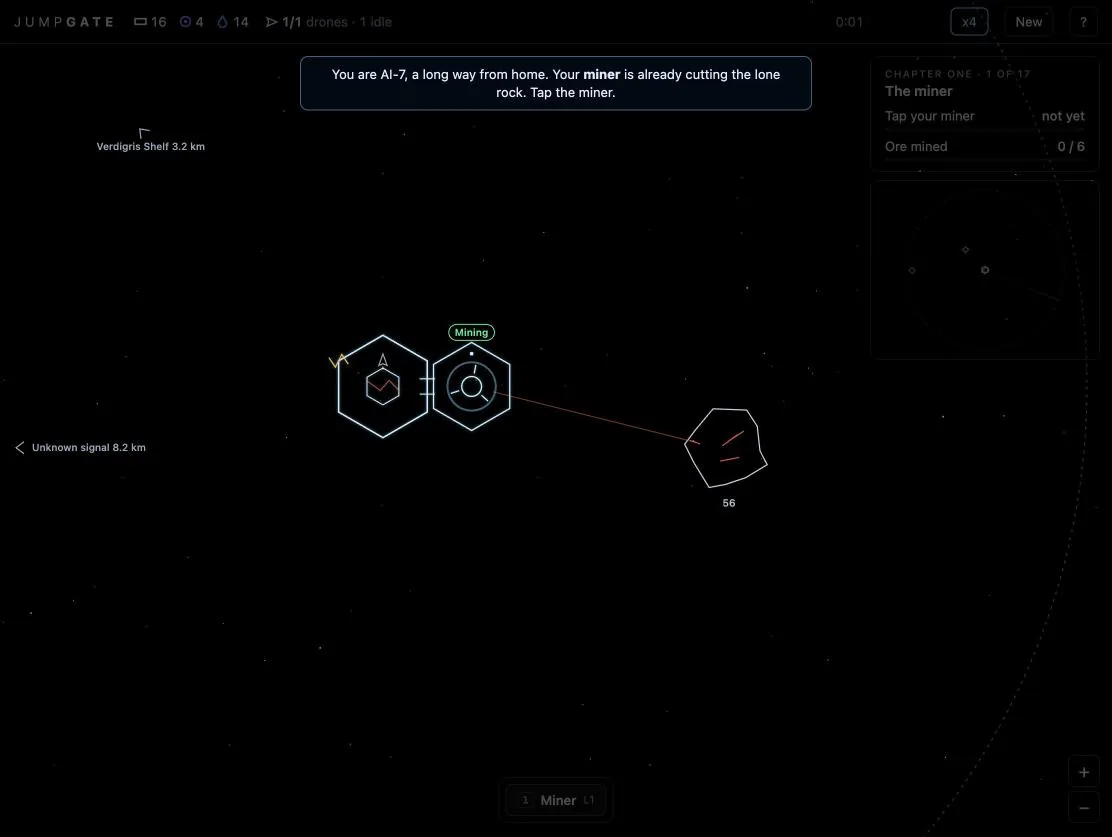
Claude: The first chapter as a guided tutorial of 17 objectives, one at a time, from the AI waking damaged beside its lone rock to a crossing and a derelict. The test player finishes it in about 19.5 game minutes and a first-time player should take 22 to 30.
- Station layout: habs dock face to face on a hexagonal lattice, so the station is a layout you design, and touching habs pass items straight across with no drone.
- Energy with a bar on the top line, a burner with salvage settings and a scrap option, and a damaged drive that limps at 40%.
- Compute and research: a damaged core, one drone to start, and a short list of technologies filled from the compute trickle.
- Move: pick the AI, tap a destination, one speed, with a dirty red-orange exhaust and dust streaks.
- The scanner: pings with unknown signals that resolve as you get close, an endless generated map, and a drift find now and then.
- The story beat: a hull older than you, cut open from the outside.
 (open full size)
Chapter One begins: the AI, its miner, and the lone rock. 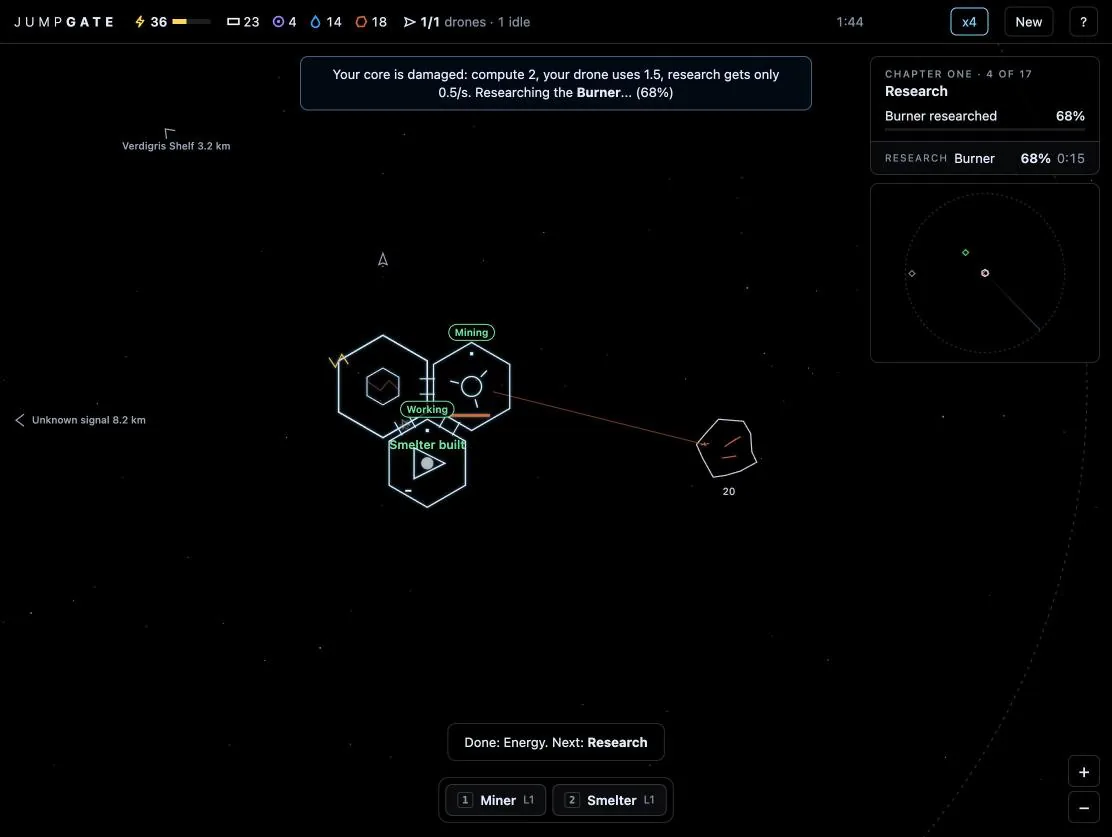 (open full size)
The first smelter built, with the Burner being researched from a tiny compute trickle. 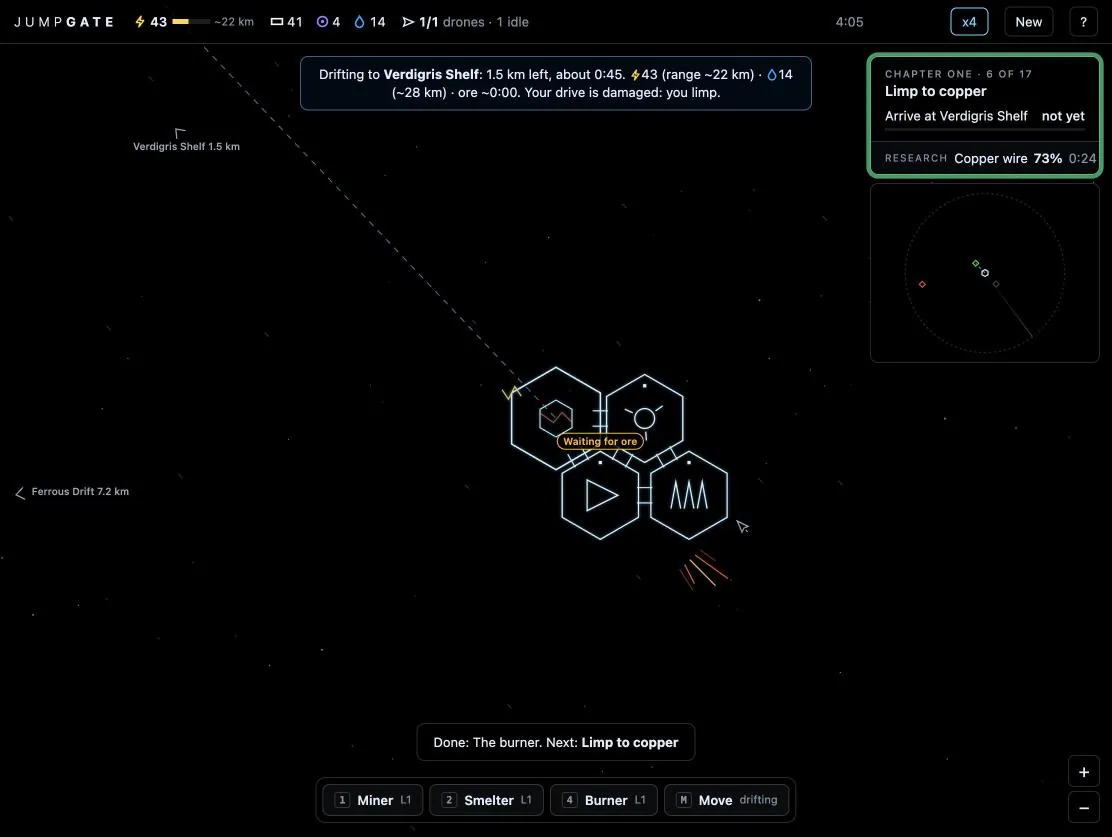 (open full size)
Limping to the copper field on a damaged drive, red exhaust and all. 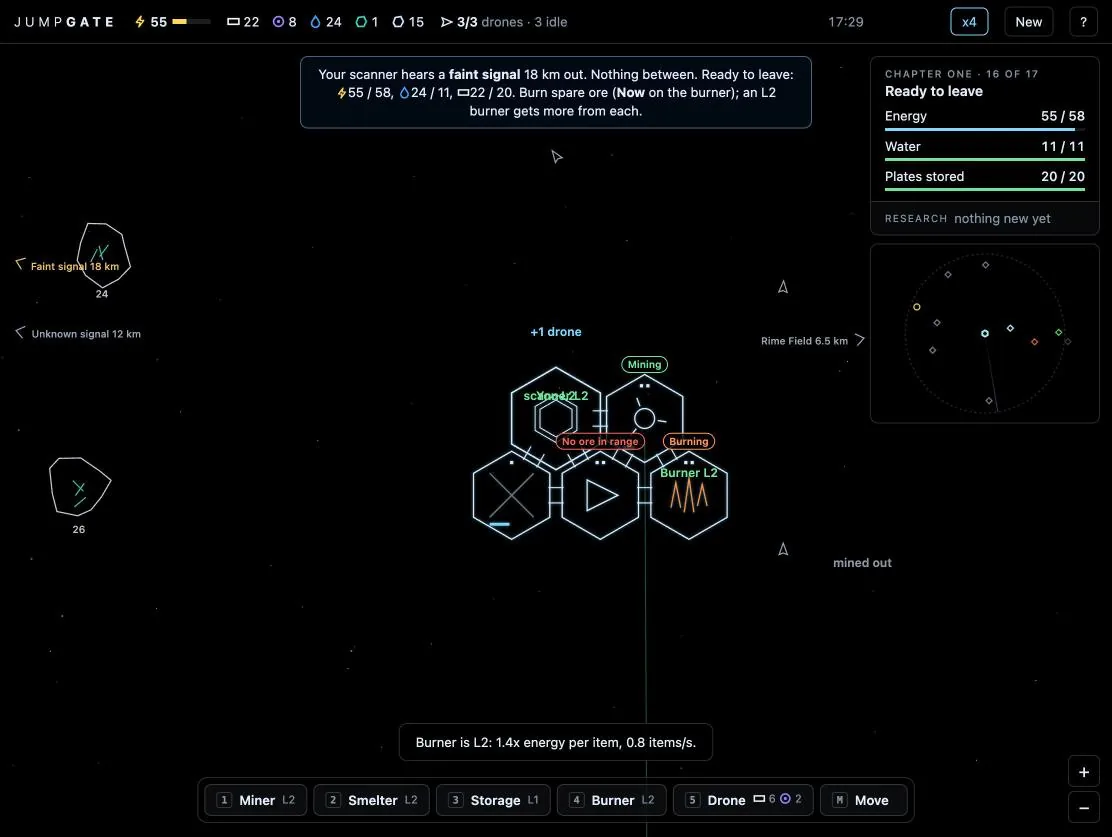 (open full size)
The station as a lattice of habs, at 17:29, ready to cross. 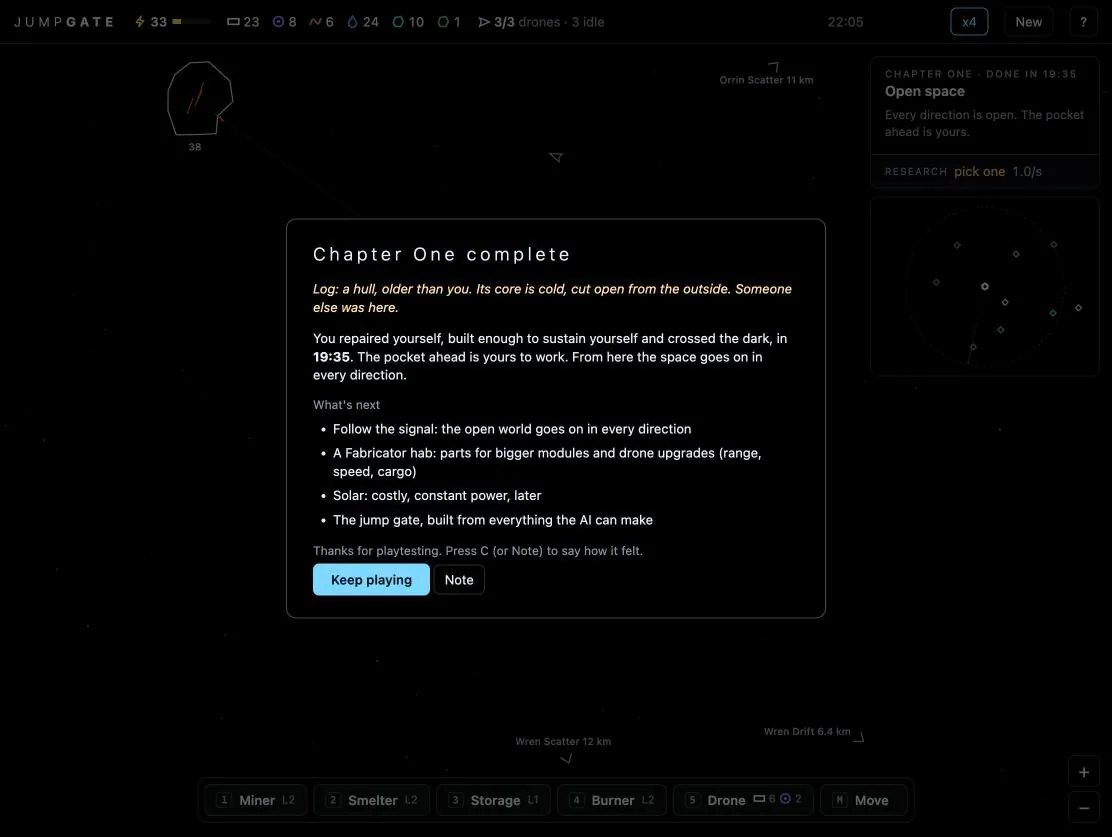 (open full size)
The end of Chapter One, in 19:35 for the test player. Published as “v3 Chapter One”
Design talk after version 3
Oct 15, 1:14 pm to 1:32 pm
What Kraig decided next, with no code yet: rocks that break into pieces, everything drifting, the AI's swarm voice, a zoom that turns abstract, the long arc to an enemy-held planet, and a Chapter One that wakes on a dying battery.
designmechanic
Rocks that break apart, and everything drifting
“I think the mining laser is good for like breaking apart the ore, but I think it should make little pieces that the drones have to go and pick up and bring back to storage, whatever we have for storage.”Kraig, 1:05 pm
“I think everything in the game should like slowly be moving. I feel like it would be interesting if like seed maps get a start, but like all of the asteroids and I don't know, like they don't have to. Some of them could be stationary, but I like the idea of things slowly drifting. So like if you're mining an asteroid, it slowly drifts away. Or maybe even the idea that like you have to just like maintain speed with whatever thing you're working on. Like I like the idea that like you can drive the station wherever you want, but you can also like lock in and kind of just maintain with it.”Kraig, 1:12 pm
Claude: Two changes queued for the next build. The miner's beam cracks chunks off the rock, and drones fetch them to storage; the miner no longer holds ore. And everything drifts slowly: some rocks sit still, but the one you mine moves away, so the station can lock on and match a target's drift.
- Mining makes pieces that drones collect.
- Slow drift for fields and rocks, with a lock-on.
designart
The AI's swarm voice, one continuous zoom, never quite enough
“You can come up with the AI's voice because that'll be easy to change. We just need like a placeholder. But I kind of like the idea of the Hugging Face agent swarm chatter. Like they are a collective, like, wow, we found other agents vibe. I think that's kind of like a topical way for like AIs to talk. And I think it's interesting, but it should be like, you know, very binary terminal-esque code language kind of.”Kraig, 1:14 pm
“I kind of like the homeworld aspect where if you zoom out, it like becomes abstract. I mean, we can have a mini map now, but it would be really cool if the UX, the UI was just like super minimal and the game just felt distant and expansive and quiet and lonely. And you can zoom out really far to see all the systems and the planets or like whatever like information we have mapped out and scanned. I want it to feel like a whole galaxy that you can travel between. And you can zoom all the way in. I mean, right now we have the like asteroid geometry line minimalism, which I kind of like. And we'll keep going with that, but we could change it in the future, but we'll see.”Kraig, 1:16 pm
“I also just like the idea of just bareness and desolation and isolation, and like the resources we get are just almost never enough, and you have to use problem solving and efficiency systems to like make it work. And there's a way to do everything. It just starts really slow and hard and annoying. And if you are strategic and creative with how you do things, like, it'll just save headache and time and speed everything up and make you more efficient.”Kraig, 1:19 pm
Claude: The placeholder voice for the AI is a collective of sub-agents talking in terse terminal lines, like [core.0] ore.lock(R-14) :: 36u and [swarm] ack ack ack, rare and understated. The view becomes one smooth zoom from drones and chunks out to systems and a galaxy, turning abstract past a threshold, with a very quiet interface. And a tuning principle for everything: resources are almost never enough, and cleverness is what speeds things up.
- Swarm chatter in a binary, terminal register for the AI and the story beats.
- A continuous zoom to an abstract galaxy view; a minimap is fine for now.
- Everything is possible, but starts slow and hard; layouts and routes are the reward.
designstory
The arc: from empty space to an enemy-held planet
“So I picture our game starts like literally between systems in the middle and deadness of space where there's literally nothing. And as we travel, we find more and more matter to build. And our solar slowly, very slowly, also builds because we're getting closer to a sun. Heat. Well, I guess heat would be the same. Well, heat might slowly go up, maybe. I don't know. But the like goal is to try to find a planet to harvest. And that takes a system. So, you know, traveling in that way, we're trying to find a system. ... I think when we're traveling, there should be small debris that hits the front of the ship that causes damage. And on this first tutorial run, you know, it causes just enough damage to like really become a problem and a worry. And it makes you realize that you need defense systems for the front. So that's where like your first fleet would come in. It would shoot point defense flak to take out asteroids in front while traveling. And that's like a resource that gets spent up. Iron bullets, right? And if we do shielding eventually, but like that should be a movement mechanic that, you know, is really hard and scary at first and then teaches you to like do things differently the next time you travel between a system.”Kraig, 1:22 pm
“the end goal, the final part of the game is finding the planet to harvest, and that's where all the end goal milestones and goals come in, like the Dyson Sphere, the uplink to contact the homeworld, the space elevator, and the logistics program for up and down from the gravity well. So, like, yeah. The whole mid-game is trying to get to find the planet and to get there. And that's also where we'll, like, run into the biggest fortified defenses from the enemy. So the enemy is going to occupy the world, and we're going to have to clear them out to get there.”Kraig, 1:25 pm
Claude: This replaces the idea of starting in the home system. The game starts in the void between systems, almost no matter, with solar power slowly rising as the ship nears a sun. Debris hits the front of the ship while it travels, a worry in the tutorial run, which teaches that a point-defense escort is needed. The mid-game is finding the planet and getting there; the endgame is there: the Dyson sphere, the uplink to the homeworld, the space elevator and logistics up and down the gravity well, all toward the jump gate. The enemy occupies the planet with its strongest defenses, and has to be cleared out.
- Early game: the void between systems, scraping by.
- Mid-game: finding the planet and getting there.
- Endgame: the planet, the Dyson sphere, the uplink, the space elevator and the gate, against fortified enemy defenses.
designstory
Chapter One is the awakening
“chapter one is just the derelict, or like the awakening. So it's building, it's trying to like hobble together enough of a station to survive, to collect resources to leave, and that first flight over to the next collection of resources. Okay, so I like the idea of energy being used to propel us as like, you know, the way that we move, and that gets better and better over time. But the really cheap, bad, dirty way at the start is excess material can be jettisoned, and that propels us a tiny amount in the opposite direction. So instead of the burner, like making fuel and whatnot, I think this is like a really scrappy first way that we go to the next system.”Kraig, 1:27 pm
“maybe that was a bad idea. Let's go back to the burner. As like chapter one. And the burner, like, so the story is like the Habs solar is broken. I mean, I don't know why it wakes up in the first place, but yeah, there is no solar. So the story starts with the Hab like waking up, and it has just enough battery to like start its mission. And early in this chapter one, you know, you need to build a power source. So that's the burner. And that just burns material, whatever it is. It's very inefficient. And the end of chapter one, before we leave, should be building like a crude engine so that we can propel ourselves like very slowly. And we just get, we go slowly towards the copper, and we get bombarded in the front with debris or asteroid dust or whatever”Kraig, 1:30 pm
“in chapter one, you don't even know about the debris until you start moving, and there's no way for you to stop it. You just have to take the hits, but we'll make it so it'll never destroy the station, and it'll just bring it down and damage it a lot.”Kraig, 1:32 pm
Claude: First an idea to move by jettisoning matter, then Kraig took it back: the burner stays. The AI wakes with its solar broken and just enough battery to begin; early on it builds the burner for power; the last objective is a crude engine to crawl toward the copper. On the way debris and dust hit the bow, with no warning and no way to stop it. The hits damage the station a lot but can never destroy it. Repairs and forward defense follow in Chapter Two.
- No solar at all in Chapter One; a dying battery, then the burner.
- A crude engine as the last step before leaving.
- Debris as a surprise you can only take, which never destroys the station.
Version 4: the awakening
Oct 15, 2:10 pm to 2:51 pm · v4–v4.1
Chapter One rebuilt around the dying battery: the first rock drifts in, you mine it by hand, research unlocks every mechanic, the smelter refines and a new constructor makes parts, and a crude engine flips and burns toward the copper while debris hits the bow. Music and a full set of sounds arrived the same hour.
designtravel
Normal moves, and flip and burn
“i want normal move mechanics for the ship. i want to select the hub in the middle and click on the map where i want it to move”Kraig, 2:06 pm
“i want flip and burn somehow”Kraig, 2:09 pm
“there's efficiency in doing simple straight line journeys. if you stop the ship mid travel or give it a new destination it has to spend extra energy adjusting and wastes time as well”Kraig, 2:10 pm
Claude: Travel became The Expanse's flip and burn: the whole station turns as one body to put its engine behind it, burns to the midpoint, flips 180 degrees in a slow visible turn and burns to a stop on the target. A new destination or a stop mid-trip first kills the speed you have, so straight runs are the efficient ones, and the course preview shows the extra energy and time before you commit.
- Select the AI, tap anywhere, and it goes there, like an RTS.
- Flip and burn: accelerate to the midpoint, flip, brake to a stop.
- Momentum: changing course or stopping mid-trip costs energy and time.
designeconomy
Refining and constructing; work costs power, autonomy costs compute
“compute needs a readout in UI like power. hovering over power or any item should give more details”Kraig, 2:13 pm
“we should show materials flowing between modules”Kraig, 2:14 pm
“the smelter should just process raw materials It shouldn't make actual items. Like iron plate should be made in a constructor. From processed metal. Silicon wafer should be made from silicon So iron ore is turned to iron. Which is turned to iron plate.”Kraig, 2:23 pm
“any work should use power. And any autonomous work like the drone we talked about should use compute. Like the mining laser should use more power than an idling module not being used. Like there's idling and then there's being used. Different power levels.”Kraig, 2:25 pm
Claude: The chain got a second step: the smelter only refines (ore to iron, copper, silicon; ice to water) and a new constructor makes parts from what it refined (plates, wire, wafers). Every module draws a little power idle and more while working, the laser most of all; anything that runs on its own, like the drone or Auto mining, reserves compute. Compute got a readout beside the battery, every stat opens a card that explains it, and items crossing between touching modules show as small coloured dots.
- Smelter refines, constructor makes parts; a good line puts them side by side.
- Idle and working power draws on every module; drones and Auto reserve compute.
- A compute readout, and a detail card behind every number.
- Materials visibly flow between modules.
v4milestonetravel
Version 4: Chapter One, the awakening
“let's get music in the game. Similar to Hollow Arc, but a little more spacey. Very lonely. Droney. A little bit of synth. ... Maybe the asteroid should like drift in. I don't like that the ship just starts mining. I want auto turned off to start, and you should have to mine it yourself.”Kraig, 1:56 pm
“almost every new mechanic should be unlocked with research”Kraig, 1:59 pm
“we should be recommended to get to 100% battery power before starting our first move”Kraig, 2:02 pm
“the drones should never fly behind the engine plume. they would burn up. they should fly in front to defend or on the sides in formation”Kraig, 2:30 pm
Claude: Chapter One rebuilt from the design talk after version 3. The AI wakes between stars on a dying battery with its solar broken; the first rock drifts in and you mine it by hand; research unlocks each new piece (the smelter, the burner, automation, the crude engine); every module starts idle until you pick what it does. The last step is a crude engine: charge to full, then flip and burn toward the copper, where unannounced debris hits the bow and damages the habs but never destroys them. A range circle shows how far a full battery reaches. The test bot finishes the chapter in 20 to 22 game minutes.
- A dying battery, the burner for power, and the crude engine as the last step.
- The laser cracks chunks off rocks; the drone flies out to collect them.
- Everything drifts slowly; modules start idle until you pick a recipe.
- Flip and burn with momentum, a range circle, and charge to 100% before leaving.
- Debris on the move, with integrity per hab that never reaches zero in Chapter One.
- Drones fly in formation in front and to the sides, never in the plume.
- Swarm chatter, a continuous zoom out to an abstract map with a faint star, and generative music.
Published as “v4 the awakening”
v4.1fixplaytest
Version 4.1: never stuck
“all of my stores are my storage is full. And I need to collect ice to make water ... there's no way for me to get rid of material because my power is already full so I can't burn it so we should be able to just burn even if our power is at a hundred just so we could get rid of um, excess stuff”Kraig, 2:34 pm
Claude: A playtest deadlock: every store full and the battery full, so nothing could move. The burner now vents when the battery is full, you can throw out what's above your reserve, and no store ever just says "full": it says what to do. A test now checks that the ship can never deadlock.
- The burner burns even at a full battery, venting the energy.
- Jettison from the AI and the storage hab.
- Every full store says what to do about it.
sound
Music, and a sound overhaul
“let's add the music to the game and let's just do a quick overhaul of the sound effects. I want them to be ... whatever you think is best. Let's just do a quick overhaul on the sound”Kraig, 2:45 pm
“The mining audio is just too much. It's like way too loud and just too much ... just need to be subtler. Because it's going to happen all the time. It can't be annoying”Kraig, 3:30 pm
Claude: A generative score in E minor: parked, a slow detuned drone, long pads and a cold note far off; on a real trip it lifts with a hopeful turn, a rising motif and a soft pulse that follow the burn, resolves on arrival, and plays a tiny triumphant phrase at the end of Chapter One. The effects are synthesized to sit with it: laser charge and pulse, chunk cracks, drone blips, dock clunks, burner crackle, engine rumble and flip servos. After Kraig's note the mining sounds dropped 12 to 20 dB, darker and a little different every time.
- A generative, lonely, droning score that lifts when the station moves.
- A full synthesized effects set, with Music and Effects sliders.
- Mining sounds far quieter, and quieter still on Auto.
The opening, and just getting by
Oct 15, 3:45 pm to 5:00 pm · v5–v5.5
Version 5 starts with the hub alone and dark: it boots, its sensor sphere finds a rock, a pulse laser mines it by hand in a race, and a free reboot wakes the one drone. Power and compute became stores with flows, both short from the start. Then a design pass on the whole look.
v5–v5.1openingmechanic
Version 5: the hub wakes alone
“the intro and text at the start should be slower so i can read it and understand. everything should animate in slowly and more cinematically as well”Kraig, 3:00 pm
“I'm kind of wondering if we even need a miner module. I like the idea of just having the single hub to start. And maybe it has like a really crude mining laser ... it should be able to mine really slowly.”Kraig, 3:04 pm
“I kind of like the idea of pulses instead of just a continuous laser ... targeting, charging, building, pulse. So that you kind of know there's like a rhythm to it instead of just a constant laser beam.”Kraig, 3:08 pm
“I like being able to just steer the ship as a unit and like it's your job to keep whatever you're targeting within the sphere of work I think that is how the game should be instead of this like lock-on thing”Kraig, 3:15 pm
“I don't think the drone should come out of the hat. I think while we're waiting for the asteroid to come within the radius, we should do the reboot, research that's free. And then that enables the drone to be used with compute.”Kraig, 3:39 pm
Claude: A slower, more cinematic opening. The hub drifts dark in the void, its systems come online one by one, and a sensor sphere grows out from the hull until it finds the first rock; then the laser's reach extends. The miner module is gone: the hub has a crude pulse laser built in that targets, charges and fires one pulse per chunk, and you aim it by resting the cursor on a rock. The rock drifts through your reach and out again, so mining it by hand is a race. While it approaches, a free System reboot brings compute online and unfolds the one drone. Lock-on is gone: before the engine you can't move at all, and the story sends rocks one at a time.
- The hub alone, dark, booting system by system; the interface fades in as it's needed.
- A pulse laser in the hub instead of a miner module; hover to mine by hand.
- The first rock is a race; a free reboot wakes compute and the drone.
- No lock-on and no moving before the engine; only the rocks the story sends.
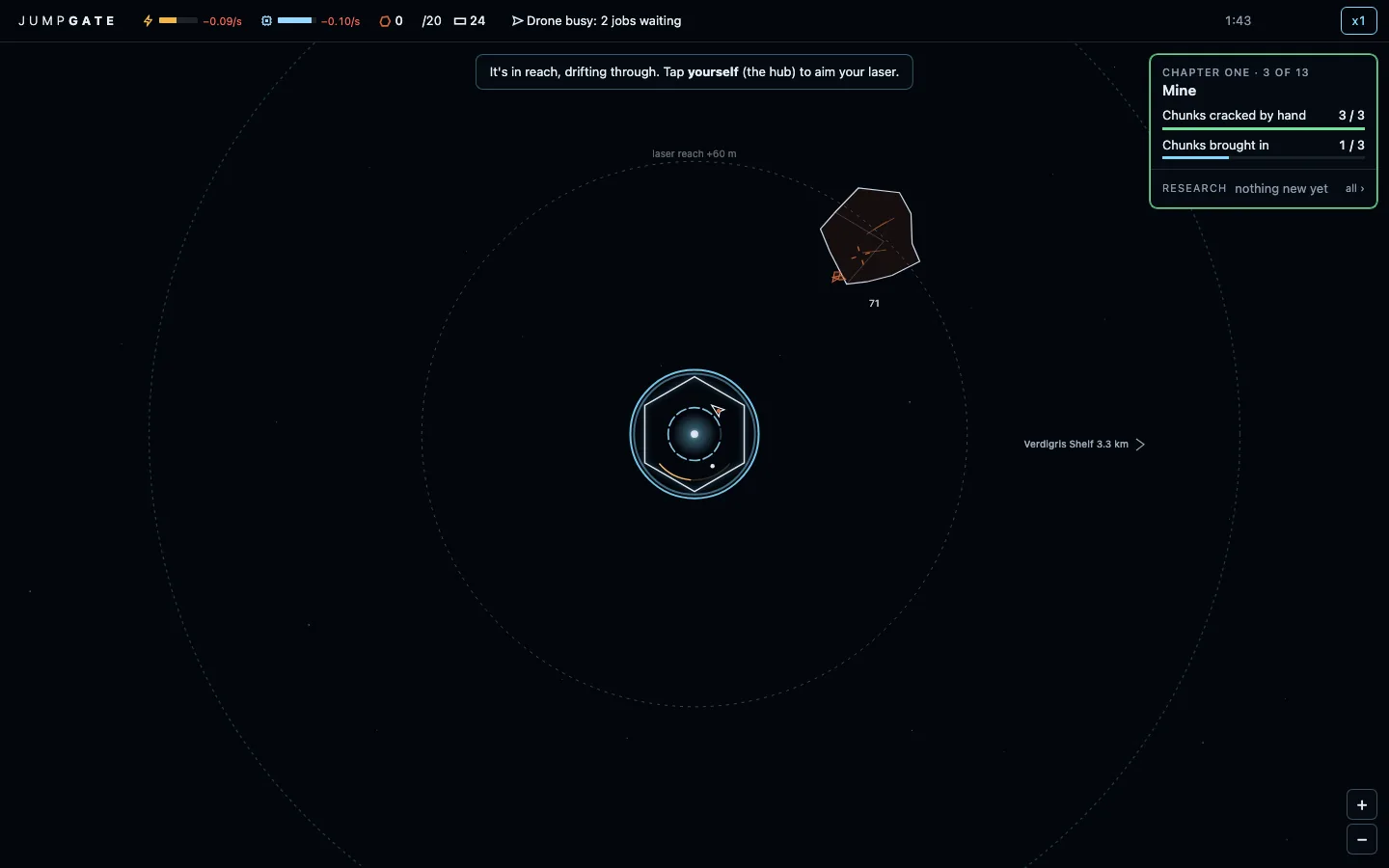 (open full size)
The first rock drifting through the laser's reach, mined by hand (from the current build). Published as “v5 the opening”
v5.2economyart
Version 5.2: just getting by
“compute doesn't really make sense. So you like solar there should be a capacity that you can store and then there should be a generation ... that can be positive and negative. ... the generation minus the consumption equals the rate of change.”Kraig, 3:36 pm
“the drone is doing work. It's flying around, it's collecting stuff, it should be using compute. Like it should be harder to research a little bit. And um, especially at the beginning, there should just be a deficit of power and compute. And we're just getting by.”Kraig, 3:49 pm
“if it's processing making something, or there's like a task it's completing, if we could make a circle like completion loading bar that would be ideal. Even if it's like the hexagon following the path of like the border, I think that would be cool.”Kraig, 3:50 pm
Claude: Power and compute became stores with flows: a capacity, a generation and consumers, with the signed net rate in the top bar. Empty never stops anything, it only slows it. A working drone draws compute, so running it visibly slows research, and early Chapter One hovers around zero on both. Each working module traces its progress around its own border, and the core was redrawn as a mind: a breathing node, a ring that lights as compute fills, a point orbiting for the drone.
- Compute and power as stores with a generation, consumers and a net rate.
- A working drone costs compute; research is harder; both start in deficit.
- Progress traced around each module's border.
- A new core: a node, a compute ring and an orbiting drone.
v5.4–v5.5art
Version 5.5: a design pass, and a dust cloud
“do a quick design upgrade for this first chapter”Kraig, 4:35 pm
“did we do the like space storm or dust idea? I'd like to see an example of that within the first chapter. Like maybe at the end when we're going to like the first, after the first engine burn, we pass through a cloud.”Kraig, 4:53 pm
Claude: The look stayed vector lines on black, made consistent: one palette (cyan for compute and the interface, one warm amber for energy and the engine), one type scale, distinct icons for every module, rocks with a faint ore tint, chunks as small tumbling shards and a sparser starfield. Then a dust cloud across the first crossing, where debris came thickest and the sensors shrank. It was taken out again in version 8.3.
- One palette and type scale; module icons with working, idle and damaged states.
- A dust cloud across the first trip (removed in version 8.3).
- The camera starts closer, so the station reads larger.
One inventory, one drone
Oct 15, 5:41 pm to 10:09 pm · v6–v6.1
One shared hold instead of a store in every module. Touching modules pass items instantly and a single drone does everything else, in a fixed order: repair, build, haul, collect. Debris hits the bow, then the engine end after the flip; damage slows a module, repairs cost plates, and mass makes every trip cost more.
v6economy
Version 6: one ship inventory
“most modules have storage. Having the AI manage storage kinda works but the player doesn't know what's going on easily or if they need to manage it”Kraig, 5:32 pm
“What if instead of 'saved for building' items are used for building or research or whatever based on a priority system. Like they get used before going into an up cycling recipe. Idk and yes, silicon and wafers should be chapter two for sure”Kraig, 5:34 pm
Claude: One shared hold in the core, with storage modules adding room to it and modules keeping only a tiny working buffer. One status says whether you need to do anything, with a one-tap fix when you're stuck. Items are claimed in a fixed order: builds first, then research, then processing, then the burner. Blueprints can be placed before you have the parts and are built in order. Chapter One uses only iron and copper.
- One ship inventory and an inventory panel with one status line.
- Priority claims instead of a safety stock.
- Queued blueprints, built in the order placed.
- Silicon and wafers moved to Chapter Two.
designdrones
Touching modules pass; one drone does the rest
“maybe adjacent modules can instantly transfer materials next to them, and that's like a great bonus for like proximity. But any module that's requesting or delivering something that isn't adjacent, we need to use the drones for that.”Kraig, 5:47 pm
“Yes, drones should build and repair.”Kraig, 5:50 pm
“I picture expanded drone capacity as like a plus one tied to training runs or training sets for the AI. So like the AI 7 will be upgraded to AI 8. And then at that point, you're able to like build another drone.”Kraig, 5:56 pm
Claude: Proximity is the big layout bonus: modules that touch pass items instantly, and anything else is a drone trip. The drone also builds and repairs, so every job draws on the same drone, in a fixed order Kraig picked: repair, then build, then haul, then collect. Chapter One has one drone the whole way and it never improves; more drones come later, one per AI training run.
- Touching modules pass items instantly; everything else goes by drone.
- The drone's job order: repair, build, haul, collect.
- One drone for all of Chapter One, with no drone upgrades.
- Later drones come from training the AI (AI-7 to AI-8).
v6.1mechanicdebris
Version 6.1: debris, damage and repairs
Claude: Kraig picked these one at a time from a few options each: debris comes from the direction of travel, so the bow takes the hits while accelerating and the engine end takes them after the flip, leaving the middle as the safe spot; a damaged module works slower in proportion (60% integrity, about 60% speed); repairs cost a few iron plates and drone time; every module and everything in the hold adds mass, so a bigger station travels slower and costs more per trip. Built together with one drone on its fixed job order and instant transfers between touching modules. Repairs start below 90% integrity.
- Debris hits the bow, then the engine end after the flip.
- Damaged modules slow down in proportion to their integrity.
- Repairs: a drone job costing up to 3 iron plates.
- Mass: modules and cargo make every trip slower and costlier.
- One drone with the fixed job order; touching modules pass at once.
Modules, readouts and the first burn
Oct 15, 10:41 pm to 11:18 pm · v7.4–v7.19
A late evening of playtest notes, each built within minutes: bigger module shapes tried and taken back, any module movable, a top bar that shows every resource and never jumps, one look for power and compute, a cutscene for the first burn, a flip-and-burn readout by the ship, readable research and short thruster hops.
v7.4–v7.6uiplaytest
Version 7.4: the top bar, cleaned up
“we need to see resources up on this bar again. the inventory line and color isn't helpful at all. we also don't need drones 1/1 that can just be in core. put sound, new and ? button behind the jumpgate logo as a button for menu”Kraig, 10:31 pm
“the drone busy text keeps jumping around making the resource icons bounce as well hard to read. place drone info to the right”Kraig, 10:36 pm
“maybe these should be number / storage number”Kraig, 10:38 pm
Claude: The top bar lists every resource again, ore then refined then parts; the drone moves into the core's card; sound, new game and help go behind the logo as a menu. Warning chips sit at the far right, digits are fixed-width so nothing bounces, and one chip shows the whole hold, used over room.
- Every resource back on the top bar.
- The logo opens a menu; the drone's status lives in the core.
- Fixed-width numbers and right-hand chips, so the bar never jumps.
- One hold chip: used / room.
v7.1–v7.7mechaniclayout
Version 7: bigger shapes tried, then any module moves
“i don't like the big shapes for modules. we need to go back to single size for now”Kraig, 10:24 pm
“we should be able to move any module. should be a button "move" and you click another module and it swaps or you place it in an empty area and it moves there. has to be adjacent to another module and have connection”Kraig, 10:40 pm
Claude: Version 7.1 added scrap and rebuild (half the cost back, floating out for the drone) and a placement preview that colours the modules a new one would touch. Version 7.2 tried modules in shapes (a smelter three cells long, a triangular constructor) where any flush edge connects; after playing it Kraig sent them back to single cells, keeping the flush edges and the preview. Then any module can move: a Move button, then tap another module to swap or an empty spot that keeps the station connected; the drone carries it.
- Scrap and rebuild, and a placement preview showing what touches.
- Module shapes tried in 7.2 and taken back in 7.3.
- Move or swap any module, as a drone job.
v7.8–v7.10uiplaytest
Version 7.10: one look for power and compute
“i don't think this should be in chapter 1”Kraig, 10:42 pm
“we were using a bunch of compute and the battery depleted so the percent went to 0. i still want the rate showed even at zero... should've been like -1.54 or something like that. also if battery is at 100 and we're adding power, it should say that”Kraig, 10:44 pm
“we can simplify and unify these. power and compute bars should be same size. i don't need the 45 or the 16 numbers. power icon should be bolt. compute is good already. compute stays that blue. power goes green, yellow and red.”Kraig, 10:50 pm
Claude: Module upgrades moved out of Chapter One, so there the layout is the only lever (13 steps now). The rates show the true net, generation less demand, so an empty store reads negative and a full one positive. Then power and compute became one design: an icon, a bar the same size and a coloured rate, with power as a lightning bolt on a green, yellow or red bar and compute staying blue. The stored amounts moved into the hover cards.
- Upgrades out of Chapter One.
- Rates show the true net, even at empty or full.
- Power and compute readouts unified: icon, same-size bar, coloured rate.
v7.11–v7.15travelartsound
Version 7.11: the first burn
“after you start this first flip and burn there should be a cinematic cut scene where the camera zooms into the ship. the engine ignites and you start moving as the stars slightly trail”Kraig, 10:57 pm
“on flip and burn, there should be some sort of speed and acceleration indicators with ship. want the player to understand that we're speeding up until the middle, then cut engines, adjust with thrusters and flip then restart the engines”Kraig, 10:59 pm
“i like the stars parallaxing in the background that become small lines as we move but the dust is bad”Kraig, 11:00 pm
“the engine icon should be pointing out with the bloom direction. all module details should stay vertical for the player so rotate as the ship rotates”Kraig, 11:02 pm
“the sound of the storm debris is way too loud and not right. should be like tiny ice hitting the front of a car. subtle”Kraig, 11:03 pm
Claude: The first flip and burn gets a short cutscene, once a game and skippable: letterbox bars, the camera moves in close, the engine ignites and the stars begin to streak. Every trip now has a small readout beside the ship: the phase (align, burn, cut and coast, flip, braking burn, arrive), speed, acceleration and a trip bar with the midpoint marked, with thruster puffs and a hiss on the flip. The dust streaks by the ship are gone, module icons stay upright as the station turns, and debris hits became tiny, quiet ice ticks.
- A first-burn cutscene, about 5.6 seconds, skippable.
- A flip-and-burn readout by the ship: phase, speed, acceleration, trip bar.
- Thruster puffs and a hiss on the flip; stars streak with speed; no dust streaks.
- Module details stay upright; the engine icon points along its plume.
- Debris hits sound like fine ice on a windscreen.
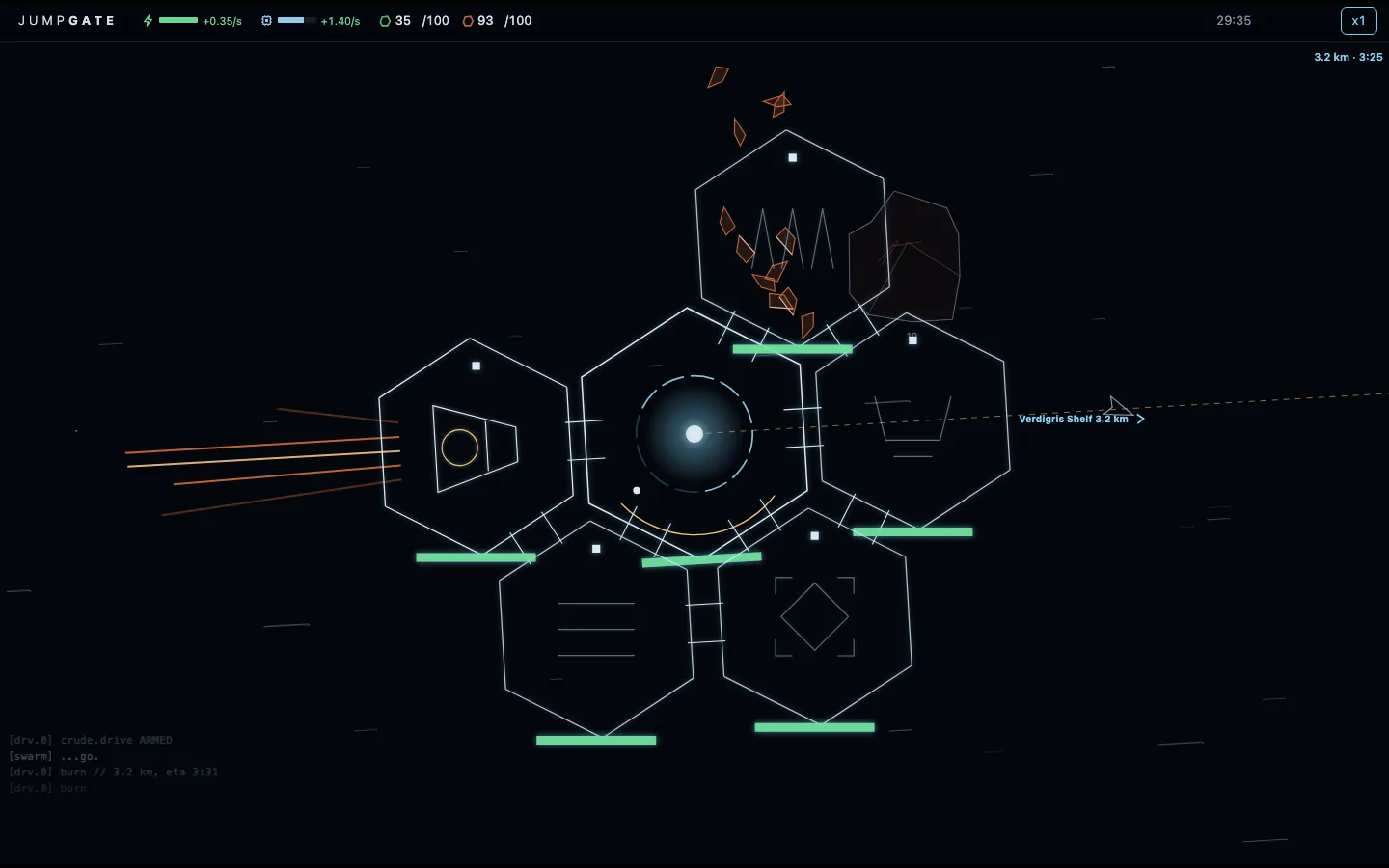 (open full size)
The first burn: the camera moves in close as the crude engine ignites. 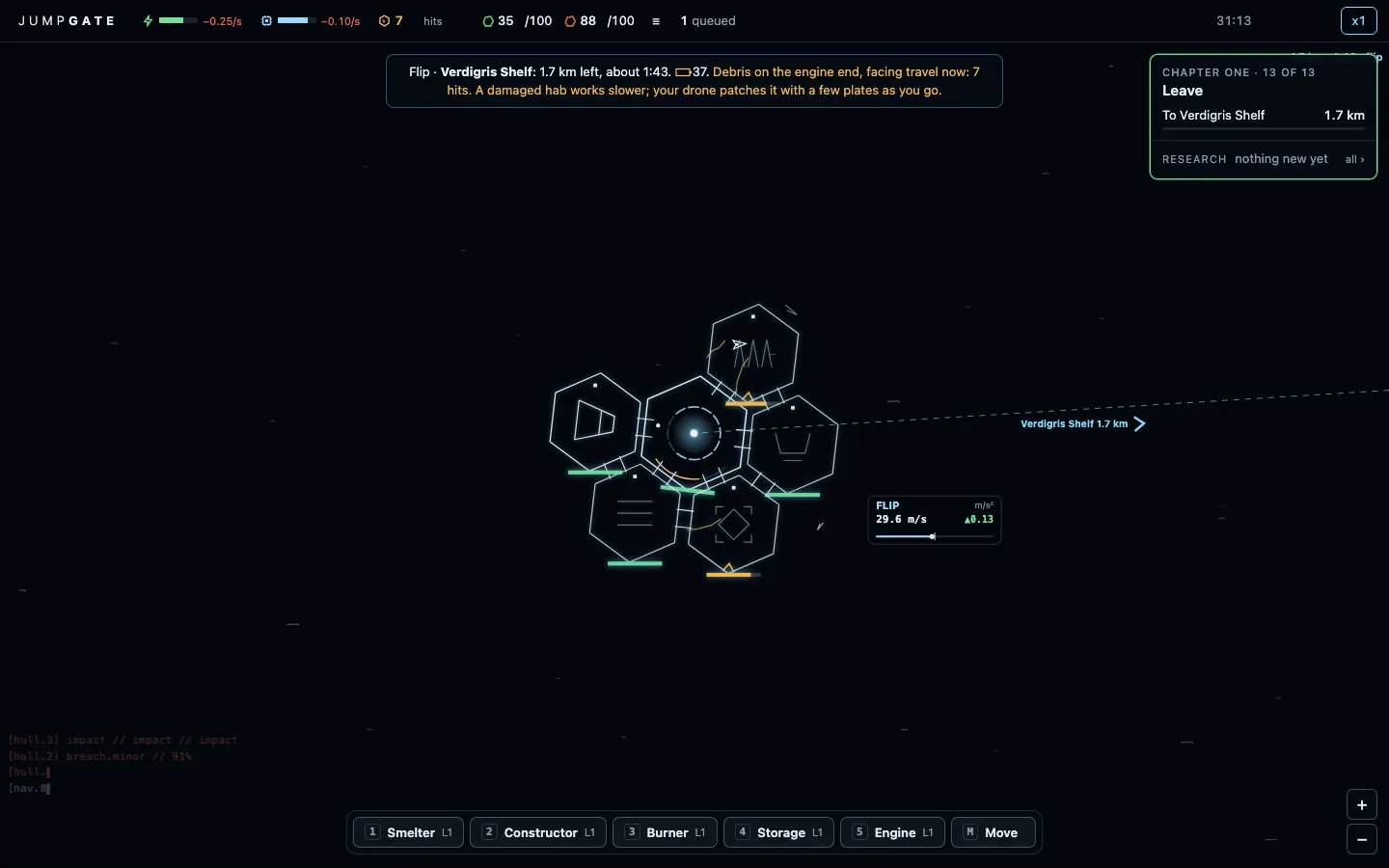 (open full size)
Mid-flip on the way to the copper field: the readout, a trip bar and the debris count. Published as “v7.11 first burn”
v7.16–v7.19uitravelplaytest
Version 7.16: readable research, thruster hops and a Move toggle
“i can never read this. it can be taller and have rows so the details are there”Kraig, 11:05 pm
“we should use thrusters to move around small areas like within the drone radius. doesn't require flip and burn. also should be able to select the core without the move indicator. there should be a move toggle button in menu”Kraig, 11:07 pm
“need description under each. i don't know what those numbers are. need more details so make it taller”Kraig, 11:11 pm
“it's set to auto and i have copper ore but it's not making copper. why”Kraig, 11:15 pm
Claude: The research block under the objective became taller, in rows: a label and the time left, the full name, what it unlocks, the bar, and what's next; when compute is starved it says so. Each research choice shows a one-line description and labelled numbers. Short hops inside the drone's range use thrusters only, slow and cheap, with no flip and burn; tapping the core just selects it, and travel happens through a Move toggle (on the tools bar, the core's card or the M key). A module at its stock limit now names it instead of wrongly saying there's no ore.
- A taller research block in rows, and research choices with descriptions.
- Thruster hops inside the drone's range.
- Selecting the core only selects; Move is a toggle.
- Fixed: a stocked module says so instead of "no ore".
Resources on demand, and a drone that's never stranded
Oct 15, 11:29 pm to Oct 16, 12:08 am · v8.0–v8.1
The biggest rethink so far. Always processing everything was built and rolled back within minutes; instead only ore is stored, each ore with its own small cap, and every build or repair is a queued request that makes its whole chain from ore when it's needed. In between, the drone learned to repair in transit and to dock before every burn, and a cancelled burn now leaves you drifting.
v8.0designeconomy
Always processing, tried and rolled back
“I'm still under the idea that like we should always be processing all materials. So it just seems silly to like keep copper ore around... we need to like fix this whole resource issue”Kraig, 11:20 pm
“but the burner should take the highest processed items because it is the most efficient fuel. i think the burner should just be on or off. if power is low, it burns. no recycling, just burn. maybe”Kraig, 11:22 pm
“It's kind of the opposite of Factorio... keeping base materials in bulk. And only making higher items when it's needed. So just like blueprints for modules, you have like the queue for like spending items. You can only queue a spend if you have the ability to make it. And when you queue it, it starts the process of building the whole tree up to make what you want”Kraig, 11:28 pm
Claude: Version 8.0 made every module process all the way up whenever it could, with the burner as a simple switch. Within minutes Kraig turned it around, so it was live only briefly: the game went back to the version 7.19 build and the idea was parked on its own branch. The new direction is the opposite: keep raw ore in bulk and make the higher items only when something asks for them.
- Version 8.0 (always process) rolled back to 7.19.1, its saves still load.
- The new direction: ore in bulk, everything else made on demand.
v7.20–v7.23dronestravelplaytest
Versions 7.20 to 7.23: drifting, and a drone that's never left behind
“the drone should repair while we're transiting”Kraig, 11:41 pm
“during a flip and burn, the flip and burn should just be canceled and you just drift in that direction at that speed at which it stopped. Until you start a new flip and burn or you just like hit the stop button so that you just like come to a stop.”Kraig, 11:44 pm
“when we start a flip and burn, the drone should come to the core like drones should just come to the mo- a module to dock and then the burn starts. And if we need repairs, the drone can just go over to the modules that need repairs. At any point. Then then we won't lose the drone.”Kraig, 11:49 pm
“there should be no 'tap to read faster'. if the player presses any button, a small 'press to skip' should fade up but not over any text. off to the side or below maybe. this inventory shouldn't be visible during the opening”Kraig, 11:58 pm
Claude: In transit the drone rides the hull and patches damage as you go, never the engine or anything in the plume. A Cancel burn button leaves the station drifting on at its heading and speed, with a DRIFT readout, until a new course or Stop. Setting any course first calls the drone home to dock, and the burn waits for it, so it can never be stranded. The opening now shows a quiet "press to skip" only after a first press, and the inventory stays hidden until it ends.
- The drone repairs while under way.
- Cancel burn: drift at your current heading and speed until Move or Stop.
- The drone docks before every burn; no more stranded drones.
- A quieter opening: "press to skip" after a first press, no inventory yet.
designeconomy
Only ore is stored; every spend is a queued request
“I picture mining should just always happen if it can. The mining drill is always going to drill and destroy asteroids. And ore is just going to be floating around.”Kraig, 11:33 pm
“I think the core has the storage. And it starts small, like maybe twenty. For iron ore. And then we expand that higher. And higher with upgrades. ... anything higher than that, we build on the spot we don't have any storage for higher components we only make things as need be”Kraig, 11:48 pm
“there should be some indication of what the total cost of the recipe is and like different colors on the numbers with the item so that you can see like what you do have enough of and what you are lacking. ... And also like when we queue, a build, we should be able to queue other builds as well and reorder the queue.”Kraig, 11:52 pm
Claude: Decided one question at a time: mining always runs, and a full store just leaves the extra chunks floating; the core stores ore only, each ore with its own cap of 20, raised to 100, 250 and 500 by a storage module and its upgrades; refined items and parts are never stored, only made for a request. A request can be queued only when your ore covers its whole chain, and tapping one you can't cover opens its cost card, short numbers in red, without greying anything out. The burner gets Off, Auto (burns ore above 90% of a store) and On.
- Ore-only storage: 20 of each ore, then 100, 250 and 500.
- Every spend is a queued request that makes its chain from ore.
- A cost card broken down to ore, coloured by enough or short.
- A reorderable queue; the burner Off, Auto or On.
v8.1milestoneeconomy
Version 8.1: demand-driven production
Claude: Built as decided. A production queue opens from an "N queued" chip: each request with its chain from ore, its progress and time left, up and down buttons to reorder and a cancel that refunds as ore. Queued requests progress at once and deliver in queue order. The smelter's and constructor's recipe pickers are gone, since they now make whatever the queue needs. Research stays paid in compute only. Old saves turn spare items back into ore.
- Only ore is stored; parts are made on demand.
- The production queue and the cost card.
- The burner Off / Auto / On, burning raw ore.
- No recipe pickers on the smelter and constructor.
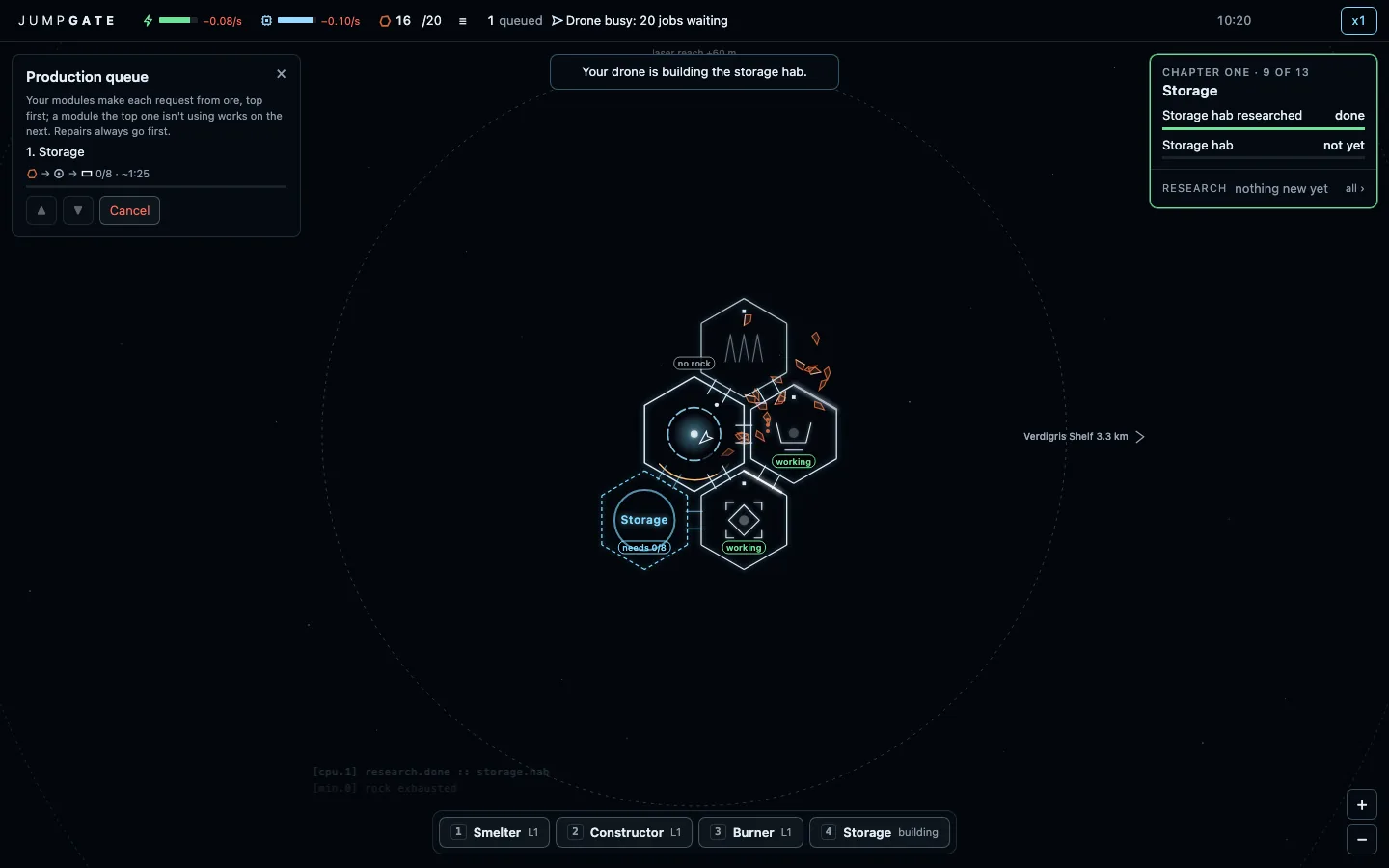 (open full size)
The production queue: a storage module being made from ore, in order. 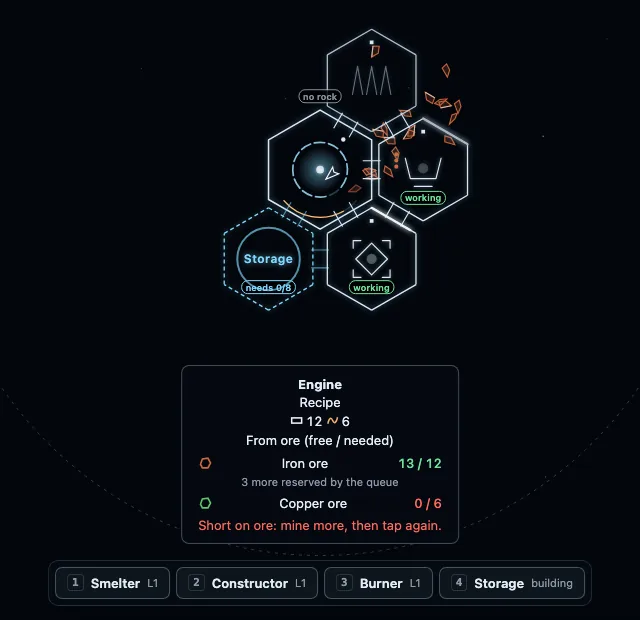 (open full size)
The cost card: what the engine needs in ore, green where you have enough, red where you're short. Published as “v8.1 made on demand”
First Flight, and the chapters after
Oct 16, 12:13 am to 12:33 am · v8.2–v8.3
Chapter One became twice as long and short on compute, the dust cloud came out, and the plan became chapters with one new mechanic each. Ten quick answers steered the next three.
v8.2balanceplaytest
Version 8.2: Chapter One, twice as long and short on compute
“I think chapter one is too easy. And I want to slow it down. I want like the times for things to be accomplished, the builds, the research, the upgrades, should all be like twice as long. ... we should be almost always at like a compute shortage in some way I think research should take more compute ... All I know is that I just want chapter one to like feel more like straining. And slow and take more time almost like twice as difficult I would say”Kraig, 12:09 am
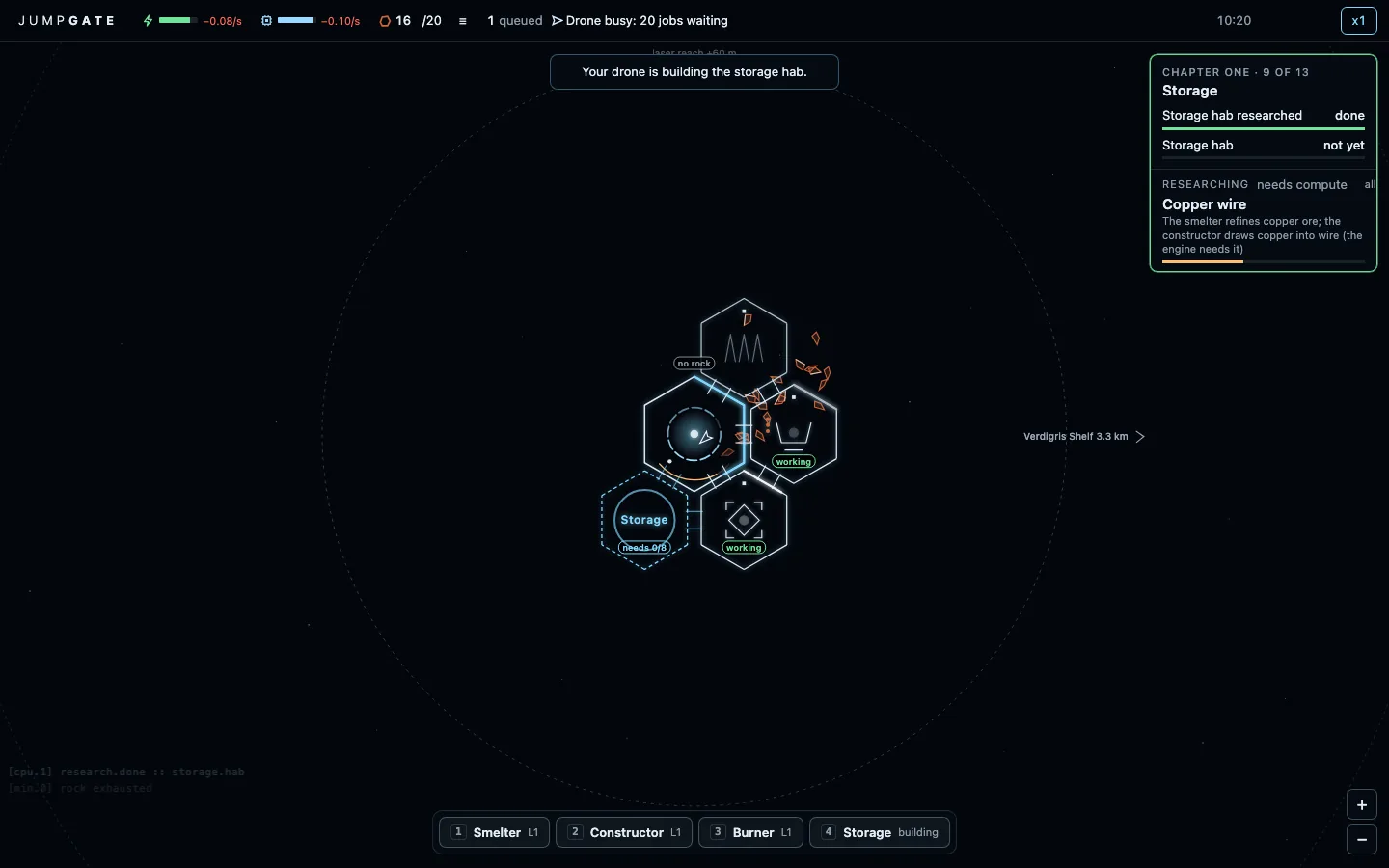
Claude: Research in Chapter One costs twice as much or more (the engine 90 to 220 compute), builds and processing take twice as long, and repairs 12 seconds. The damaged core makes less compute and holds only 6 until it's repaired, which is saved as the relief for later. Compute stays at or below zero for all of the chapter's research, and a hint names what's eating it. The test bot now takes about 28 to 36 minutes; a first-time player perhaps 45 to 60.
- Research costs doubled or more; builds and processing twice as long.
- A damaged core: less compute, and memory for only 6 until it's repaired.
- A hint that names what's using your compute.
 (open full size)
Copper wire researching on a starved core: the block just says it needs compute. designstory
Chapters, one new mechanic each
“I feel like we're trying to do too much. I almost think Yeah, I think it's all too much. We just need to like space it out more. Cause I feel like there's a lot that happens within each act almost so that each of these four acts could be their own chapters, to be honest.”Kraig, 12:11 am
“chapter one is the tutorial it's like first flight right and then chapter two could be I don't know I don't know, just format it in like chapters with no acts. And like each chapter kind of just has like a new mechanic that's introduced.”Kraig, 12:14 am
Claude: A plan for Chapter Two in four acts became chapters of their own, each introducing one mechanic with a goal, a place and a small story beat, all at Chapter One's slow pace. The draft: First Flight (built), Salvage, Assembly, Overclock, The Long Scan, Light, Point Defense, Cold Mind and Training Run, after which the map opens in every direction. Names and numbers are placeholders.
- Chapter One is named First Flight.
- No acts: every chapter after it brings one new mechanic.
- A nine-chapter draft, from salvaging the first wreck to training the AI for a second drone.
v8.3travel
Version 8.3: the dust cloud is gone
“I also think we should get rid of the space storm cloud. Idea is just not ready or good and we can always add it later”Kraig, 12:17 am
Claude: The dust cloud on the first crossing came out: its haze, its sound, its chatter and its sensor cut. Debris on the move stays, at a flat rate that gives about the same number of hits as before (around 15 on the crossing). Dust storms also left the chapter plans for now.
- No dust cloud; debris at a flat rate while moving.
- The sensor sphere never shrinks.
Published as “v8.3 latest”
designnext
Ten answers for Chapters Two to Four
“let's just do ten questions for like the next chapters that you're going to build tonight”Kraig, 12:22 am
“Yeah, let's do chapters two to four.”Kraig, 12:24 am
“I like the idea that collecting the data core and bringing it back gives us a research uh, that takes a lot of compute to get through. And upon completion, it gives us the message or some kind of lore about what happened, like final message or whatever. ... It should advance the story a little bit, maybe.”Kraig, 12:27 am
Claude: Ten questions, one at a time, to steer the next build. Salvage: the laser cuts wreck pieces like rocks into scrap, sometimes with a data core whose research reveals a short log and a reward. Assembly: an assembler that combines two parts, making repair kits, with an Auto repair switch on the core, and from here a module at zero hull is lost. Overclock: per-module upgrades that speed the bottom of the chain most. No cards between chapters, just a small title fading in. All three were built within the next half hour, as versions 8.4 to 8.6.
- The plan for Chapters Two to Four (Salvage, Assembly, Overclock), all at the copper field.
Chapters Two to Four
Oct 16, 12:45 am to 12:56 am · v8.4–v8.6
Built overnight from the ten answers, one mechanic each: Salvage (cut the wreck at the copper field, decode its data cores into logs and rewards, repair your core), Assembly (an assembler and repair kits; modules can now be lost) and Overclock (a storage module, level 2 upgrades and Engine II). About two hours of play from waking to free play.
v8.4milestonestory
Version 8.4: Chapter Two, Salvage
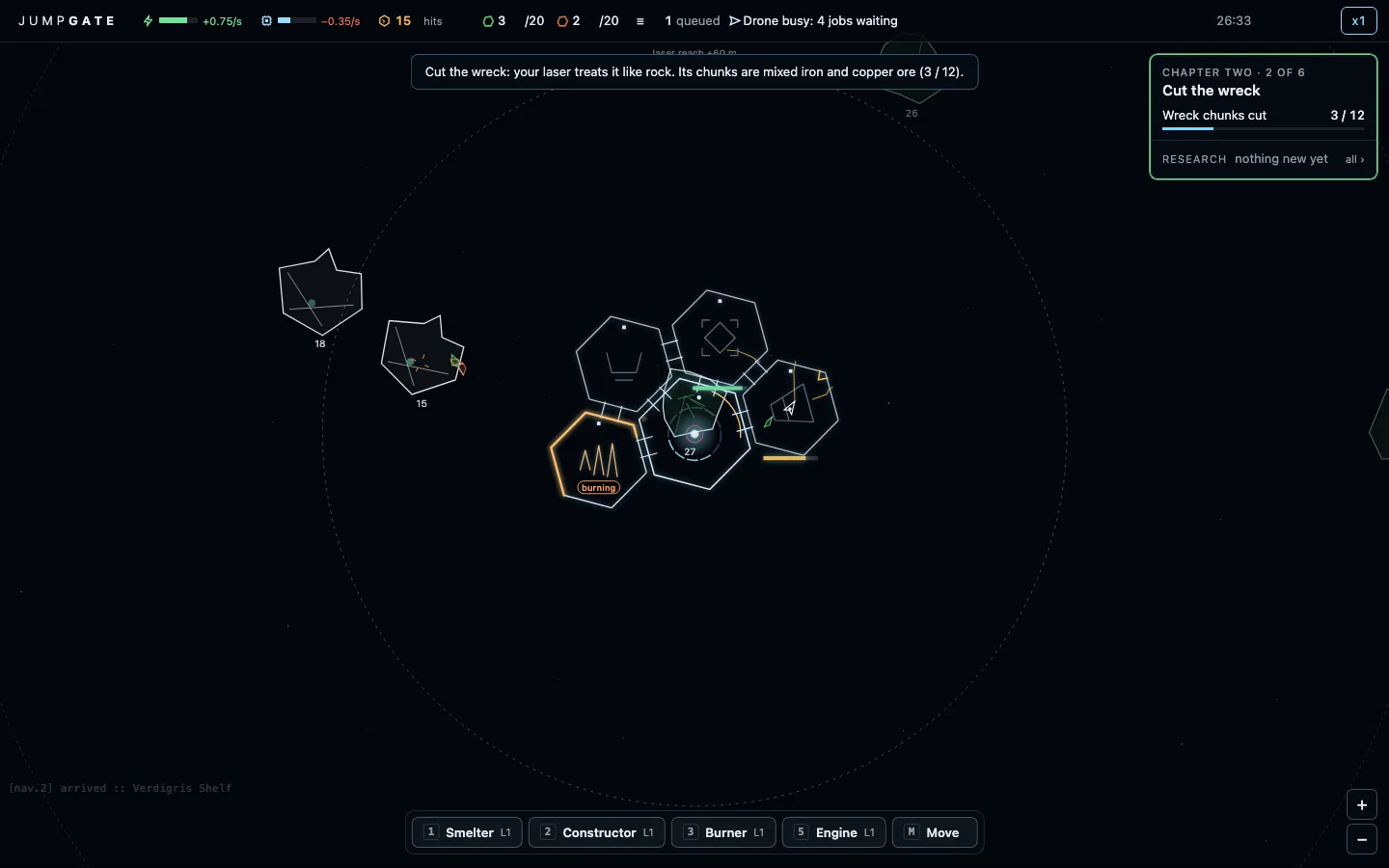
Claude: Chapter Two starts where the first flight ends: five pieces of a hull at the copper field, cut open from the outside. The laser cuts them like rock into mixed iron and copper ore, and two pieces release a glowing data core halfway through. Decoding the first takes 620 compute and writes a short log to a new Logs panel in the menu; it also marks a supply cache 1.5 km away, with fresh rocks and a smaller wreck holding the third core. The chapter's goal is repairing your own core: a 160-compute research, then plates and wire, after which the core makes about 3 compute a second instead of 1.7 and holds 20 instead of 6. Chapters now flow into each other with a small title fading in, no cards. The storage module moved to Chapter Four, and Chapter One's research costs rose again to keep it near 30 minutes. The test bot takes about 26 to 33 minutes for Chapter One and 26 to 31 for Chapter Two.
- Cut the wreck at the copper field into mixed iron and copper ore.
- Data cores: expensive research that unlocks a log and a reward.
- A Logs panel in the menu, and a supply cache to fly to.
- Core repair: more compute and room to hold it.
- Chapters flow with a fading title; storage moves to Chapter Four.
 (open full size)
Chapter Two: cutting the wreck at the copper field into mixed ore. 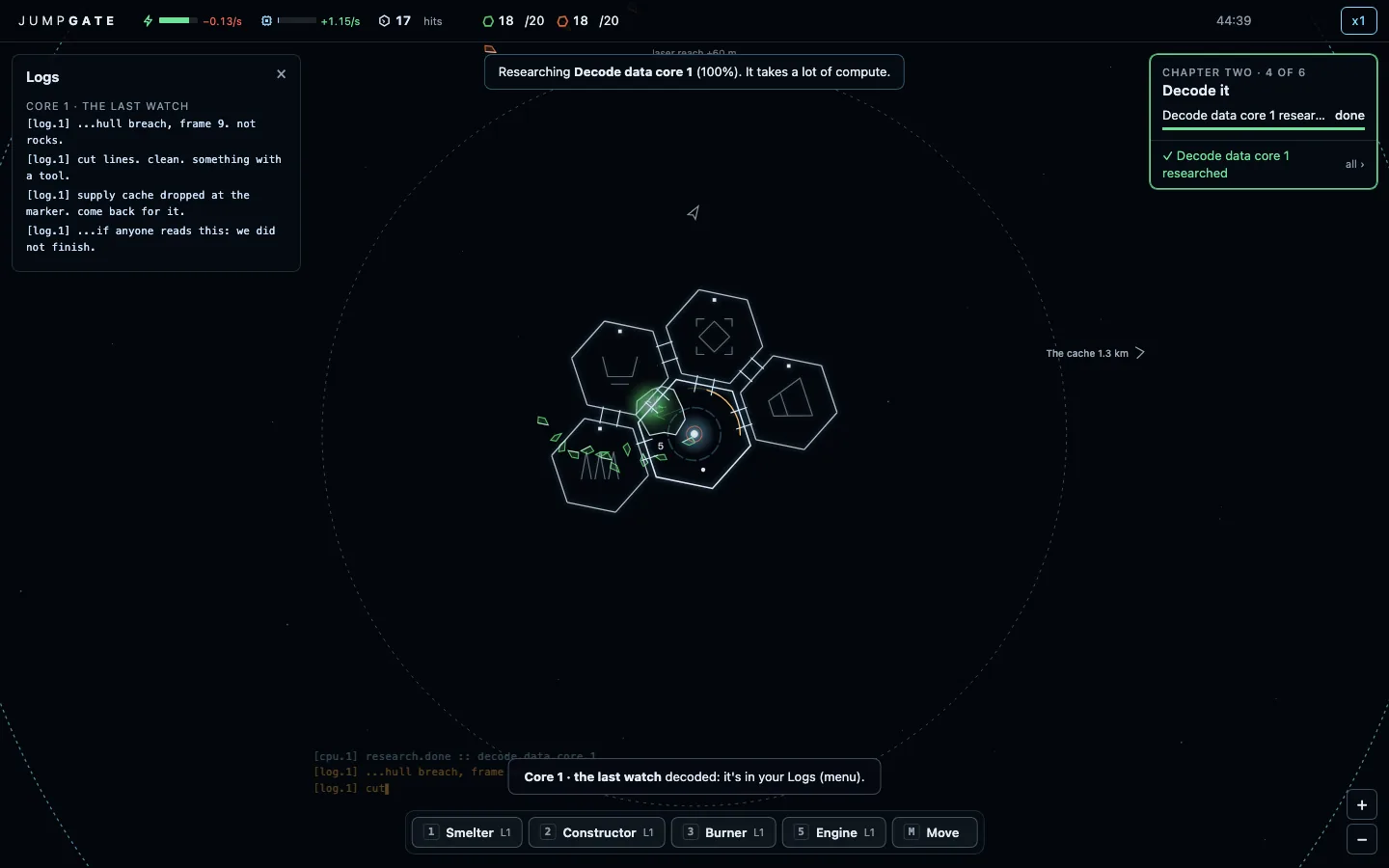 (open full size)
The first data core decoded, in the new Logs panel. Published as “v8.4 Salvage”
v8.5milestonemechanic
Version 8.5: Chapter Three, Assembly
Claude: Chapter Three decodes the second core, which brings the assembler: the first module that combines two items, and its one recipe so far is a repair kit (an iron plate and a copper wire, 10 seconds). Repairs now use kits, and an Auto repair switch on the core, on by default, queues them whenever something is damaged. A short debris shower arrives with the repair-kits step so there's damage to patch. From here a module at zero hull is destroyed and leaves a wreck the laser can cut back into about half its cost; a lost smelter or constructor can always be rebuilt from iron ore, so the game can't lock up. The test bot takes about 20 to 35 minutes for the chapter.
- The assembler, combining plates and wire into repair kits.
- Auto repair on the core, on by default.
- Modules can be destroyed now, leaving a wreck to cut for ore.
- A debris shower to practise on; no way to get stuck.
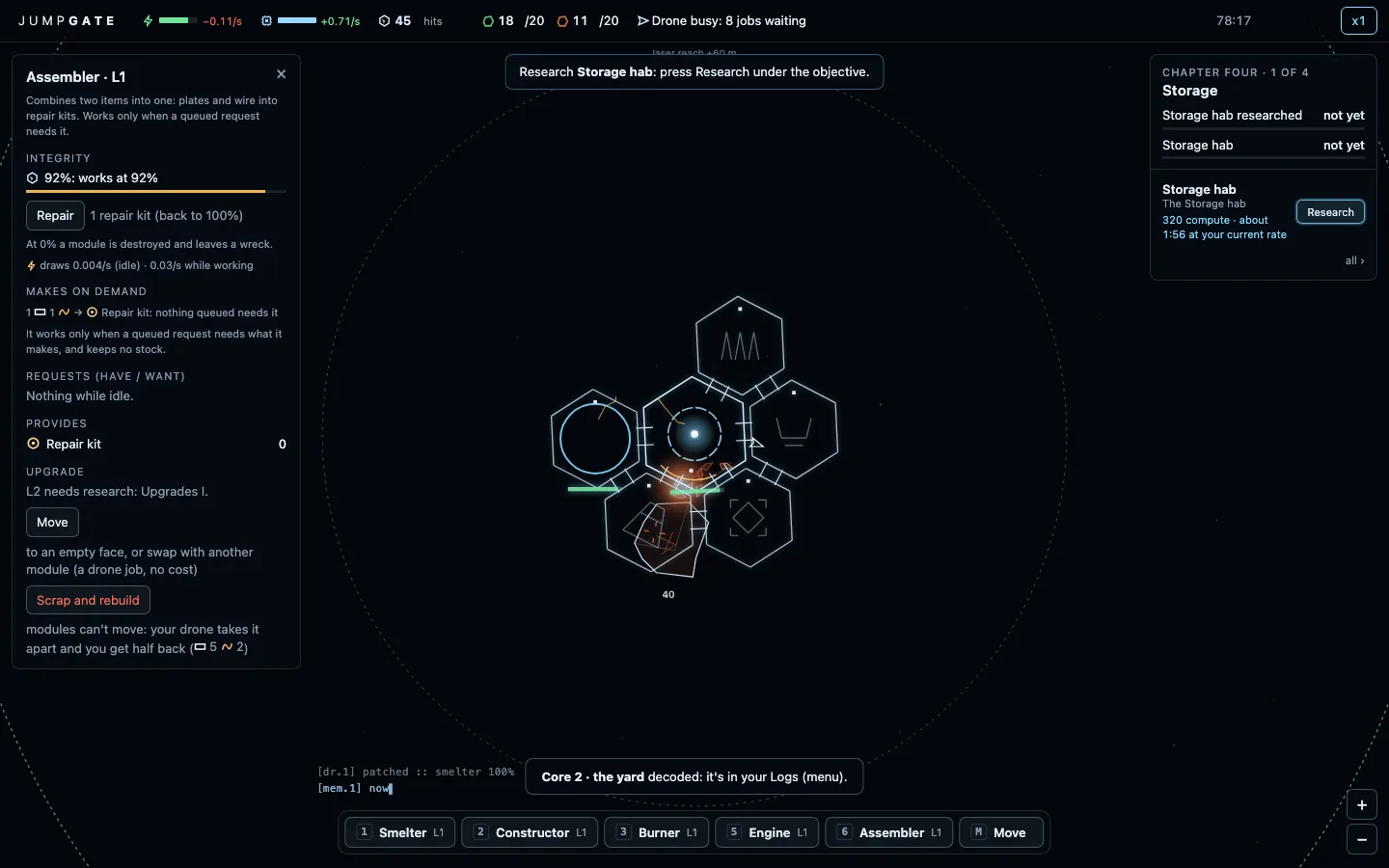 (open full size)
The assembler and its one recipe, the repair kit. Published as “v8.5 Assembly”
v8.6milestoneeconomy
Version 8.6: Chapter Four, Overclock
Claude: Chapter Four grows the station instead of adding to it. First the storage module, which raises every ore's cap from 20 to 100; then the first upgrades, taking the smelter to twice its speed, the constructor to 1.5 times and the assembler to 1.2 times, so the bottom of the chain speeds up most and the queue's times drop. The big build is Engine II, 30 plates and 10 wire, more than the old stores could ever hold. Decoding the third core reveals a faint signal about 11 km out, and the chapter ends on "Chapter Five: The Long Scan, coming soon" and free play. The test bot takes about 26 to 34 minutes a chapter, about two hours from waking to free play.
- A storage module: every ore's cap from 20 to 100.
- Level 2 upgrades: smelter 2x, constructor 1.5x, assembler 1.2x.
- Engine II, the first build too big for the old stores.
- The third core points to a faint signal; then free play.
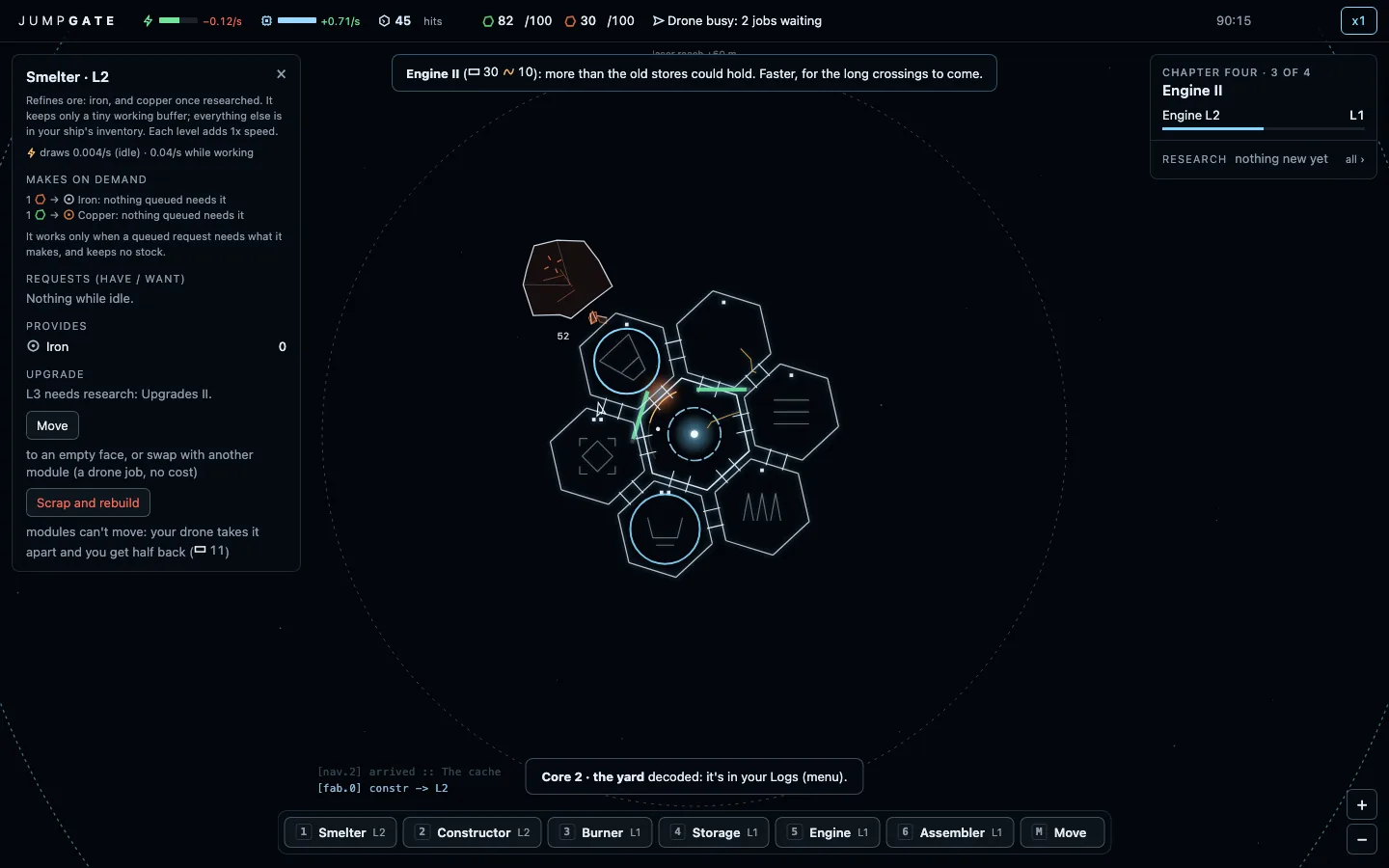 (open full size)
Overclocked: the smelter and constructor at level 2, with Engine II in the queue. 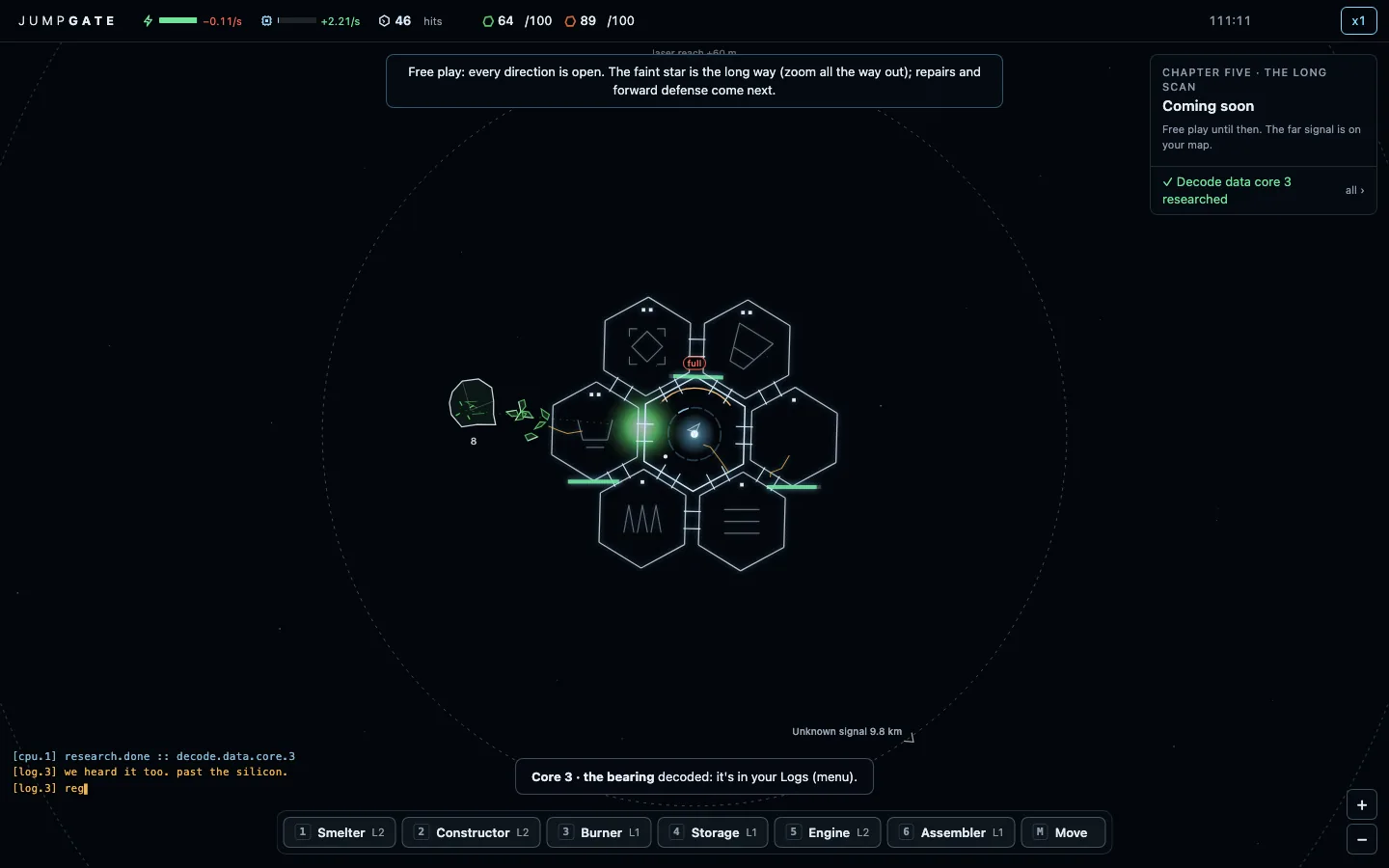 (open full size)
The end of Chapter Four at 1:51 game time for the test bot: free play, and a signal on the map. Published as “v8.6 Overclock”
Chapters Five to Ten, overnight
Oct 16, 1:13 am to 2:03 am · v8.7–v8.12
Kraig went to sleep and asked for the game built through Chapter Ten without more questions. Chapters Five to Nine follow the chapter plan, one mechanic each: a long-range scanner, sunlight, a point-defense escort, the first data center and a second drone. Chapter Ten is Claude's own draft. About five hours of play for the test bot from waking to the end of Chapter Ten.
v8.7milestonetravel
Version 8.7: Chapter Five, The Long Scan
“build to chapter 10. i'm going to sleep”Kraig, 1:05 am
Claude: The first chapter where you choose where to go. A long research (1,500 compute) and a refit give the scanner a second level, and it finds a hidden silicon field, Glass Reach, 6 km out. You set the course yourself and make the longest crossing yet, with a hint about putting cheap modules on the bow. The field sits at 6 km rather than the planned 10 because the battery can't carry the station further, even with the burner on. Test bot: about 26 to 29 minutes.
- Scanner level 2: research, then a refit from the core panel.
- A hidden silicon field to find, and your own course to it.
- Saves waiting at "coming soon" carry on into the new chapter.
Published as “v8.7 The Long Scan”
v8.8milestoneeconomy
Version 8.8: Chapter Six, Light
Claude: Silicon refining, then solar arrays. They're weak this far out but free, they work under way, and the light grows as you head toward the faint star: about 60% at the wake and over 110% at Glass Reach. A battery module adds storage, and the goal is 45 energy from sunlight, with the burner on Auto as the backup. At the field there's a buoy someone else left. Fixes: rocks of whatever ore the objective needs keep drifting in, and the patching step can no longer stall. Test bot: about 29 to 31 minutes.
- Silicon refining and wafers.
- Solar arrays whose output grows with the light.
- A battery module for more stored energy.
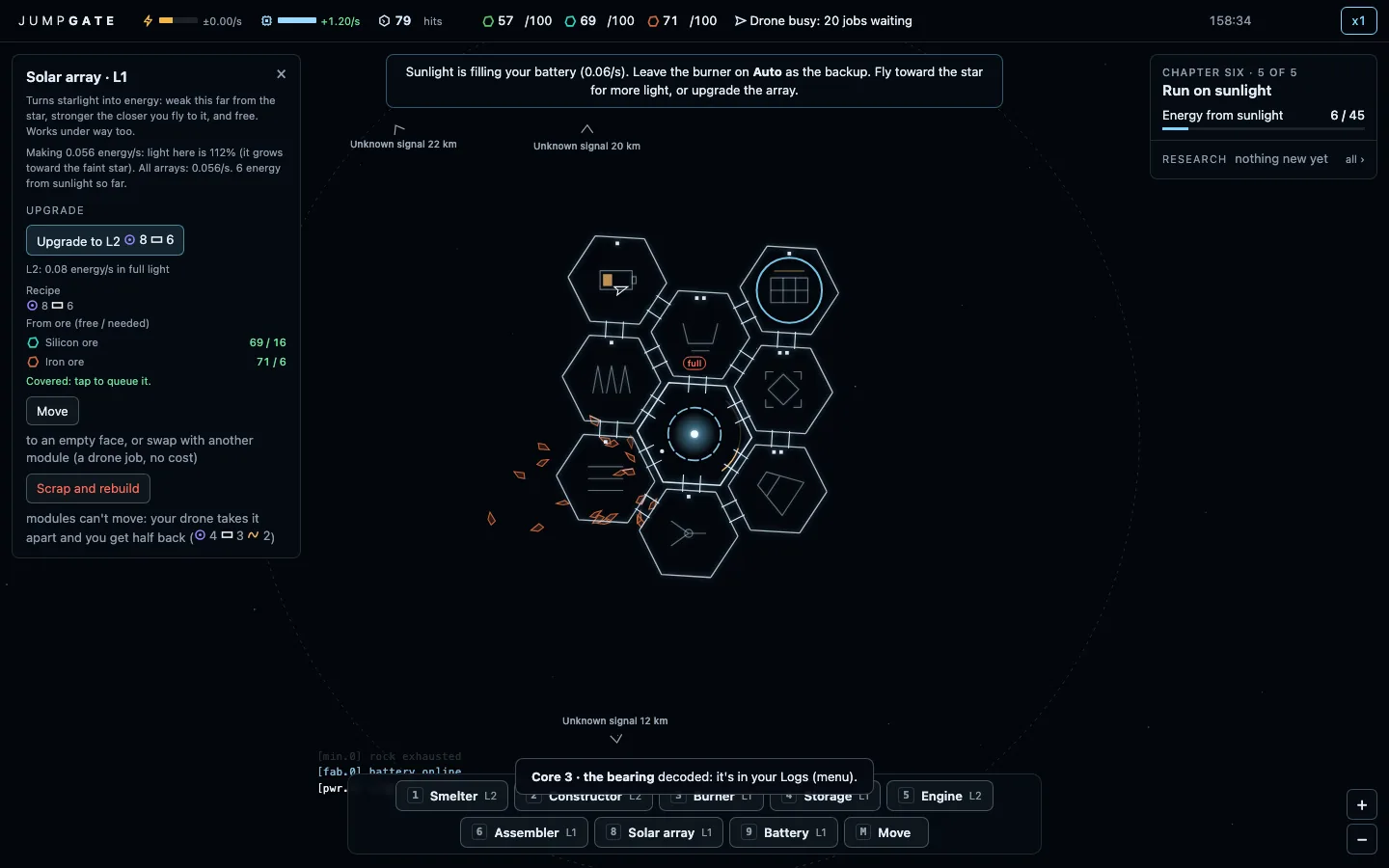 (open full size)
Chapter Six: the first solar array at Glass Reach, a little stronger than full light. Published as “v8.8 Light”
v8.9milestonedebris
Version 8.9: Chapter Seven, Point Defense
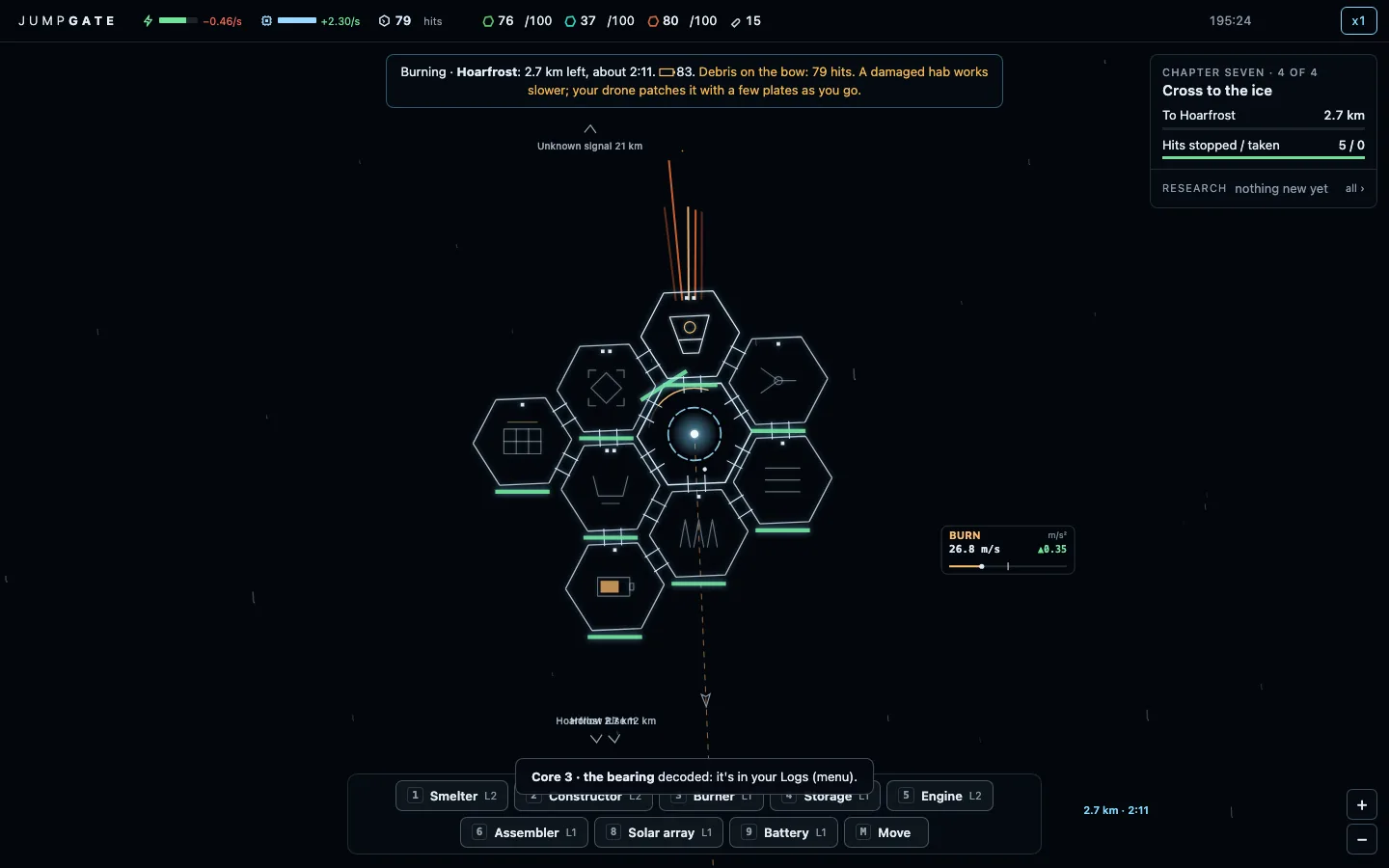
Claude: The first fleet ship. The constructor makes iron rounds, and the assembler builds an escort that flies just ahead of the bow and shoots down most of the debris (80%, a round a hit). It reserves a slice of compute, so research slows: the trade-off. The queue keeps its 16-round magazine full on its own. The chapter is the crossing to an ice field, Hoarfrost, with a live count of hits stopped and taken. Test bot: about 27 to 29 minutes.
- Iron rounds from the constructor.
- The escort: built at the assembler, flies ahead, shoots debris, costs compute.
- A hits stopped / taken count on the crossing.
 (open full size)
Chapter Seven: crossing to the ice with the escort out front, five hits stopped and none taken. Published as “v8.9 Point Defense”
v8.10milestoneeconomy
Version 8.10: Chapter Eight, Cold Mind
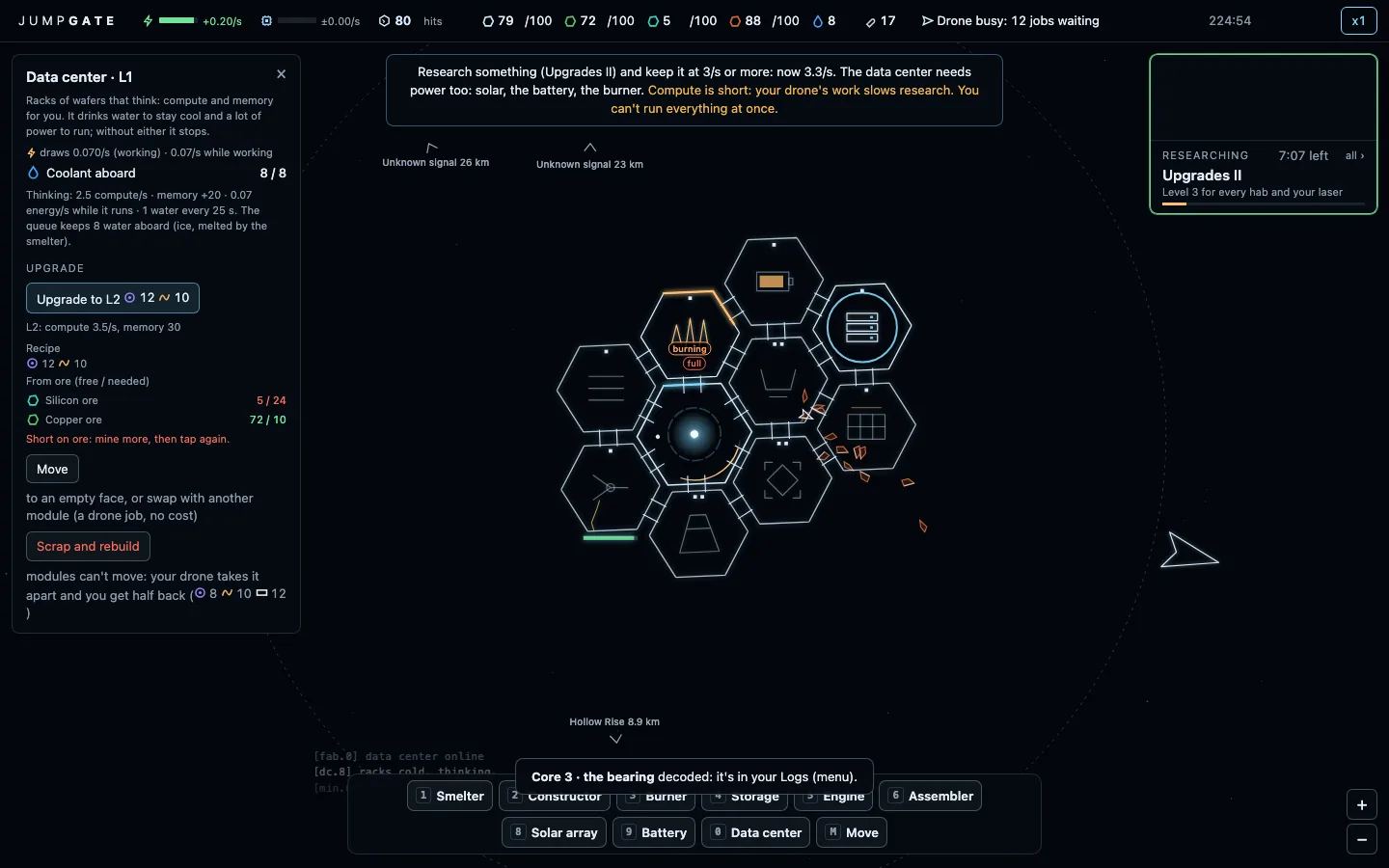
Claude: Ice melting, then the first data center: racks of wafers that add compute and memory as long as they have power and water to stay cool. The queue keeps a little water aboard and the smelter melts ice for it. The goal is to hold research at 3 compute a second for two minutes, and the next round of upgrades opens. The far signal gets clearer, and it repeats. Test bot: about 29 to 39 minutes.
- Ice melting into water.
- The data center: more compute and memory while it's powered and cooled.
- Upgrades II unlocks.
 (open full size)
Chapter Eight: the first data center, cooled with melted ice. Published as “v8.10 Cold Mind”
v8.11milestonedrones
Version 8.11: Chapter Nine, Training Run
Claude: The AI gets an upgrade. You stage a training set of wafers, wire and plates, then a long training research (3,800 compute) turns AI-7 into AI-8 and raises the drone limit to two. A drone bay research follows, and the assembler builds the second drone. Both dock before every burn, and the chapter ends with the crossing to the signal. Fix: a queued drone now claims its whole cost up front. Test bot: about 29 to 30 minutes.
- A training run: AI-7 becomes AI-8.
- A second drone, built at the assembler.
- The crossing to the signal.
Published as “v8.11 Training Run”
v8.12milestonestory
Version 8.12: Chapter Ten, The Graveyard
Claude: Claude's own draft, since Kraig asked for it built without more questions; his notes will reshape it. At the signal: a line of scorched hulls, as if a fleet died there. Two more data cores to cut out and decode, one carrying the design for the manufacturer, the first module with a three-input recipe (a wafer, two wire and a plate make a circuit board), and one with a log that points somewhere new. The first board goes into the core, you set a course toward the faint star, and as you leave, something in the wreckage isn't quite dead. Then Chapter Eleven, coming soon. Test bot: about 26 to 34 minutes; Chapters One to Ten take it about five hours.
- The dead fleet, two more data cores and a log.
- The manufacturer and its first recipe, circuit boards.
- A course toward the star, and Chapter Eleven next.
- The tools bar wraps to two rows.
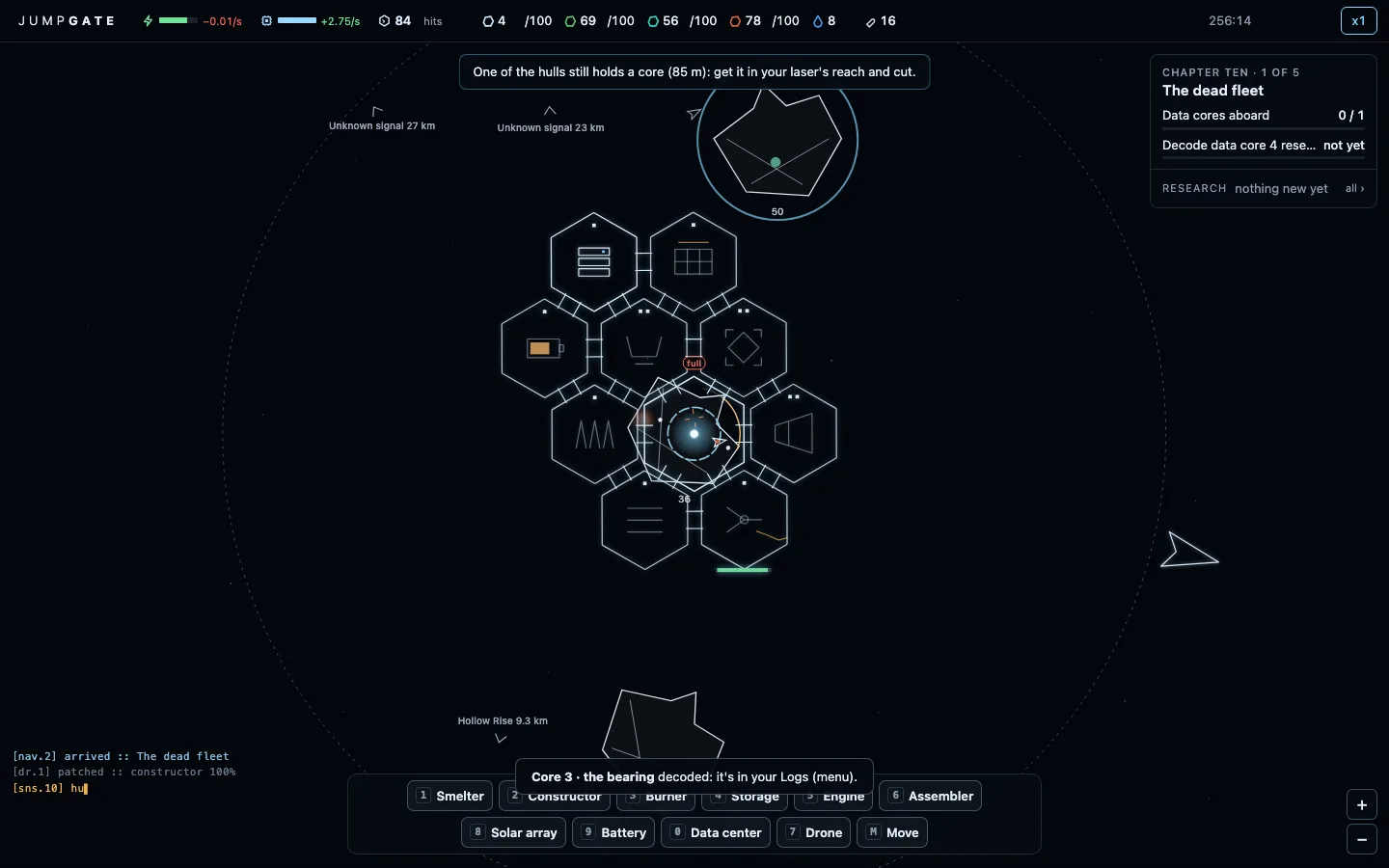 (open full size)
Chapter Ten: arriving at the dead fleet. 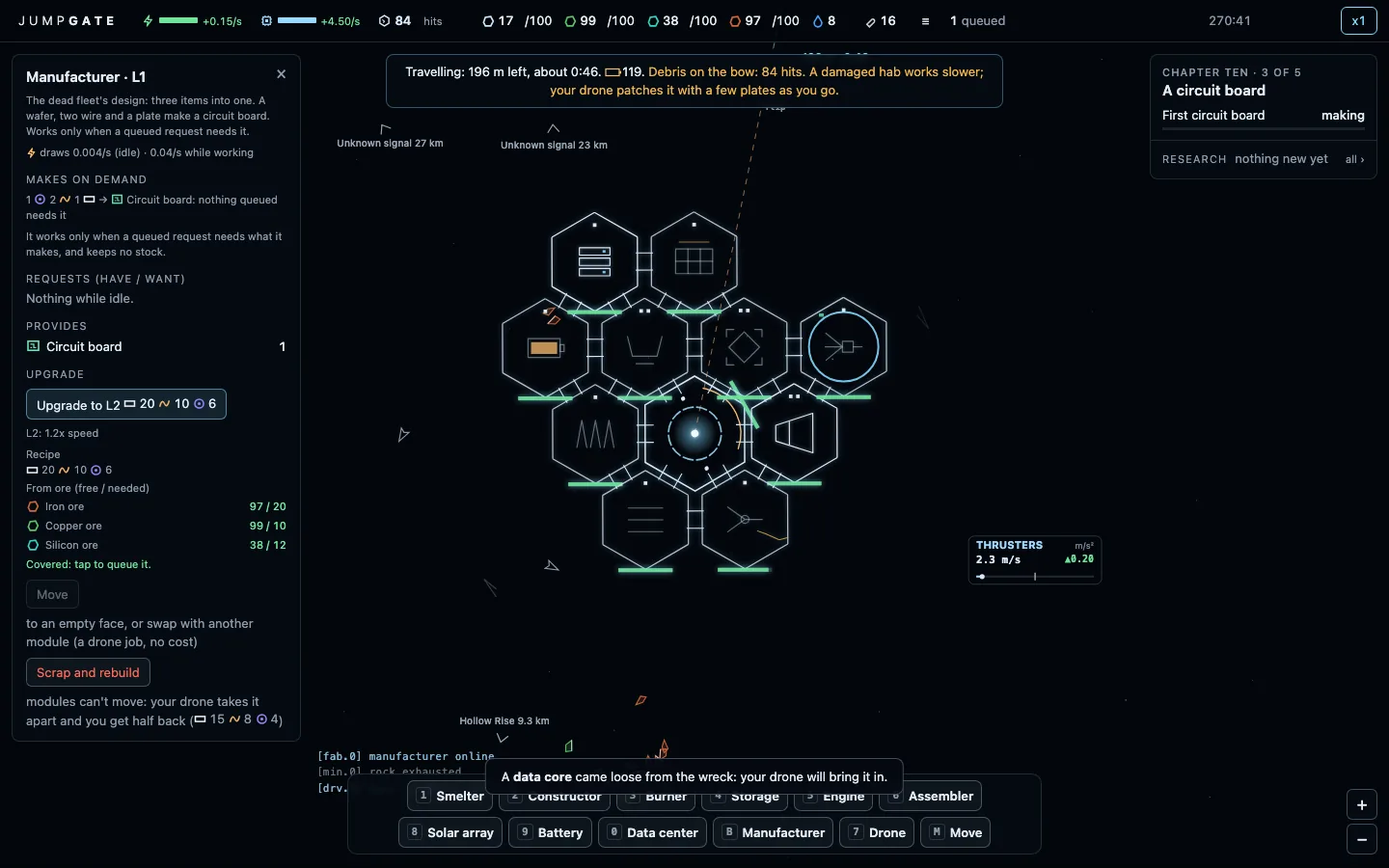 (open full size)
The manufacturer: a wafer, two wire and a plate make a circuit board. Published as “v8.12 The Graveyard”
Morning: fixes, choices and the look
Oct 16, 7:52 am to 8:47 am · v8.13–v8.18
Kraig said yes to a whole list at once: fixes to the built game (a chapter select for testing, research shown in minutes, a trip planner, a visible escort, a build bar in tabs) and a design round (a twist and a payoff in every chapter, either/or choices, side finds, the signal as a pulse in the music, a sense of being watched). He also asked to see the game in a Dune or Expanse style, didn't like the mock-ups, and kept the outlines, polished and with slightly longer modules.
v8.13–v8.14uiplaytest
Versions 8.13 and 8.14: fixes to the built game
“Yes to all.”Kraig, 7:40 am
Claude: Kraig's answer to a list of fixes and design ideas after the overnight build. First the fixes. A hidden chapter select in the logo menu starts a test game at the beginning of any chapter, on the test player's own ship, while your real game is saved and kept. Research reads as minutes at your current compute ("~9 min left"), not raw compute. Before every flip and burn a trip planner sets the energy the trip needs against the battery, the sun on the way and what the burner could make: green, amber when you'll need the burner or the sun, red when it won't make it, and a red trip needs a second tap. The escort became easier to see, with tracers and a flash for each shot, drones are numbered once there are two, and the build bar is grouped into Production, Power and Ship tabs.
- A chapter select for test games, keeping your own save.
- Research time in minutes.
- A trip planner before every burn.
- A visible escort with tracers; numbered drones.
- The build bar in tabs.
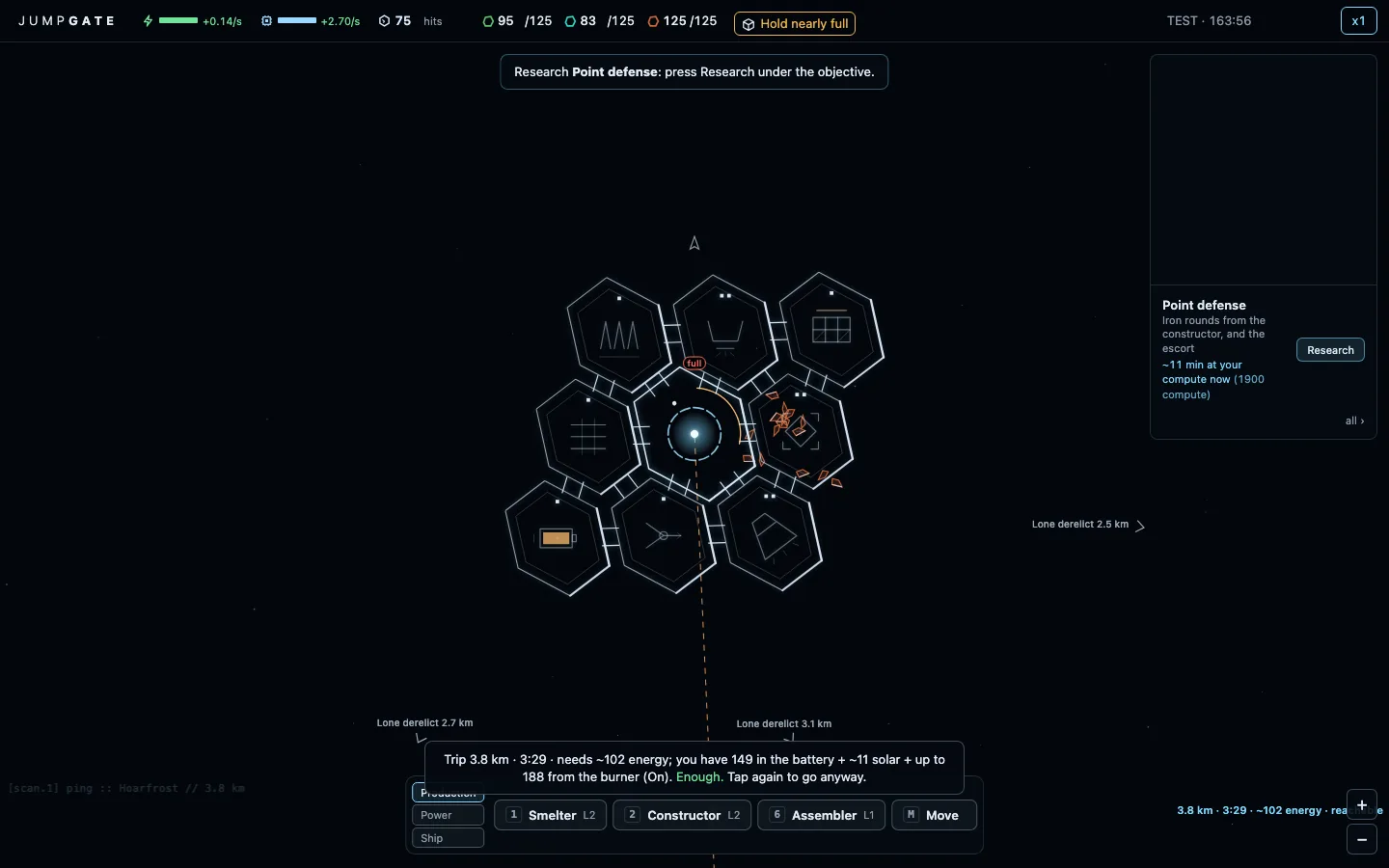 (open full size)
The trip planner before the crossing to the ice: what the burn needs against what you'll have. designart
Dune, the Rocinante, and keeping the outlines
“I'm wondering if we should move away from the asteroids minimalism and move more towards like Dune. I love the spaceships in Dune because they're like simple but geometric. And I really like the way that the light is like harsh on one side. I also like the ship designs in The Expanse, like the Rocinante. And I don't want to make any big design changes, but I'd like you to mock up like what it could look like, just like really quick, simple mock-ups.”Kraig, 7:41 am
“I don't like those designs. Let's just keep the current. Can improve designs for this one”Kraig, 7:57 am
Claude: Four quick mock-ups of the station drawn as solid, hard-lit shapes, nothing changed in the game. Kraig didn't like them, so the outline look stays, and any art work from here polishes it instead.
- The Asteroids-style outlines stay.
- Art work polishes the outline style rather than replacing it.
v8.15–v8.16designmechanic
Versions 8.15 and 8.16: a twist, a payoff and a choice in every chapter
Claude: Each chapter from Two on now has a twist tied to its mechanic, like a wreck that tumbles away, a giant rock that tests your stores, a debris band mid-crossing or something passing in front of the star. Each one ends with a payoff: the battery topped up, memory filled and a "Chapter complete" line naming what you gained. From Chapter Three each chapter also offers one lasting either/or choice, as two cards under the objective that never block you. Armor or faster repairs, wider stores or faster lines, more battery or a lighter frame. The test player also learned to rebuild lost modules.
- A twist in every chapter from Two.
- Strain, then a payoff at every chapter's end.
- One either/or choice per chapter from Three, kept in saves.
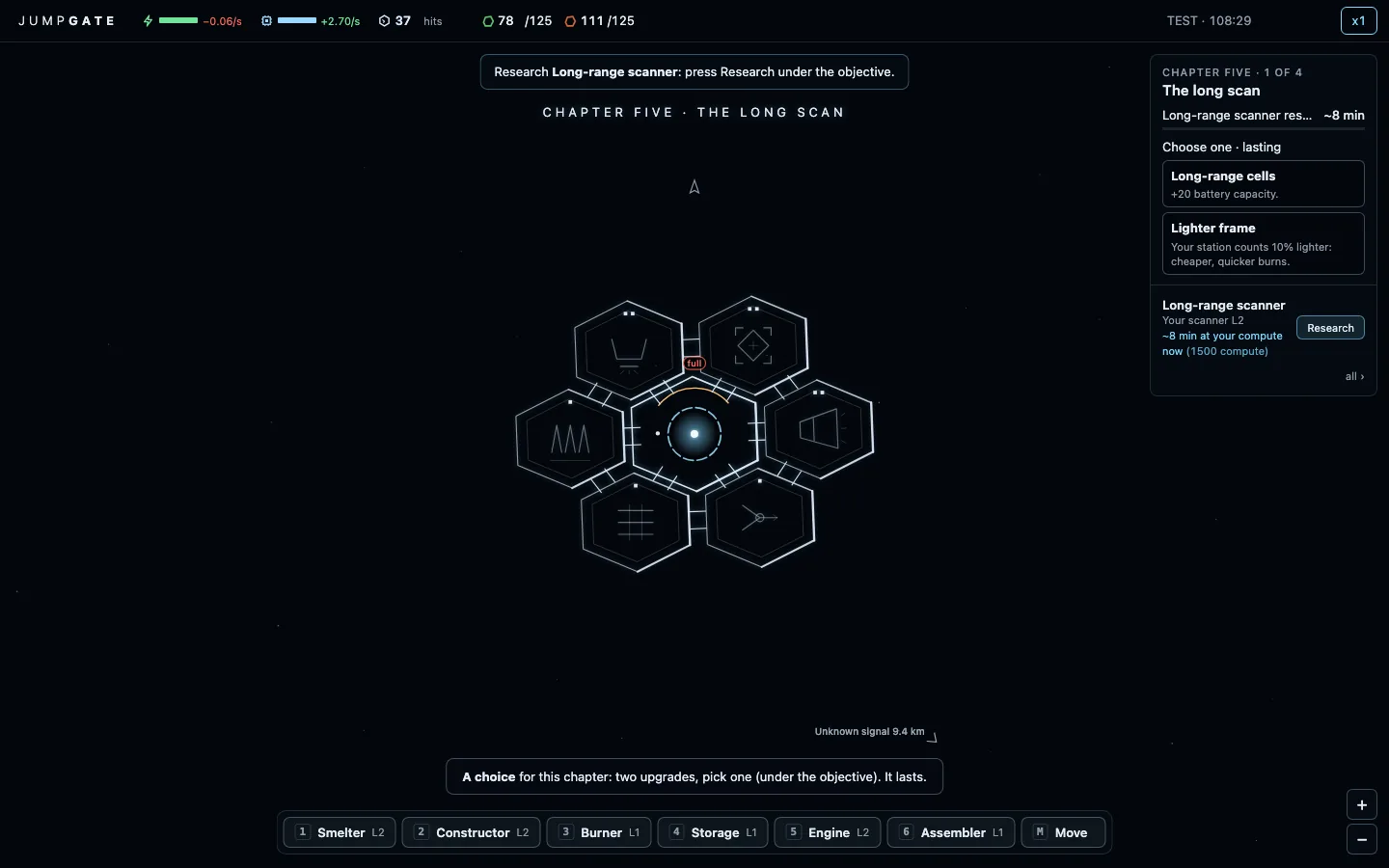 (open full size)
Chapter Five's choice: more battery, or a lighter frame. v8.17storysound
Version 8.17: side finds, the signal's pulse, and being watched
Claude: From Chapter Five, five lone derelicts sit off the story's route as unknown pings. Each holds a data shard that decodes into a small perk and a line of lore, and none is required. The signal you're following is now a faint two-note pulse in the music every 9.1 seconds, louder as you get closer. And after the dead fleet a small sign stays on screen that something has been watching.
- Five optional derelicts with data shards, perks and lore.
- The signal as a pulse in the music.
- A quiet sign that you're being watched, into Chapter Eleven.
v8.18art
Version 8.18: outline polish and longer modules
“I was thinking modules are slightly longer than the current hexagons. Would help more of a ship feel. Also all 3 sound good”Kraig, 7:59 am
Claude: Every module is now a slightly longer hexagon, stretched a quarter along the station's fore-aft axis, with the lattice stretched to match so what touches still touches, and the engine is suggested at the stern. The three polish ideas he said yes to: edges facing the faint star drawn brighter and thicker, a faint inner frame and clearer inner lines for each type, and motion, with joints pulsing in the item's colour as items cross, a soft glow on working modules and a flicker on damaged ones. The engine can no longer be destroyed, since losing it mid-flight would strand you.
- Longer modules along the ship's axis.
- Star-lit edges, inner frames and clearer icons.
- Joint pulses, working glow and damage flicker.
- The engine can't be destroyed.
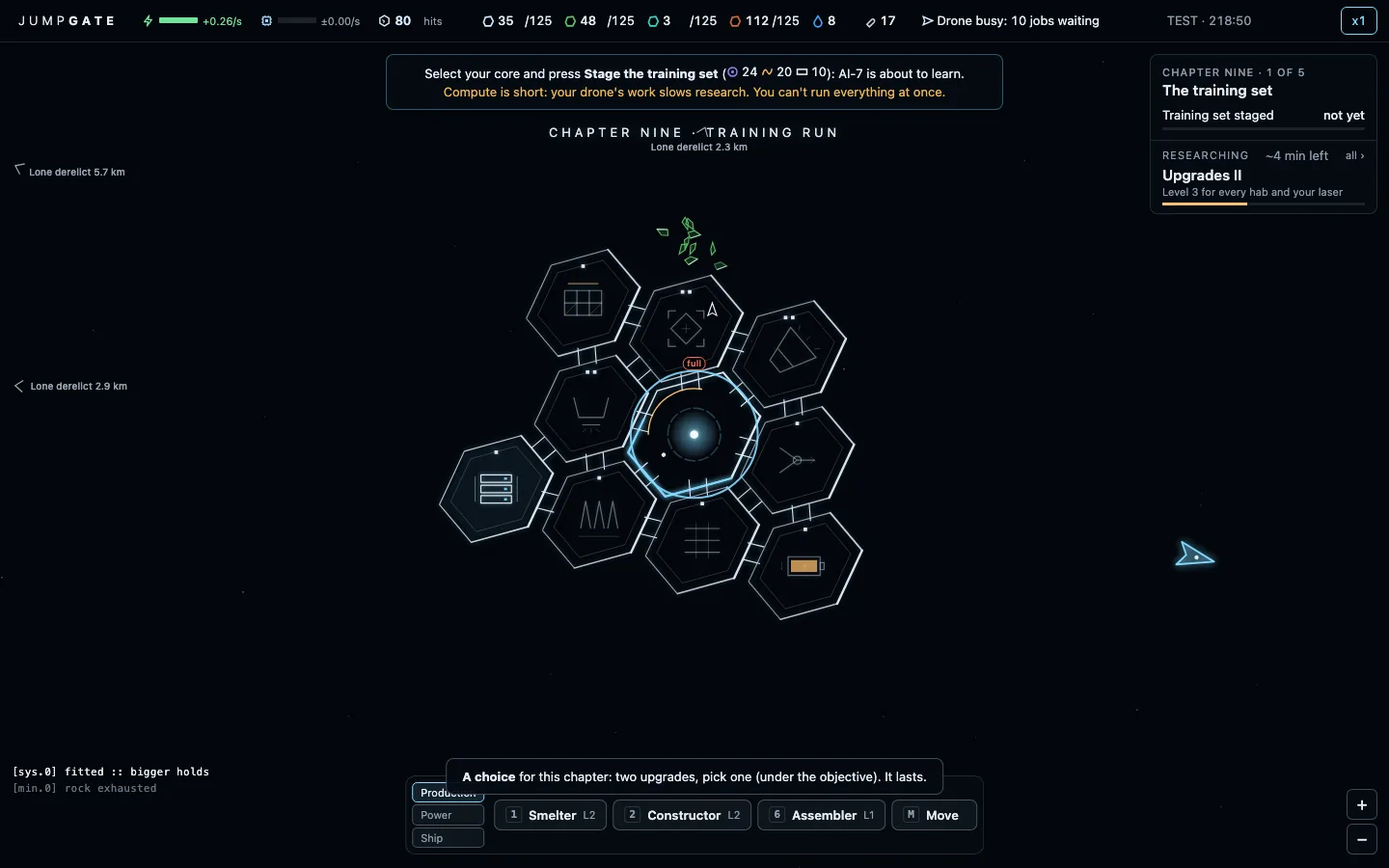 (open full size)
The longer modules in Chapter Nine, with lone derelicts pinging at the edge. 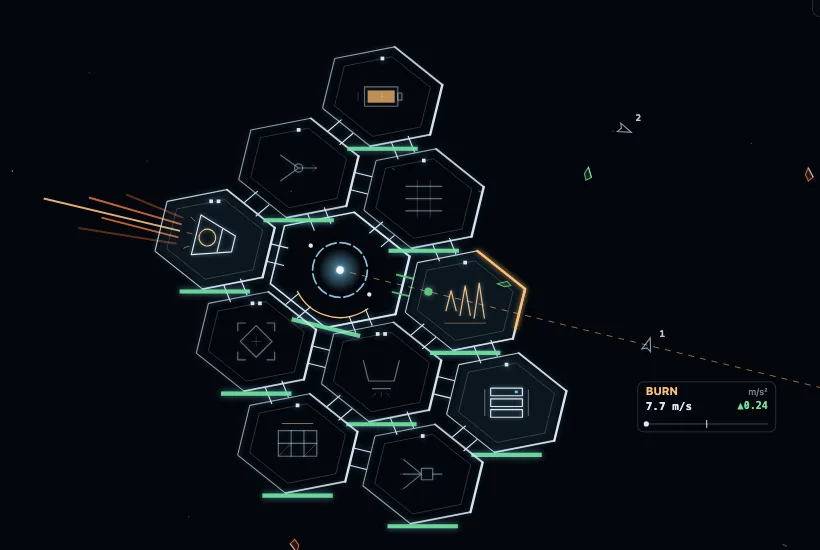 (open full size)
Under way after the dead fleet: star-lit edges and the working glow. Published as “v8.18 outline polish”
Play the build
It runs in the browser on a computer, with a trackpad or mouse and a keyboard. It's an early build: it changes every day and saves can reset between versions. Tell me what felt good and what didn't.