
Game · October 2026
Sol Factory
- Games
- AI
- Devlog
Sol Factory is a calm factory game for your phone. Earth is gone, the solar system is slowly coming apart, and from a landing pad on the Moon you build the factories that build the ship that gets everyone out: drill ore, draw belts and pipes, turn rock into parts and load cargo shuttles bound for orbit.
I design it and playtest it; Claude writes the code. The Moon is open to play now, and the other worlds are built and in testing.
Highlights
Milestone
Play it
The current build plays at /solfactory/. How to play is in Details.
Milestone · November 2, 2026
Latest: The name is now Sol Factory
The newest entry in the build log. Every entry is in the timeline below.
Newsletter
Get my letter
Get a short letter from me every couple of weeks: new trips, guides and what I'm building.
Free. Unsubscribe any time.
Details
Open the game in a phone's browser at /solfactory/. On an iPhone, tap Share, then Add to Home Screen, and it runs full screen.
Timeline · newest first
Devlog · November 2, 2026
The name is now Sol Factory
Heliopause lasted a day. Sol Factory says what the game is: a factory, built across the Sun's own worlds. The heliopause is still where the story ends. The game and this devlog now live at kraigadams.com/solfactory/, and old links and home-screen installs land here.
Devlog · November 2, 2026
All four worlds are built
The rest of the story is in the game now, start to finish. Mars, Saturn and Ceres Yard are built and in testing; they open to everyone once they've been played through and balanced. Each world adds one new idea on top of the factory.
- Mars: dust storms. Every few minutes one blows in, cuts your solar power and leaves dust on the panels until a dust drone wipes them. The canyons get in the way of your belts, and an air extractor pulls carbon dioxide out of thin air to make methane, carbon and steel.
- Saturn: there's no ground. You build on a floating platform you grow one section at a time, hang scoops into cloud bands that drift past (hydrogen, helium, methane, ammonia), and fill buoyancy tanks so the whole thing doesn't sink. Power comes from wind and fusion.
- The worlds trade. Whatever your Moon and Mars factories were making when you left keeps shipping while you play somewhere else, into a stockpile the next world's import dock unloads.
- Ceres Yard: the last chapter. The colony ship, Hearth, sits in a drydock next to your pad with nine of her twelve pieces. Every truss you deliver lengthens her keel, and each section you finish changes the yard: her reactor powers it, her drive speeds up the freighters, her habitat opens the greenhouse to stock her for the crew.
- An ending. When she's stocked, Hearth lifts out of the drydock on her own drive, and the last map follows her out past every planet's orbit to the heliopause.
Devlog · November 1, 2026
A new name: Heliopause
Payload was always a working title. Now that the story has settled (the solar system is coming apart, and you build your way out of it world by world), the game needed a name that carries it. The heliopause is the real edge of the solar system: the place where the Sun's pull finally gives out and interstellar space begins. It's where the ship is headed, and where the last chapter ends. Old links and home-screen installs still work and land here.
Devlog · November 1, 2026
Second playtest: an ending, and a reason to build it right
Kraig played the whole Moon through to the last shipment. It was good, but a little short and a little easy, and a tangle of belts worked just as well as a tidy factory. So this build gives the Moon an ending worth reaching and gives the player reasons to spread out and build properly.
- An ending. When the last part of the ship lifts off, the camera pulls back slowly until your base is a few twinkling lights on the Moon, then the whole Moon. Two other outposts are lit as well: a camp at Tycho and an observatory in the Imbrium plain with a beacon blinking, the survivors who were working while you were. Then a short transmission: the ship has its first three pieces, it still can't leave, next stop Mars. The last card shows the four chapters: the Moon done, Mars next, then Saturn and the asteroid belt.
- Rate goals. Later levels ask for a steady flow instead of a pile, like 20 water a minute held for a full minute, so a factory has to keep running, not just catch up once.
- Ore patches wear. Each patch slowly loses speed as you mine it, down to half, but it never runs dry. Squeezing more out of the starter ore gets expensive, so it pays to find new patches. There are more mixed patches further out, too.
- Moving belts draw a little power, so a sprawling factory finally makes power something to plan for. Machines draw more power the faster you upgrade them, solar panels, batteries and the reactor have upgrade levels of their own, and splitters, junctions and filters now have their own speed, so they're no longer a shortcut around upgrading belts.
- The drone depot is now a hopper pad: one rocket hopper per pad, one input side, and upgrades add cargo.
- A day and night clock in the corner shows the time to dusk, and warns in amber when your battery won't last the night. Mission Control warns you before the first night and points at where to put a solar panel and a battery.
- A darker, quieter screen: dark glass panels, slim belts with one faint arrow per tile, a Mission Control feed that types like a terminal, and labels on ore patches saying what they are and how pure. The level cards are gone. A small NEW tag marks anything new until you've seen it, and the build menu shows only what's unlocked.
- Fixes: items on belts keep their spacing, a Flush button clears a jammed belt line, Undo leaves the items on a belt alone, a stopped machine says why in its panel instead of in bubbles, contracts turn up when you're short of credits and ask for something advanced, the oxygen pipe is a clear green, and the first dig at level 3 always finds the aluminium ore you need.
- On iPhone, saved to the home screen, the game now fills the whole screen and updates itself when a new build is out.
Devlog · November 1, 2026
First playtest: find your ore, and earn every upgrade
Kraig played the Moon on his iPhone for 26 minutes and reached level 7 of 13. It ran well, but it was too easy. He had nearly 5,000 credits banked by the end, pushed machines to their top speed in seconds, and never once needed a faster belt. So this build makes the Moon slower, more expensive and more about exploring.
- Almost nothing is in view at the start: one regolith spot to earn your first credits. The new Survey pad finds hidden dig sites one at a time, and each survey costs more than the last. What's in a dig site, you only find out when you pay to dig.
- The sensor array became a Survey pad. Tap Survey and a little rover drives out to the nearest hidden dig site, uncovers it and drives home. An orange arrow on the screen's edge follows the rover and a blue one marks what it found; tap either to go there. Upgrades make the rover faster, and every fourth level adds another rover.
- Tap an ore spot to see what it is and how rich it is before you build a drill on it.
- A graphics pass: shadows that swing with the slow lunar day, floodlights on the pad at night, belts with running treads, dust when you build and when the shuttle lifts off, sparks at the smelters, pebbles and boulders, rover tracks that fade, ice that glints, and the same item symbols in every menu as on the belts.
- Five additions to the Moon: tap any goal item to see how to make it, from the ore up; each new level opens with a short card on what it unlocks; Mission Control now and then offers an optional contract for a bonus; every shipment gets a 3-2-1 countdown on the pad before it lifts off; and on the long lunar night, something occasionally crosses the sky.
- New building art: every machine is now a white lunar module with a coloured roof band for its type and its working parts on top (a drill head that turns, a crucible that glows, pistons, gas tanks, a glass dome over plants), with a green light while it works.
- A cleaner screen: the level goal now sits under your credits with a bar per item, a stopped machine says why in a small bubble (full, no power, or what it's waiting for), the build menu is a sheet with tabs and big tiles, and each machine's panel shows its speed, output and power with one Upgrade button.
- A new, quieter opening: the Moon close and lit from the side, what's left of Earth as a dim ember in a ring of rubble, and stars bending around the place the black hole passed through. No cartoon cracks, no crash zoom. It ends with a thin descent line dropping out of orbit and touching down on the Moon's lit face, the title (Chapter 1: Luna) fading in over it, then the map: your shuttle lands on bare ground and the pad unfolds under it. The Moon itself is redrawn: real crater shapes, darker lava plains and a low Sun.
- Machines take their inputs on one marked side, opposite their output, to keep the belts from turning into spaghetti.
- The cargo shuttle now leaves only with a level's main shipment, its containers filling as the goal does. Everyday sales just earn credits.
- A plain belt now fills up with two drills, so upgrading it matters. Belt lines upgrade the same way as machines: one button for the whole line, no top level, and the colour shifts from blue to gold to red as a line gets faster.
- Machines and drills have no top level: one Upgrade button. Each level adds a quarter more speed (and power) for a small price that creeps up a quarter each time, so a Smelter reaches double speed at level 5 for about 300 credits.
Devlog · November 1, 2026
The Moon
While Kraig slept, the first world went in. The grass is gone: the game now starts on grey lunar regolith pocked with craters, with Earth's remains on the way in during an intro that dives from orbit to the landing pad.
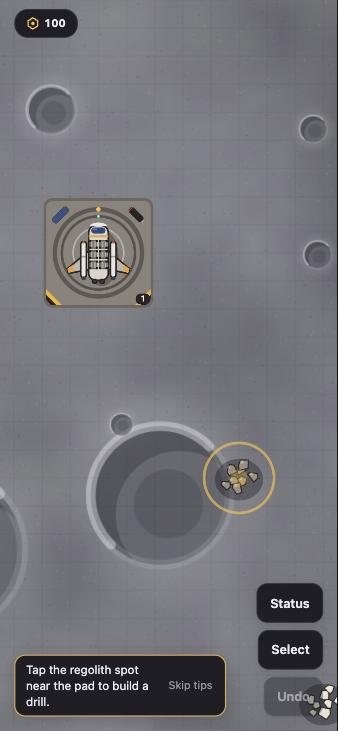
A new game on the Moon - Ore comes as single spots sized for one drill, graded poor to pure. Some further out are mixed and need sorting with a new filter. Buried dig sites hold a random find, paid for with credits.
- Real lunar chemistry: ilmenite gives iron and titanium, anorthite gives aluminium, ice melts to water, and an electrolyzer splits it into oxygen and hydrogen. Greenhouses grow algae, crops and seeds from lunar soil.
- Water and gases flow in pipes drawn exactly like belts. A fission reactor carries the factory through the long lunar night.
- The Moon ends when its three parts of the colony ship are shipped: life support, a seed vault and a navigation computer. Radio messages from mission control and the survivors mark the way.
- Also new: drone depots that fly cargo to the pad, machine upgrades, a status view that shows stuck and starving machines, save backups, and sound made entirely in code.
Devlog · October 31, 2026
A story, a solar system, and real science
The game found its reason tonight. Earth is destroyed by a passing black hole, and the whole game becomes one project: build a colony ship from parts made on four worlds. Kraig wanted everything grounded in real physics, so each world plays differently because of what's really there.
- The Moon has no air, so no weather, but brutally long nights: solar and batteries first, then a small fission reactor, like NASA's real Kilopower.
- Mars gets dust storms that black out solar panels. Saturn's sunlight is too weak to use, so power comes from its enormous winds and from fusion. In the asteroid belt the sun never sets, but heat has nowhere to go, so radiators become the puzzle.
- Water, oxygen and hydrogen move in pipes that you draw exactly like belts. Belts become cable lines between Saturn's floating platforms and magnetic rails in zero gravity.
- The Moon will be free to play. One purchase opens Mars, Saturn and the asteroid belt.
Devlog · October 31, 2026
A name, a shuttle, and a home-screen app
The game is now called Payload. The cargo shuttle was redesigned from a round of mock-ups into a long hauler with swept wings, side boosters and six shipping containers that fill with the colors of what you send. It now flies calmly: a slow lift, a glide off the edge of the map, and the next one gliding in.
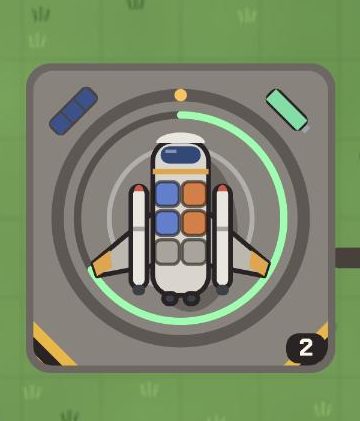
Loading on the pad 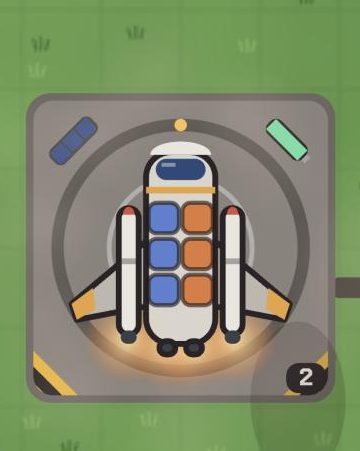
Lift-off - The pad grew to 4 by 4, with its own small solar panel and battery.
- A version you can add to your iPhone home screen, running full screen around the Dynamic Island.
Devlog · October 31, 2026
Power, credits, and a calmer screen
Solar panels and batteries arrived, tied to a day and night cycle. When the batteries run dry in the dark, the whole factory slows down, machine warning lights pulse, and a banner says how slow. Every item that reaches the pad now earns credits, more for higher-tier items, and building costs credits. Removing anything refunds it in full, so experimenting is free.
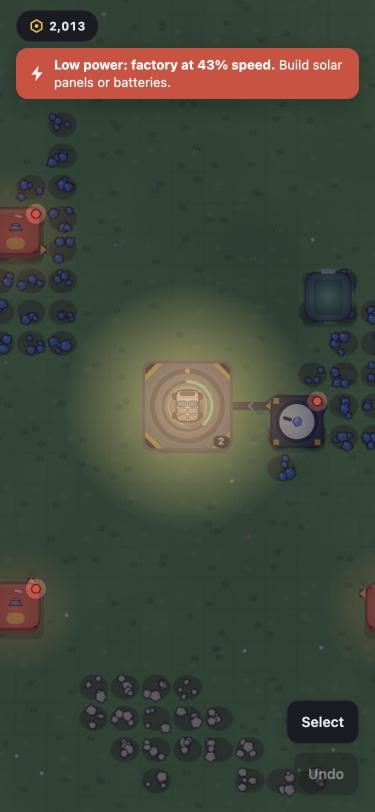
Out of power at night 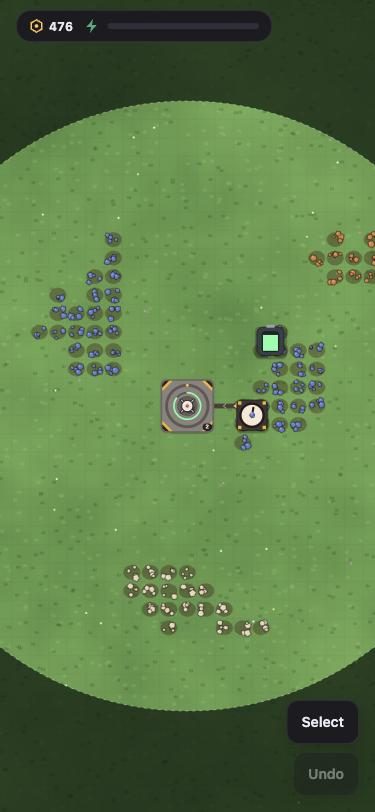
The bigger, open map The screen kept getting simpler: the toolbar went away, the goals moved into the pad's panel, and the top of the screen now shows only your credits.
Devlog · October 31, 2026
Belts that go where your thumb means
The first thing Kraig asked for was better belt drawing than other phone factory games. Lines now lock straight, show a preview with their length and cost before anything is built, scroll the map when you drag to the edge, and drop a crossing automatically when they cross another belt.
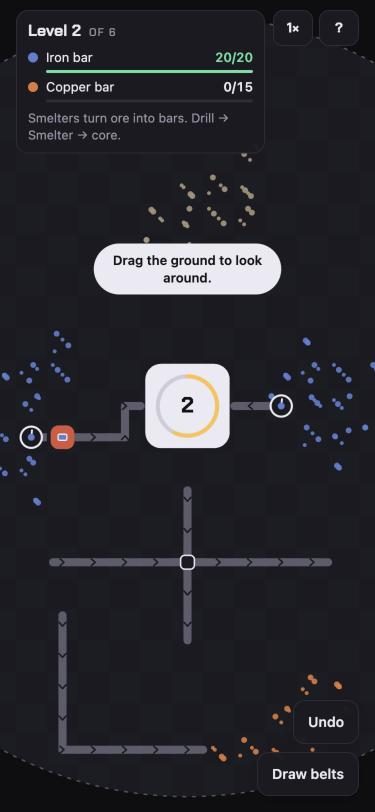
An automatic crossing - Splitters let you pick which side gets priority. Belt speeds upgrade per line, not for the whole factory.
- Machines became 2 by 2. Hold one and drag to move it, or box-select a whole group to move, copy or delete.