Making HollowARK: the devlog
Every version of a game I'm making with Claude, from the first message to version 71: my notes in my own words, what changed, and screenshots.
I'm designing this game and playtesting it as it's built; Claude, Anthropic's AI, writes all the code. Each entry below is one round: my notes in my own words (trimmed, never reworded), what Claude proposed or built, and what changed. Times are New York time. The screenshots are from the build at that moment, and a few older versions were rebuilt from the code history to show stages nobody screenshotted.
- The design conversationOct 13, 11:49 pm to Oct 14, 12:32 am
- Version 1, built overnightOct 14, 1:21 am to 1:28 am
- First playtest: controls and buildingsOct 14, 8:22 am to 8:38 am
- Nights, raids and a build queueOct 14, 9:10 am to 9:19 am
- Teach without tellingOct 14, 9:26 am to 9:50 am
- Smelters, glass and life supportOct 14, 9:58 am to 10:10 am
- The power sagaOct 14, 10:11 am to 10:51 am
- Into the mountainOct 14, 10:54 am to 11:48 am
- Staying in the caves, and a nameOct 14, 12:00 pm to 12:22 pm
- Building the baseOct 14, 12:33 pm to 1:02 pm
- Light undergroundOct 14, 1:03 pm to 1:03 pm
- Fog, power and the fleetOct 14, 1:06 pm to 1:28 pm
- A first full playthrough, and the shape of the gameOct 14, 1:53 pm to 1:54 pm
- Designing the whole gameOct 14, 1:57 pm to 2:36 pm
- The base and the fight, on paperOct 14, 2:38 pm to 3:01 pm
- Chapter One: the planOct 14, 3:08 pm to 3:14 pm
- Designing while it builtOct 14, 3:20 pm to 3:29 pm
- Stages 1 and 2: the wake and the rockOct 14, 3:30 pm to 3:32 pm
- Working backwards from the starsOct 14, 3:37 pm to 3:58 pm
- Chapter One, start to finish, and the chapters aheadOct 14, 5:00 pm to 5:57 pm
- The Lantern lookOct 14, 6:07 pm to 8:01 pm
The design conversation
Oct 13, 11:49 pm to Oct 14, 12:32 am
Forty-five minutes of talking before any code: what kind of game, how drones work, the look, the enemy and the story. Claude asked one question at a time, offered a default each time, and wrote every decision into a design file.
design
I want to make a video game
“I want to make a video game”Kraig, 11:49 pm
“2D alien world colony game”Kraig, 11:50 pm
“Top down”Kraig, 11:50 pm
Claude: Claude's first suggestion was a calm hiking game built on Kraig's real routes. He wanted an alien world instead. Claude then offered a RimWorld-style colony with three colonists, and he turned that down too.
- The game is 2D, seen from above, on an alien world.
design
Start with a base, build drones
“Not what I want”Kraig, 11:51 pm
“Start with a base. Build resource collector drones”Kraig, 11:51 pm
“Still designing”Kraig, 11:52 pm
“Like Factorio”Kraig, 11:52 pm
- You start with one base and build drones that collect resources.
- Like Factorio, the game is about building automation that grows. The difference: drones carry everything, so there are no conveyor belts.
designmechanic
Chains of drones, three temperatures
“So drones have a limited distance, to be chained together for longer distances, and also upgraded for speed and cargo and strength of carrying weight.”Kraig, 11:54 pm
“Yeah, let's keep it simple. Let's just have room temperature, hot and cold. And then iron ore, copper ore, molten ores.”Kraig, 11:57 pm
- Every drone has a limited range, so far deposits need a chain of drones.
- Materials have a weight and one of three temperatures, and those decide which drones can carry them.
designmechanic
Power, smelters and ice
“All the buildings are connected with lines for power, and that transports power between them. There's power generation, there's solar, there's batteries for collecting, there's a day and night cycle. There are smelters for processing raw ores into metals.”Kraig, 11:59 pm
“I think ice should be a material, a resource, and it's the only way that we make water. And the ice can be used to cool the melting process.”Kraig, 12:00 am
- Solar power by day, batteries for the night.
- A smelter turns ore into metal; a melter turns ore into molten metal for bigger parts.
- Ice is the only source of water, and it keeps the melters cool.
designart
The look: Foundation and Dune
“Factorio is like steampunk. I want this game to be very simplistic, minimalist design, but kind of Apple-esque. Kind of like Foundation or the Dune.”Kraig, 12:02 am
“I like the light gray stone, white light, colder, more sci-fi feel.”Kraig, 12:03 am
Claude: Claude turned that into rules: big calm ground with no clutter, plain geometric shapes, almost no colour, and the day and night cycle carrying the mood.
- Light grey stone, white light, cold and sci-fi.
- Colour only where it matters: live power glows, molten metal is orange, ice is pale blue.
design
Enemies with a purpose, and lasers
“Like Factorio, there's pollution and bugs. But I never really liked how they do it in Factorio. It just seems like an annoyance. And I usually turn off enemies in Factorio. I want this game to be more objective and mission-based.”Kraig, 12:04 am
“A drone can almost become like a tower. So like a defensive network of drones. But they'd have to be powered and fed. Maybe laser based if it's power. Makes it easier than making bullets. I feel like bullets are stupid anyway.”Kraig, 12:06 am
- Bugs attack the base now and then, but the real game is going out to hunt them and their bosses for rare materials.
- Combat drones are the same drones with lasers, running on power. No ammunition.
design
Never settle: the convoy
“In Factorio, I don't like that you kind of start building the base and never really leave that area. I like the idea of a convoy, or, you have to, every couple of days, decide when you need to pack up and leave.”Kraig, 12:07 am
- The base is always on the move. Staying to mine longer or packing up before the attacks get worse is the main decision.
designstory
The story: crash-landed and hunted
“There should be one foreboding enemy pressure or enemy army that builds and builds and builds, and if you're really good at the game you can go far, but eventually everyone dies.”Kraig, 12:09 am
“There's just this one vehicle, command vehicle, that has people in it that live in it, and they control all of the drones around them to survive, and they just need to keep moving, collecting resources, automating, upgrading as they're being hunted, because they crash landed on an enemy planet.”Kraig, 12:09 am
- A crew of five lives in one command vehicle and steers a swarm of drones.
- One enemy force, later named the Tide, grows forever. There's no rescue and no win screen.
- Each run gets a new map. Your score is days survived plus distance travelled.
art
The first mockup
“It's a lot simpler than I expected, but maybe that's the best way to start.”Kraig, 12:15 am
“Let's keep giving details until we are ready to do the first playable version.”Kraig, 12:16 am
- Two still pictures, not the game yet: the camp on grey stone by day, and the same camp at night under attack.
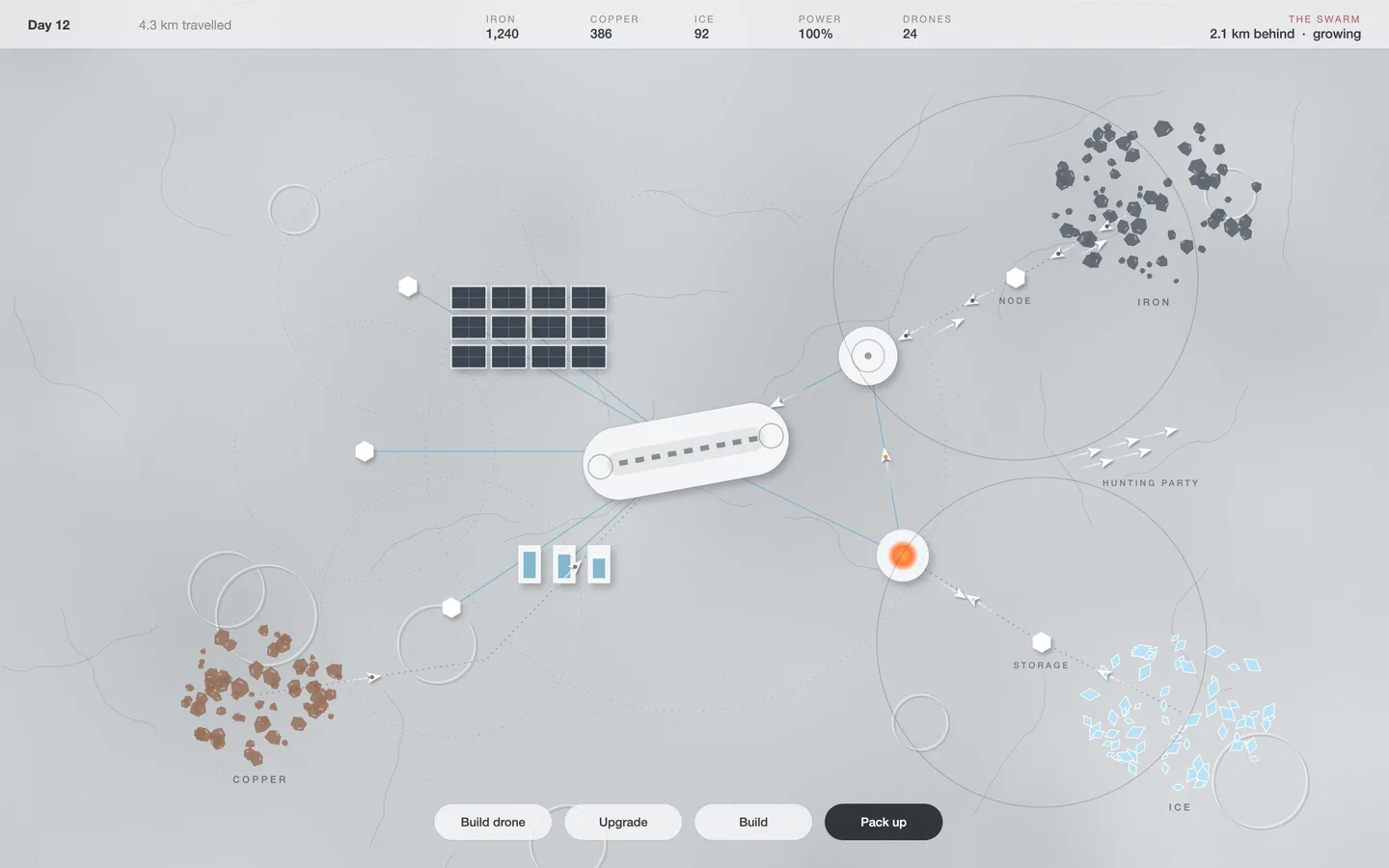 (open full size)
The mockup by day: the command vehicle in the middle, drones hauling iron and ice, solar panels and batteries. 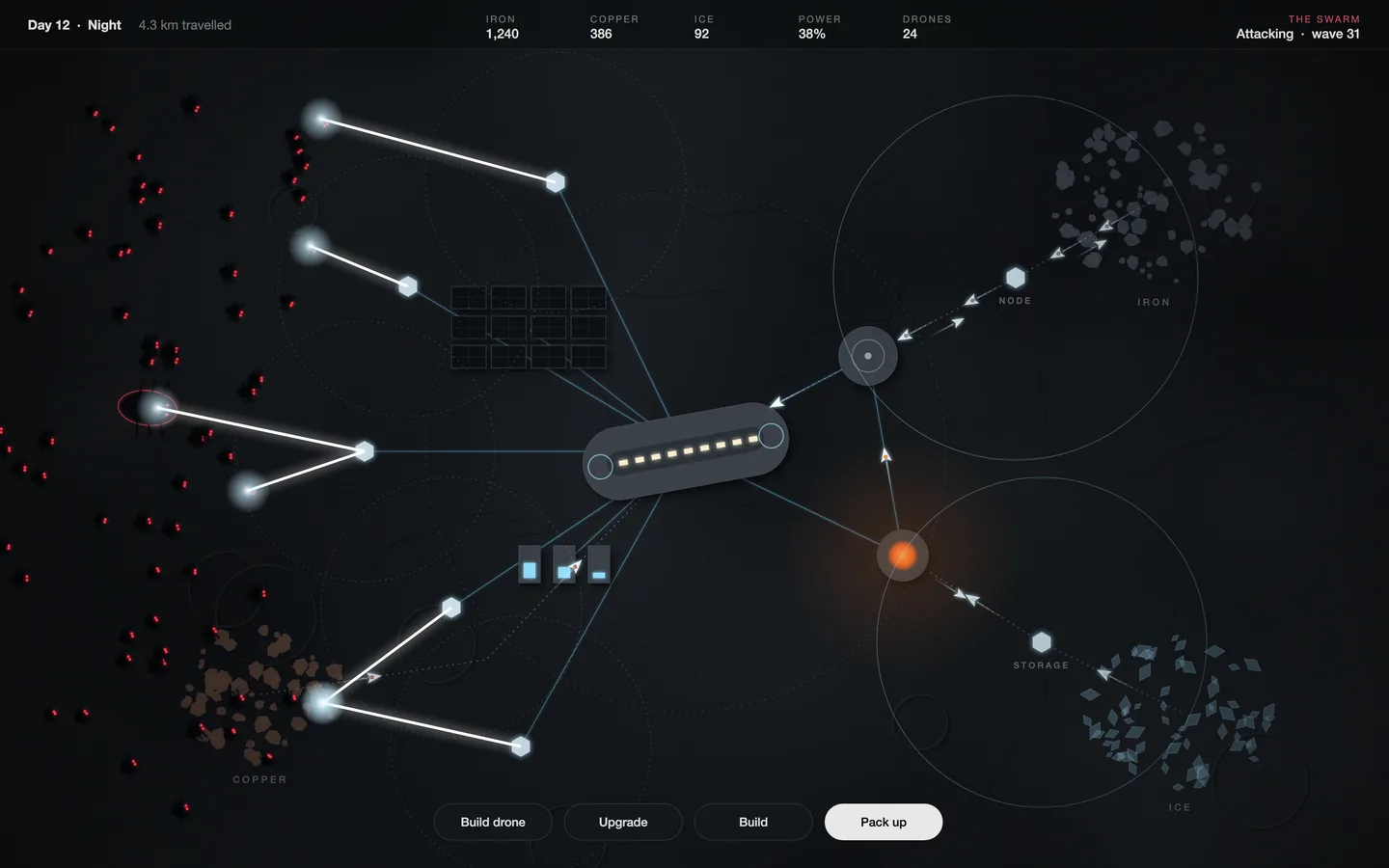 (open full size)
The same camp at night: power at 38%, the swarm coming in from the west, lasers firing. designmechanic
Everything is a drone
“Storage drones don't make sense. You can connect drones. They don't have to be nodes. You can just have a drone be stationary and it can be a drop-off spot for another drone moving cargo.”Kraig, 12:17 am
“The enemy grows in difficulty and intensity, but you for sure can defend against the main attack if you're on track and strong and growing, so you can stay and fight. But if you want to pack up and leave and not have to fight, that makes sense as well. There's strategy to that.”Kraig, 12:18 am
“I want them all to be movable ships, but they pack into one main ship... you can move a base of like six buildings, but it unpacks to have like 40 or 50 different things.”Kraig, 12:21 am
“It should always be a spectrum of choice. Each with pros and cons.”Kraig, 12:25 am
“Packing up and leaving, you can only go as far as you have power.”Kraig, 12:25 am
- Any parked drone is a drop-off point, so chains link up without special drone types.
- Buildings are ships that unfold as they grow and fold back up to travel.
- A design rule for everything: every choice is a spectrum with pros and cons, never one right answer.
- Batteries are your travel range.
design
Keep it simple
“I think it seems good at first, but now, the more I think about it, the more it might be annoying from a play perspective.”Kraig, 12:31 am
Claude: Claude's answer: only materials are physical cargo (ore, metal, ice). Parts are recipes, not items: an upgrade is just a cost taken from one shared stockpile, so nobody manages warehouses of gears.
- Kraig agreed. Hauling materials is the puzzle; spending them is one click.
milestone
Build it while I sleep
“I think we're at the point when we should just build a working version. I'm going to bed... You can take as much time as you need to build something that's really cool that I can play in the morning when I wake up.”Kraig, 12:32 am
“I guess trackpad and keyboard on my Mac is how I would play. I don't know what that would be like. A browser-based game or whatever, I don't know. Whatever's best. You know better.”Kraig, 12:32 am
- Claude picked a browser game in plain JavaScript and Canvas, played with a Mac trackpad and keyboard.
Version 1, built overnight
Oct 14, 1:21 am to 1:28 am · v1–v4
Kraig went to bed. Claude wrote the whole first version in about an hour: the rules first, tested by a bot that plays the game without graphics, then the drawing, the controls, the sound and a single-file build.
v1milestonetech
Version 1: the first playable build
Claude: Kraig was asleep. Claude worked through the night in this order: the game's data and tuning, map generation, the simulation, objectives, then a test bot that plays the rules headless in Node, before drawing anything. Then the renderer, the interface, trackpad controls, sound made in code and a build script that bundles everything into one HTML file.
- Ark-9 crash-lands with five crew and four drones; the Tide closes in from the west.
- Drones haul, mine, relay, defend and hunt, with four module slots each.
- One network of beams carries both power and cargo; a stranded drone trickle-charges and hops home.
- Smelter, melter, solar array and battery bank grow from drones and fold into pods to travel.
- The tests caught real bugs before morning: the starting copper sat just outside the Ark's reach, the swarm ramped up too fast, and one run survived the Tide with a full-health Ark, which shouldn't be possible.
- The working title, Driftline, was Claude's placeholder.
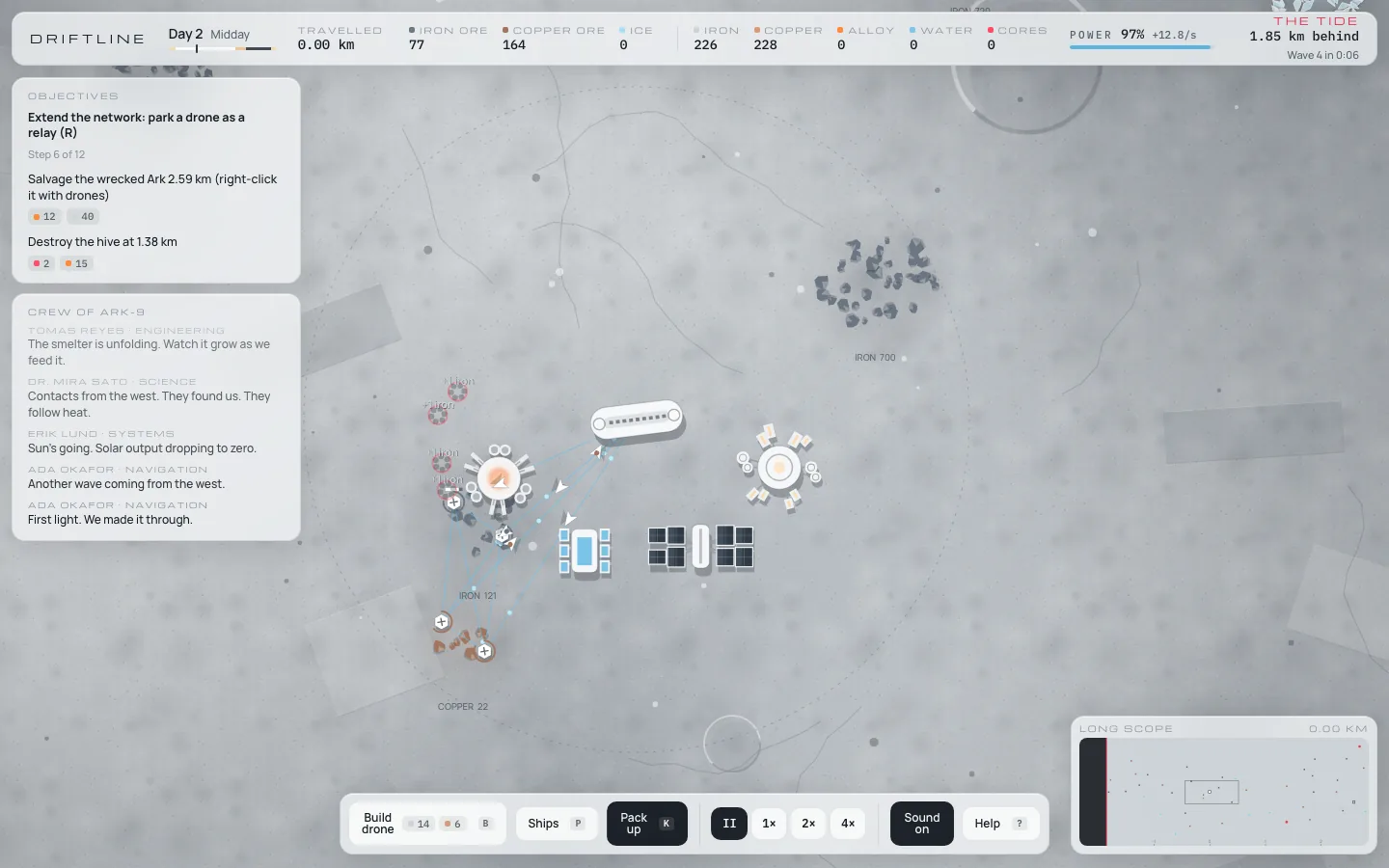 (open full size)
The first full-size test shot, just before 1am. Claude's note: "Promising first look." 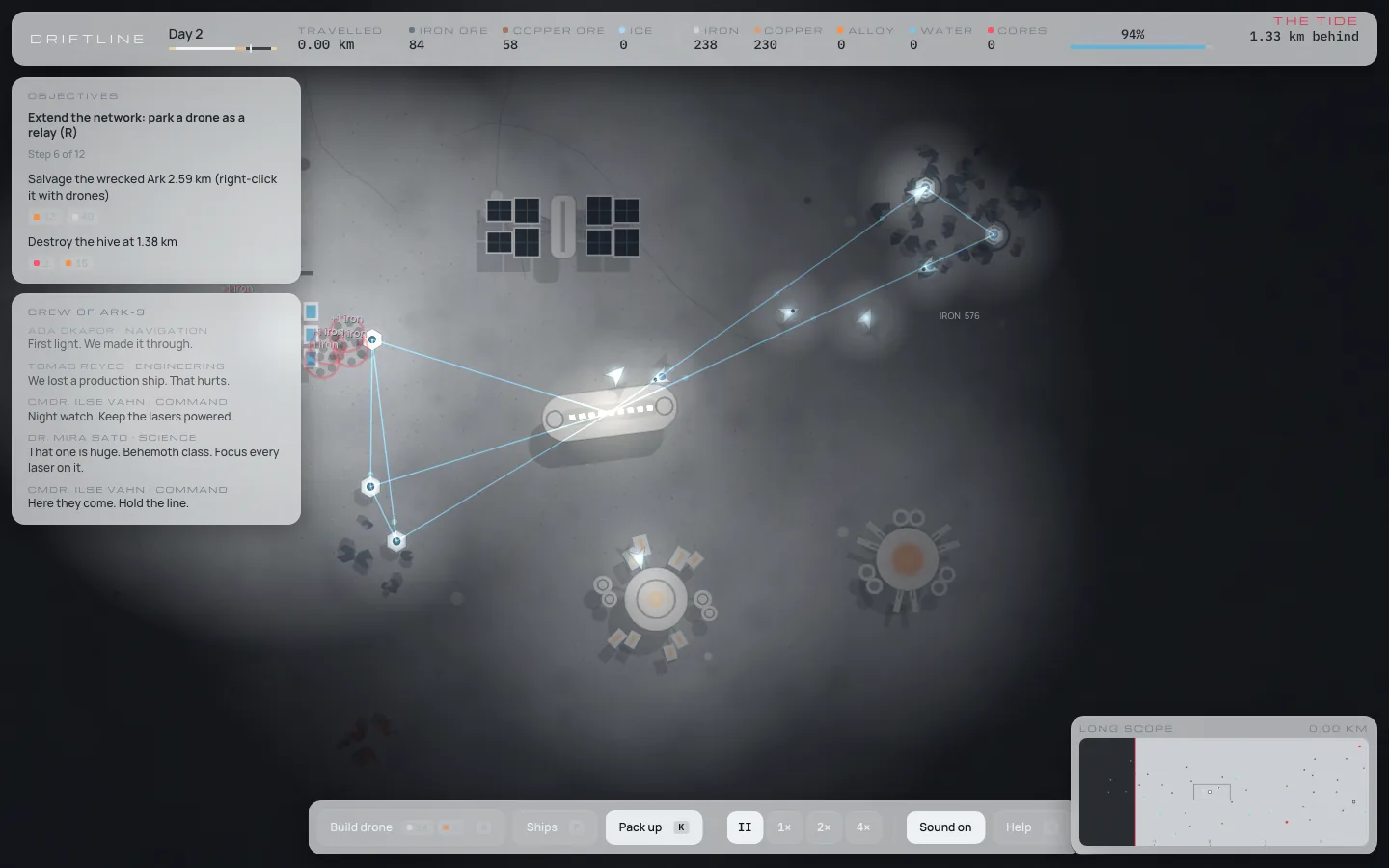 (open full size)
Night: the ground goes dark and the base becomes a pattern of lights. Published as “First playable”
v2–v4polishbalancetech
Versions 2 to 4: polish before morning
- When the Tide catches the Ark now, the run really ends.
- A quiet DAY 3 title at each dawn, and a warning when a wave sets out.
- Smaller, subtler ground slabs, and one clean line from each defender back to the Ark.
- Test numbers: the bot lasts 7 to 11 days; a player who never moves dies around day 4, so the game teaches moving on.
- About 3,400 random orders from a "monkey" tester, including saves and reloads mid-run, caused no crashes. A late-game frame with 338 bugs on the map draws in under 1 ms.
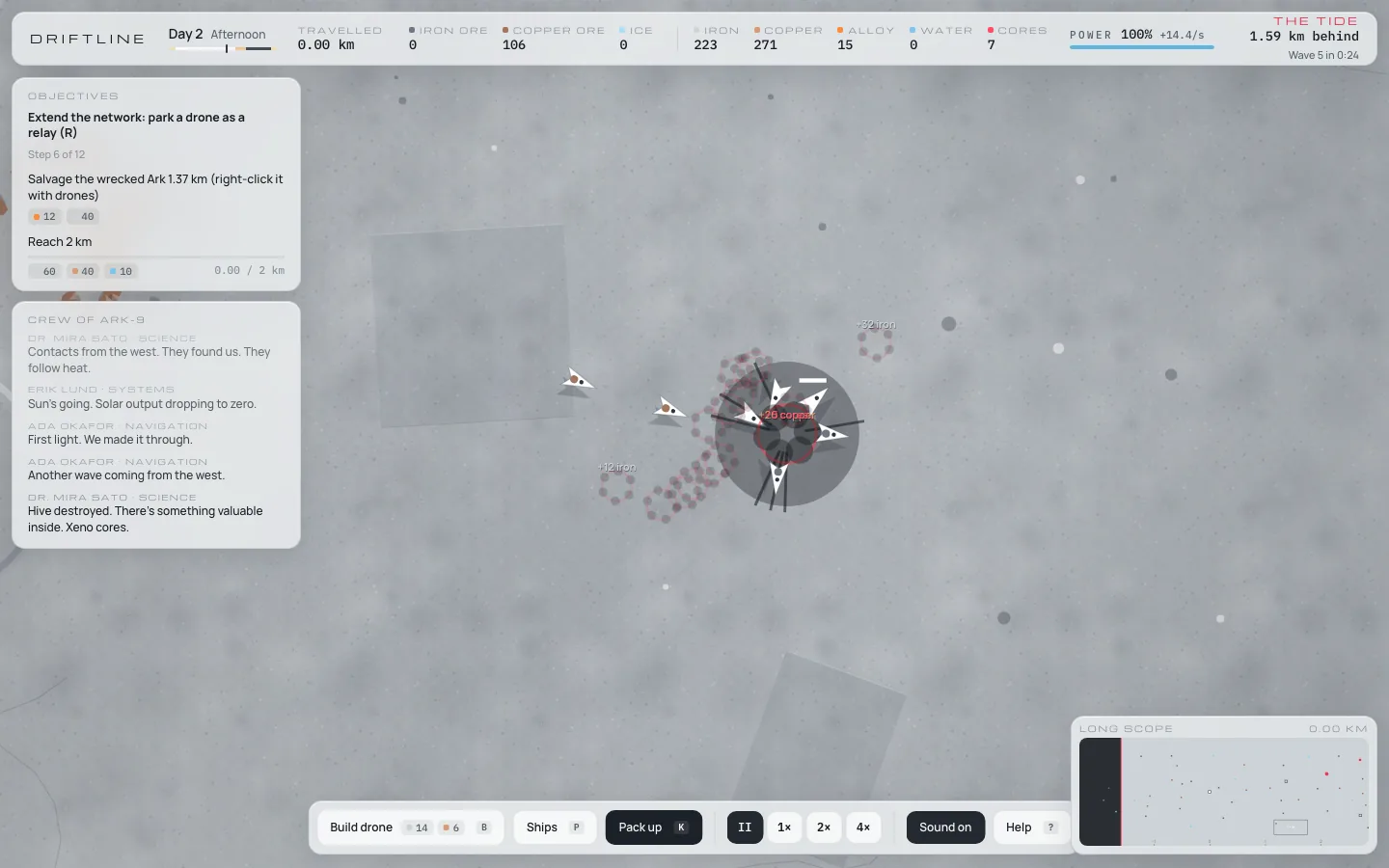 (open full size)
A hive hunt: six laser drones broke a hive and its guards in about 40 seconds. 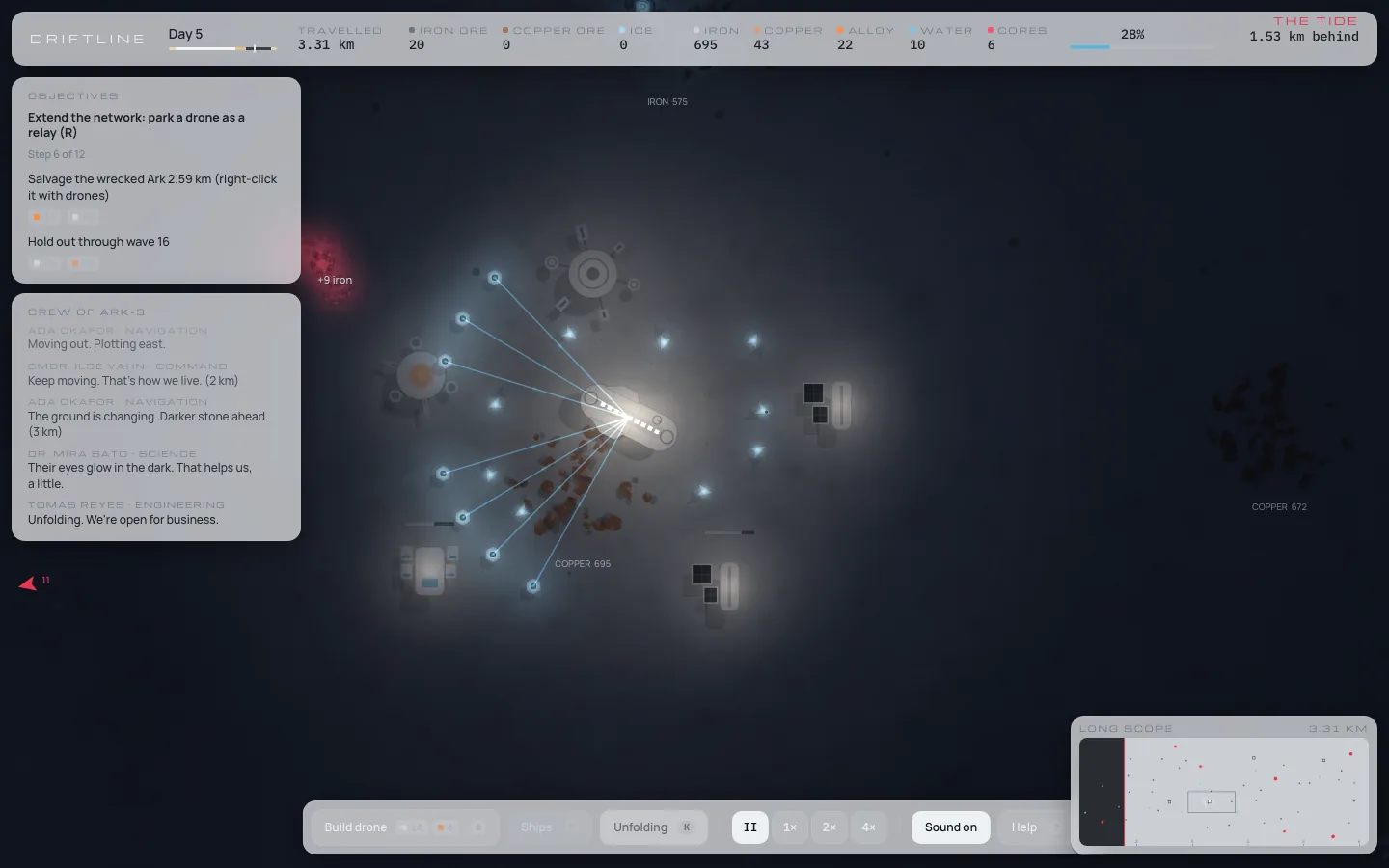 (open full size)
Version 4 at night, the last screenshot before Kraig woke up. 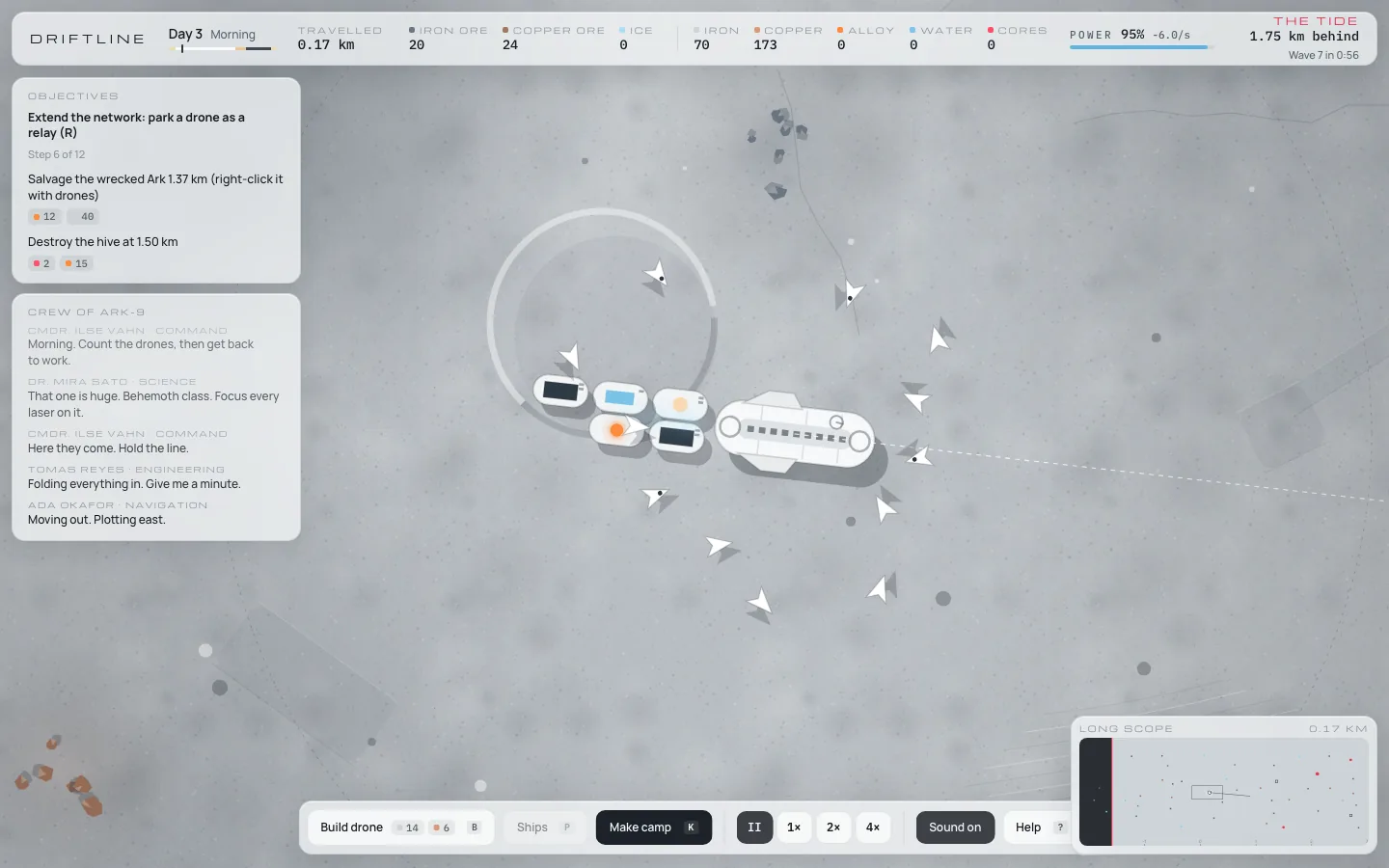 (open full size)
Packed up: the base folds into pods behind the Ark and moves as one train. Published as “Tutorial and night fixes · Dawn titles, wave alerts, softer ground · Cleaner network lines”
First playtest: controls and buildings
Oct 14, 8:22 am to 8:38 am · v5–v8
The first notes from a real player: camera keys, drone shortcuts, buildings, a drone limit and a tidier screen.
v5controls
WASD moves the camera
“This is really cool”Kraig, 8:20 am
“I need WASD to move the camera”Kraig, 8:22 am
- W, A, S and D pan the camera. Defend moved to G and hunt to T, since A and D were taken.
Published as “WASD camera”
v6controls
Number keys for drone jobs
“For panning the camera. We can use 1234 for drone commands?”Kraig, 8:22 am
- 1 to 5 give drone jobs; Tab cycles the game speed.
Published as “Number keys for drone jobs”
v7mechanic
Drones grow into buildings, and a drone limit
“I think we should be able to upgrade drones into the smelter, constructor, etc. buildings. They become bigger and it takes a few seconds. We should build drones after clicking on the Ark. They make them near it.”Kraig, 8:30 am
“I also think there should be AI datacenters and mechanics for the number of drones we can have”Kraig, 8:31 am
- A drone grows into a building where it stands, over about 4 seconds.
- Drones are built from the Ark's panel and appear beside it.
- A Fabricator (Kraig's "constructor") builds drones faster.
- AI datacenters raise the drone limit and draw power all the time.
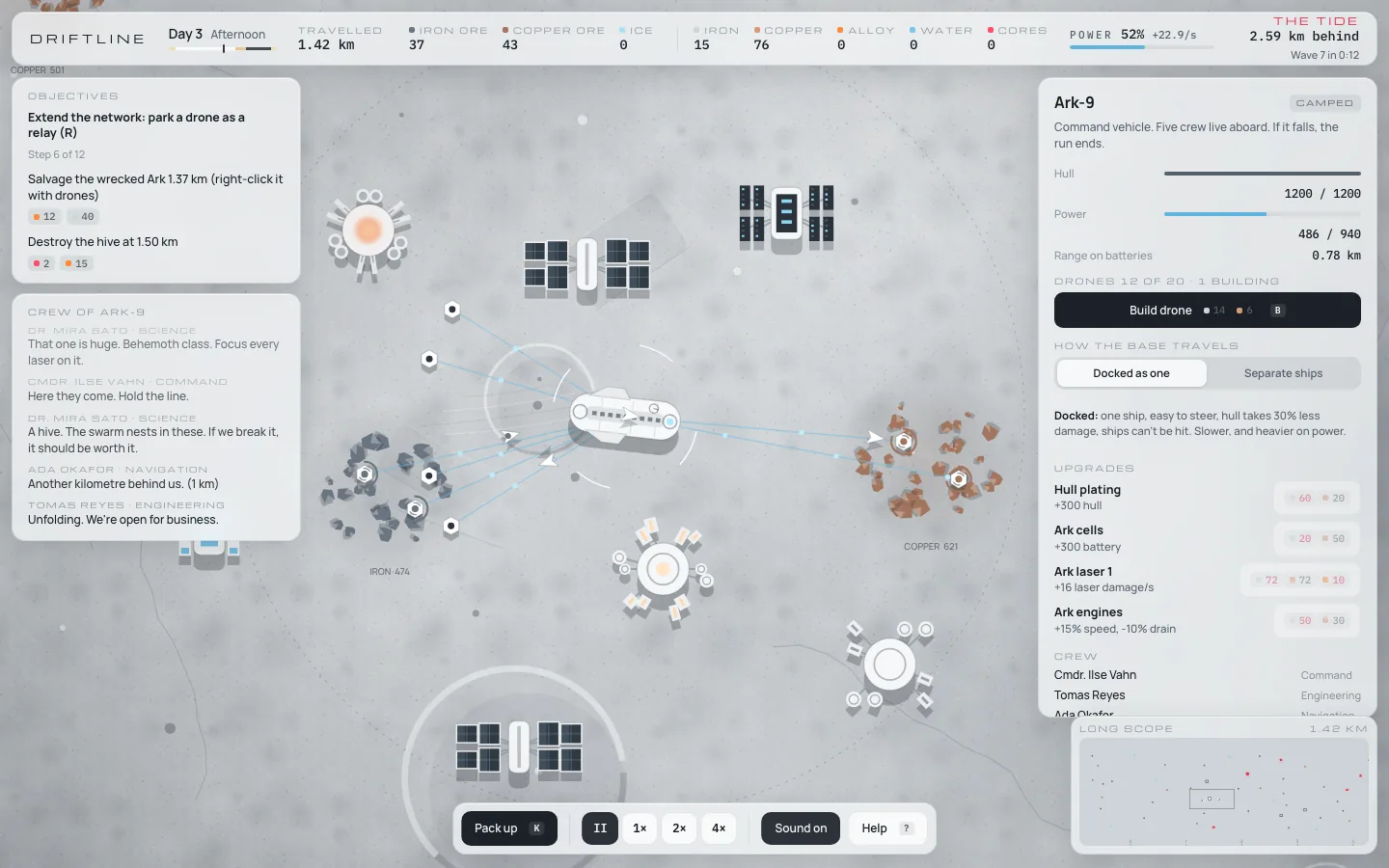 (open full size)
Version 7: buildings grown in place from drones, and the Ark's panel with the drone count. Published as “Buildings in place, datacenters, drone limit”
v8ui
A tidier screen
“We need to be able to close the objectives and story box. The mini map needs to be built into the UX in the corner”Kraig, 8:38 am
- The Objectives and Crew boxes fold down to a title line.
- The minimap sits flush in the bottom-right corner.
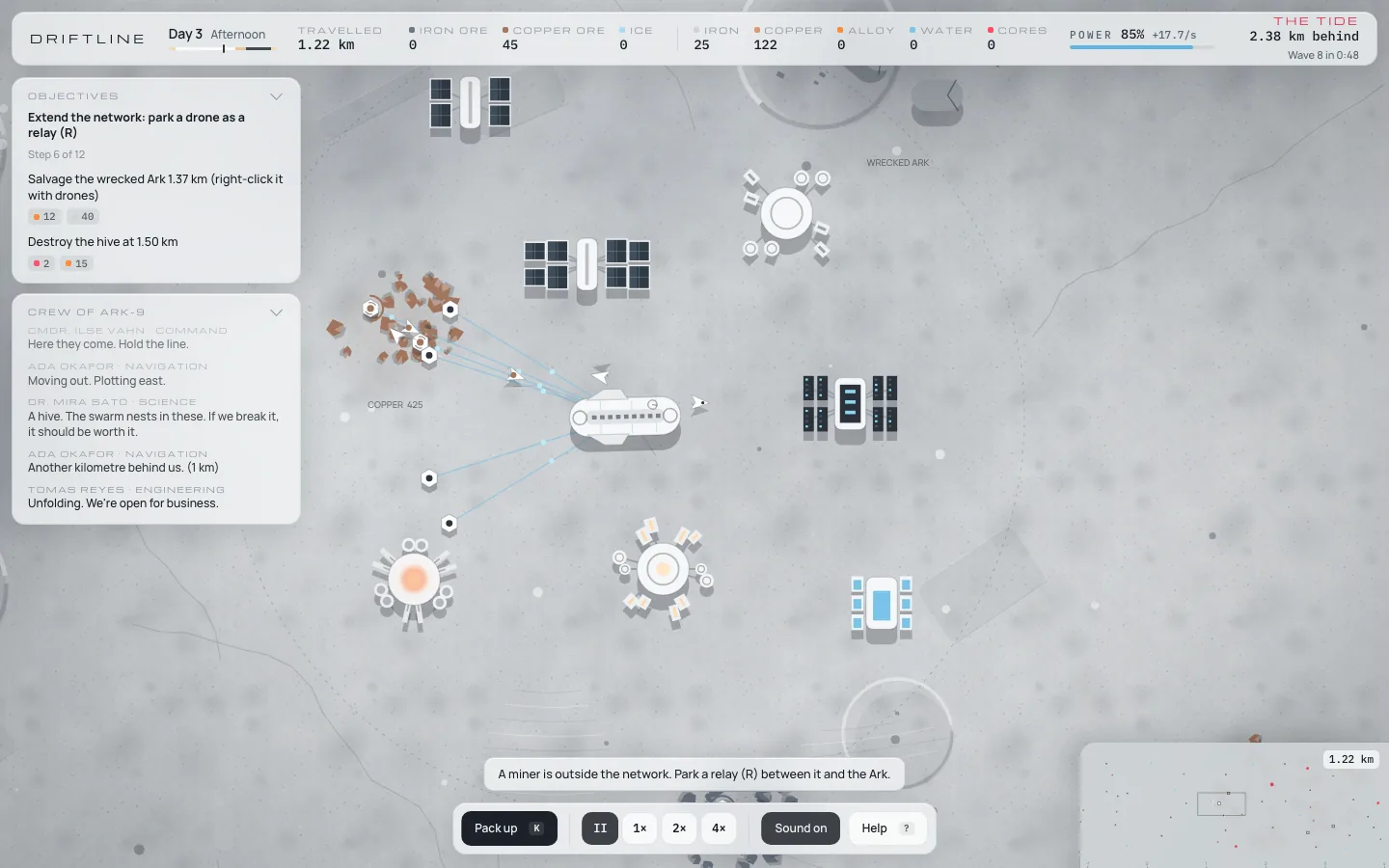 (open full size)
The scope moved into the corner. Published as “Collapsible boxes, corner scope”
Nights, raids and a build queue
Oct 14, 9:10 am to 9:19 am · v9–v11
Longer days with golden sunrises, raids out of the dark, and a way to see what's being built and where an objective points.
v9ui
A build queue you can see
“I built a drone but I didn't see a building timer indicator”Kraig, 9:07 am
“It should be a queue on the UI”Kraig, 9:08 am
“This has to be able to be more closed and collapsed”Kraig, 9:10 am, with a screenshot
- A build queue in the bottom-left with progress and cancel.
- A ring around the Ark fills while a drone is built, with a faint drone taking shape where it will appear.
- Folded boxes really fold now.
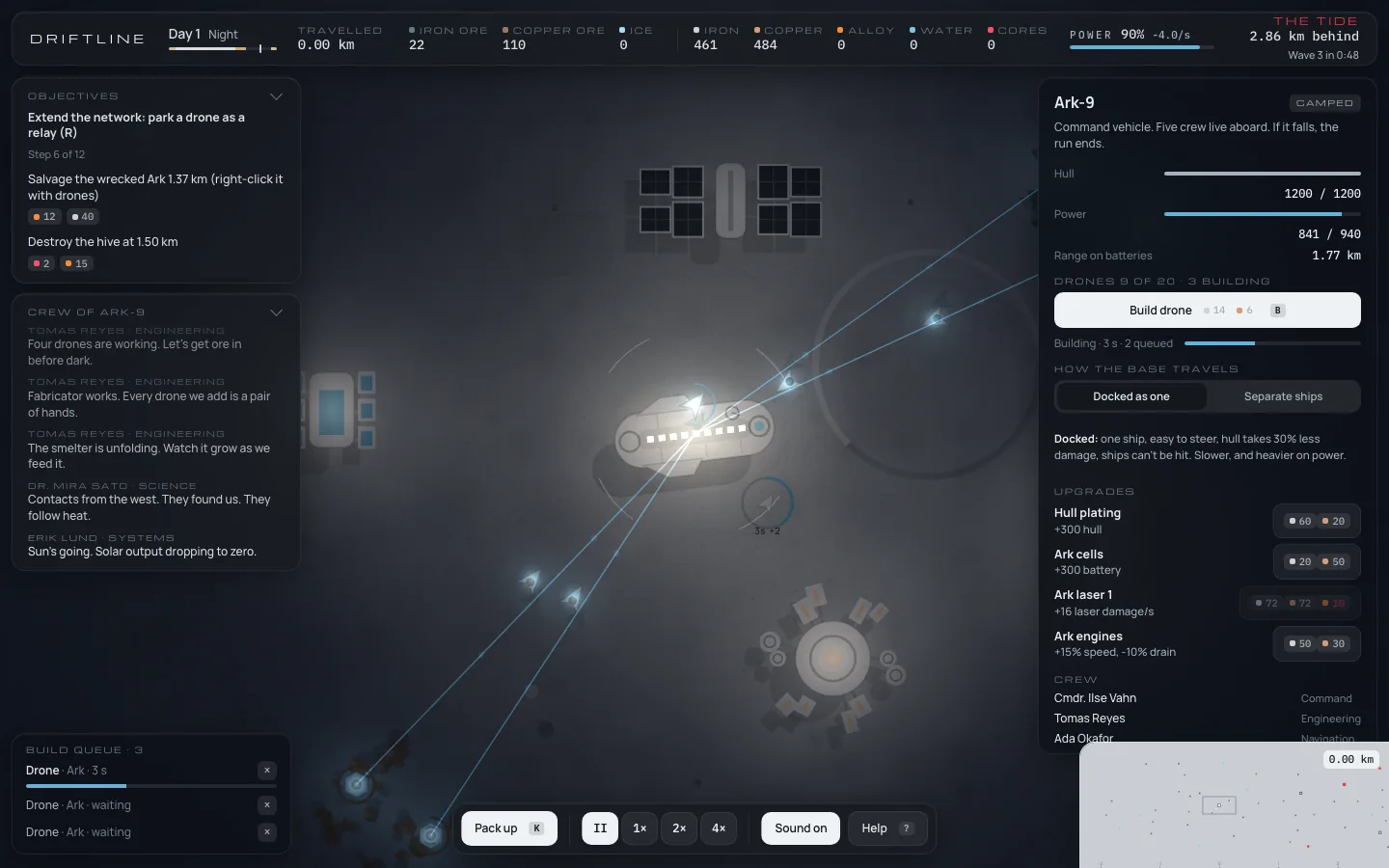 (open full size)
The build queue and the progress ring. Published as “Build queue, collapse fix”
v10mechanicartbalance
Night raids and golden hours
“Night one happened but no enemies tried to attack”Kraig, 9:10 am
“I think the day night cycles should be longer. There also should be a sunrise sunset transition”Kraig, 9:11 am
- Every nightfall a group of bugs comes out of the dark around the camp.
- Days are 8 minutes, with a long golden sunrise and sunset.
- The first sunset was too sepia and lost the cold Foundation look, so Claude toned it down to a softer gold.
- Longer nights drained the starting battery before dawn, so the Ark got a bigger battery.
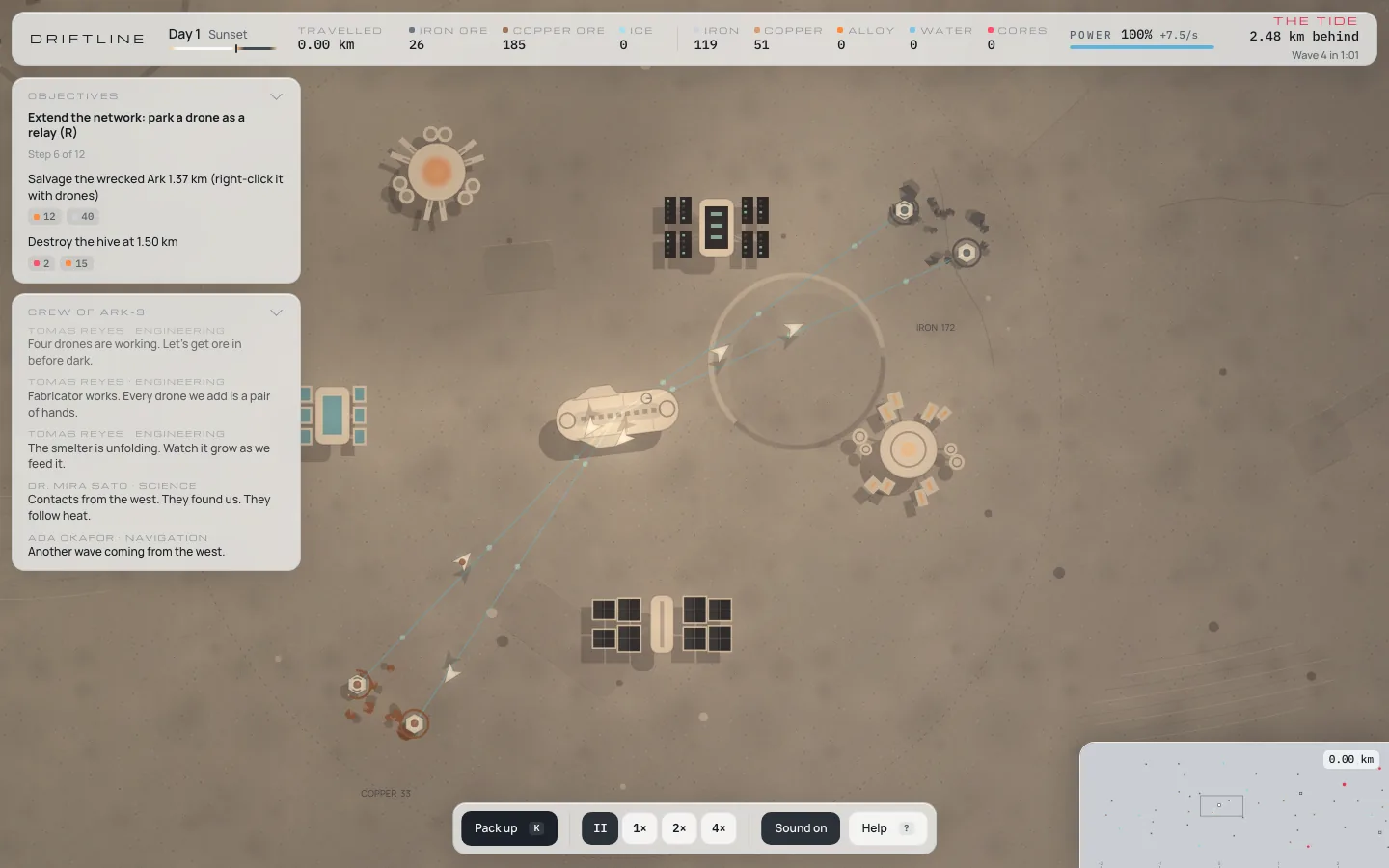 (open full size)
Sunset in version 10. Published as “Night raids, longer days, golden hours”
v11ui
Objectives that point the way
“Hovering over an objective should show a pointer indicator of the direction and highlight it on the map and mini map”Kraig, 9:18 am
- Hovering an objective rings its target on the map and the minimap, with an arrow at the screen edge when it's off screen.
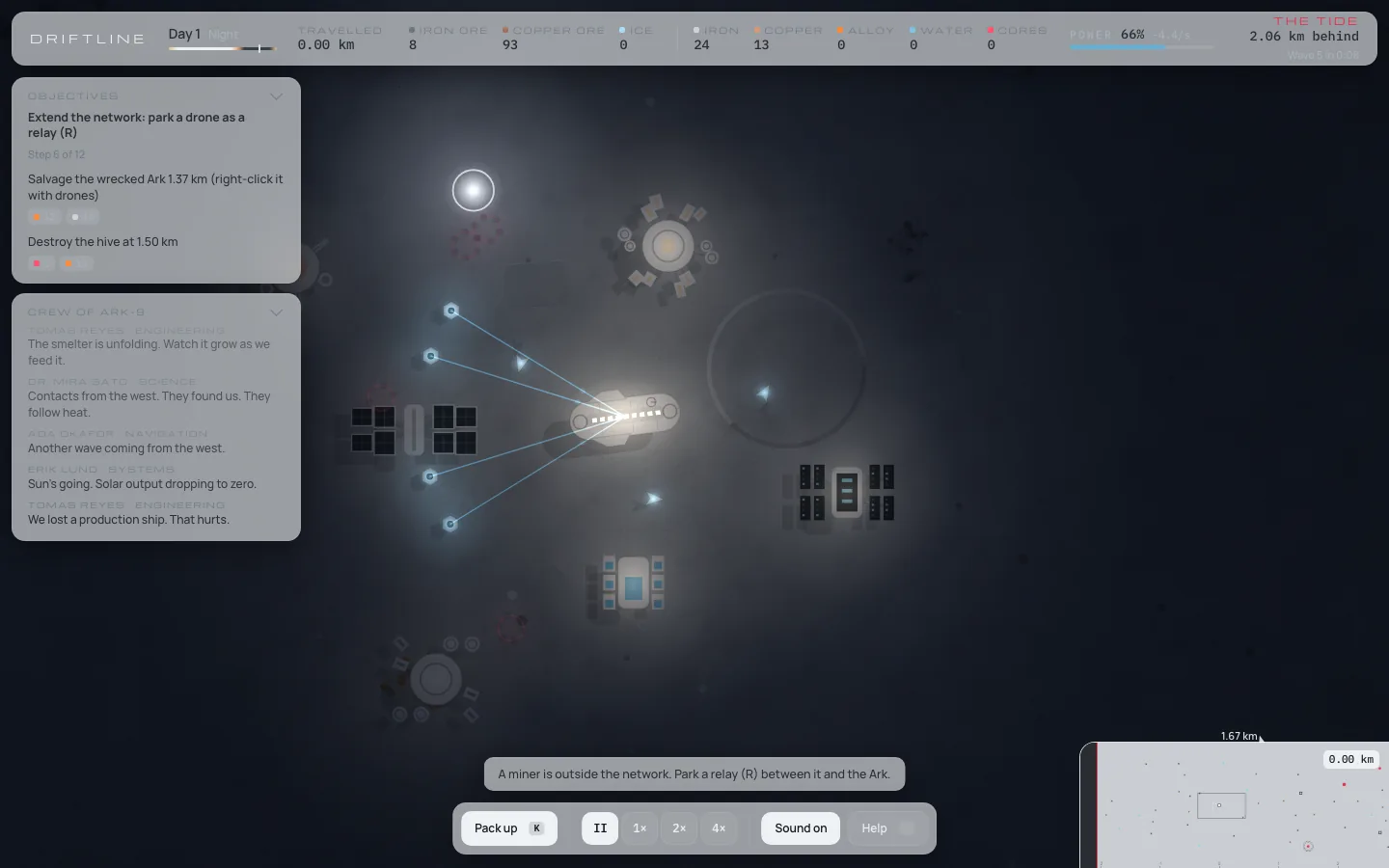 (open full size)
The objective's target, ringed. Published as “Objective pointers”
Teach without telling
Oct 14, 9:26 am to 9:50 am · v12–v18
The opening was too fast and showed too much. It became a crash-damaged Ark you repair step by step, each repair switching on the next thing, slowly and on purpose.
v12designtutorial
Start damaged, unlock as you go
“I think the start needs to start more simple and teach the player how to do things without telling”Kraig, 9:15 am
“We need to seriously limit the options and complexity at the start, and those get unlocked as the player continues objectives”Kraig, 9:22 am
“I think the Ark should start damaged after the crash, and your first objective is repairing it so it can then move and make more drones, etc.”Kraig, 9:24 am
- You start with one drone and a smoking Ark at a third of its hull.
- Repairs to the fabricator, hull and engines each open up the next options; anything still locked is hidden.
- The top bar fills in as you go, and the Tide waits until your first smelter runs.
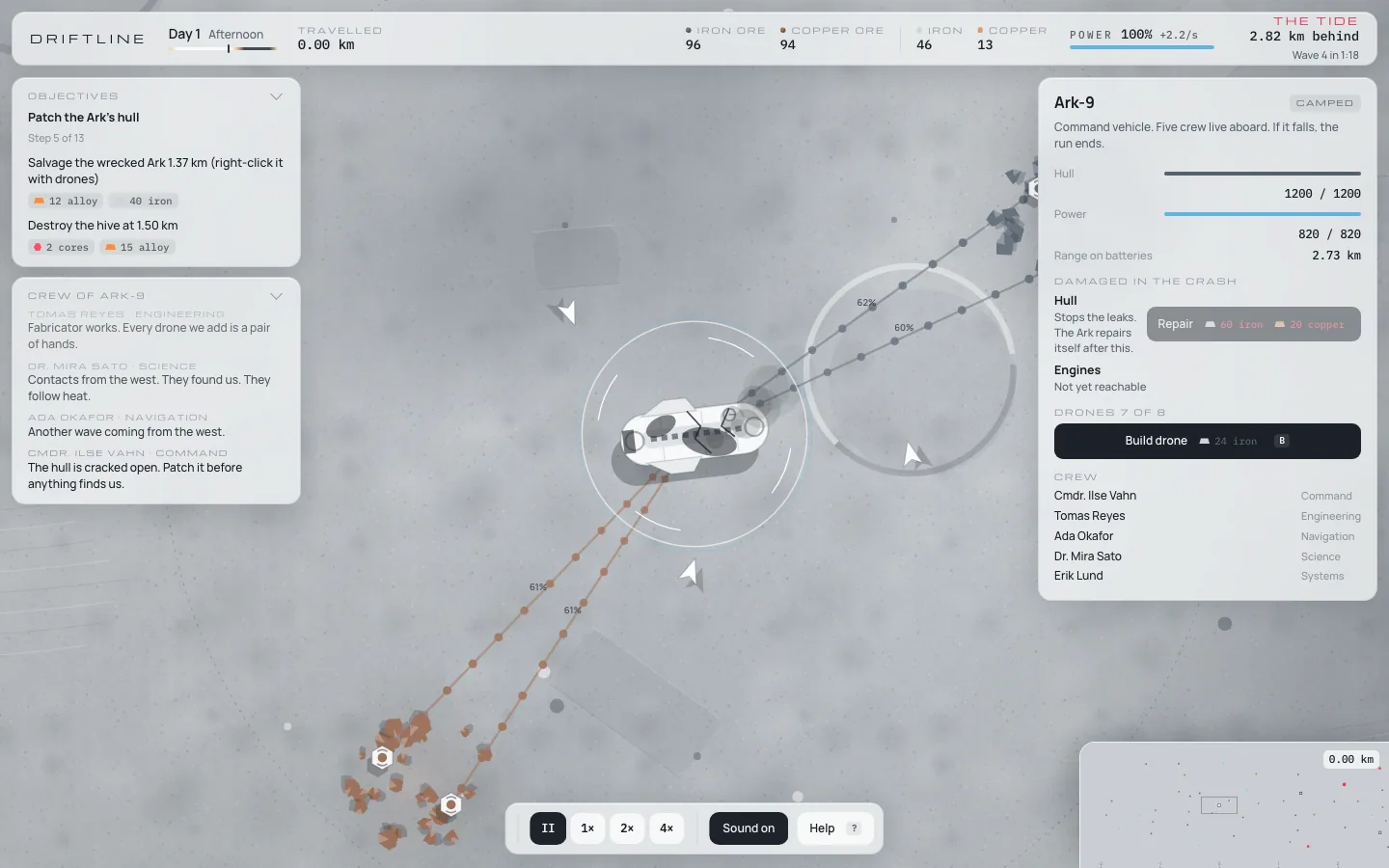 (open full size)
The damaged Ark and its Repairs panel. Published as “Damaged Ark start, unlocks”
v13mechanicsoundbalance
Mining lines replace hauling
“Not sure I like the haul mechanic. I think when I make a drone a miner, the power flows to the mine and ore flows back to the Ark in a line. Any distance is allowed, but at the expense of power delivery and output back along the logistic line.”Kraig, 9:26 am
“I want music like this”Kraig, 9:29 am
“It's too easy and quick. We need to slow down the rate of mining and collecting at the start here”Kraig, 9:30 am
“The hull repairs and upgrades should take some time depending on the cost”Kraig, 9:32 am
“The game should start morning”Kraig, 9:33 am
- A miner runs a line back to the Ark: power out, ore home, shown as a stream of dots. The haul job is gone.
- Mining is under half the old speed, and repairs take time by cost.
- Music: Kraig linked a dark sci-fi ambient track as the reference. Claude wrote a score that's generated live in code, with no audio files, darker at night and with a low pulse when the swarm is close.
- Runs start mid-morning.
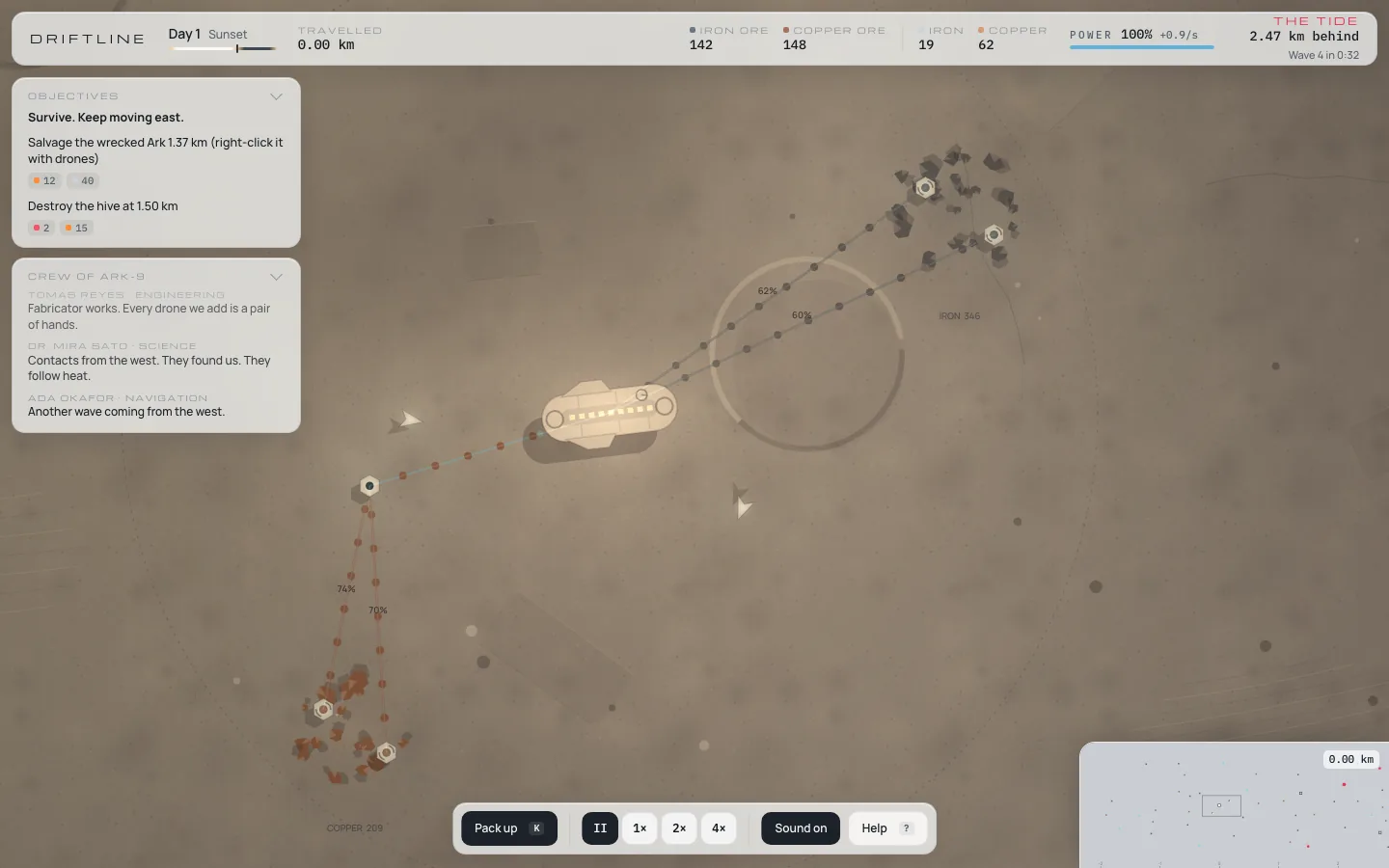 (open full size)
The first mining lines. Published as “Mining lines, music, slower start”
v14artmechanic
A crash to open the game, and honest dots
“A small animation for the crash at the start”Kraig, 9:33 am
“It's kind of hard to tell if this repair needs ore or metal. Hovering over should show more info, or we need to make icons and colors more detailed”Kraig, 9:32 am, with a screenshot
“The line back from the mine should more accurately represent the number of ore coming back. There are too many dots for what I'm actually getting”Kraig, 9:35 am, with a screenshot
- The Ark falls in burning, hits with a shake and a dust ring, and leaves a long gouge in the ground.
- Each dot on a line is one unit of ore at the real mining rate.
- Every cost names what it is ("60 iron"), with its own icon shape.
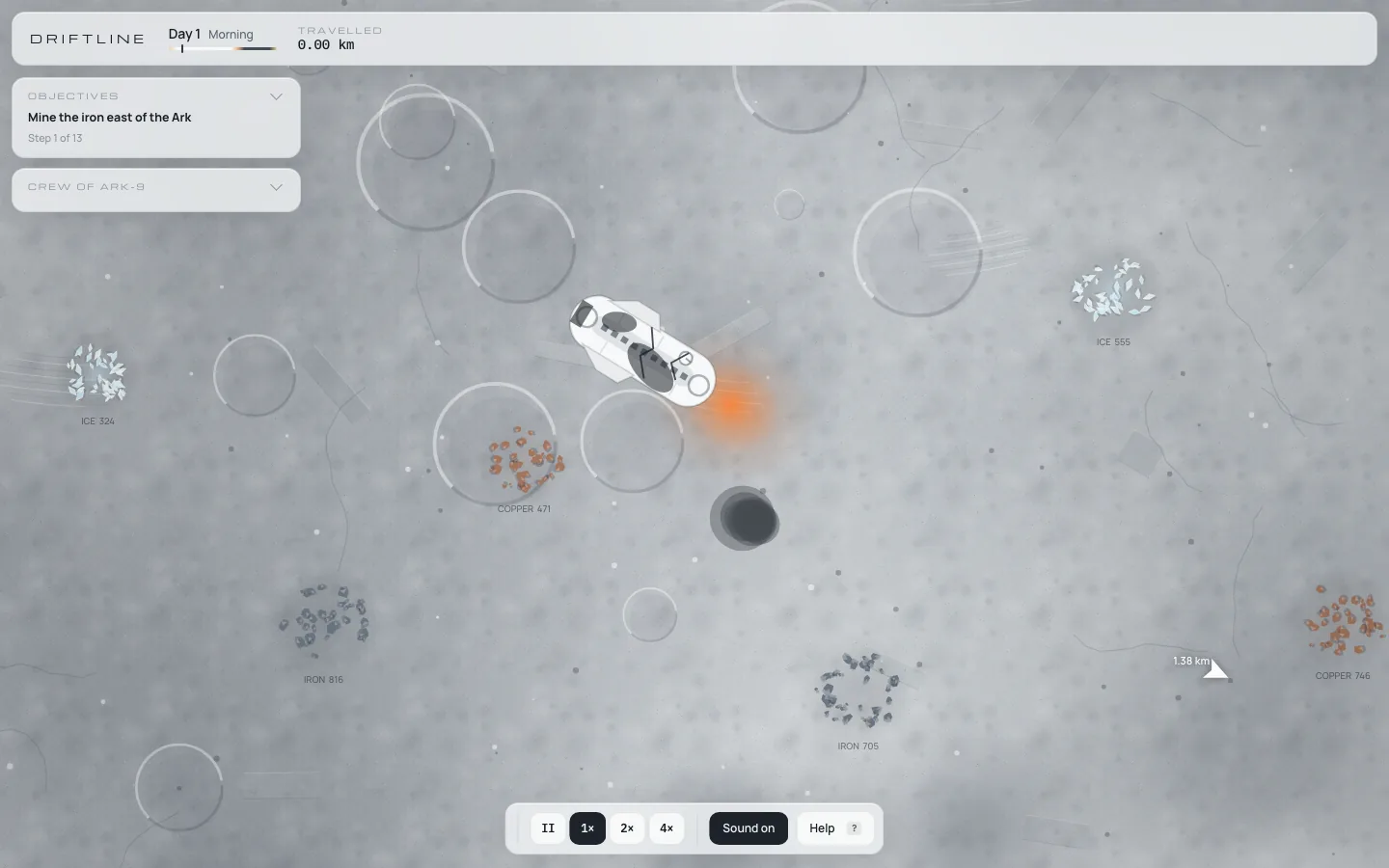 (open full size)
The crash intro, rebuilt from version 14's code for this page. 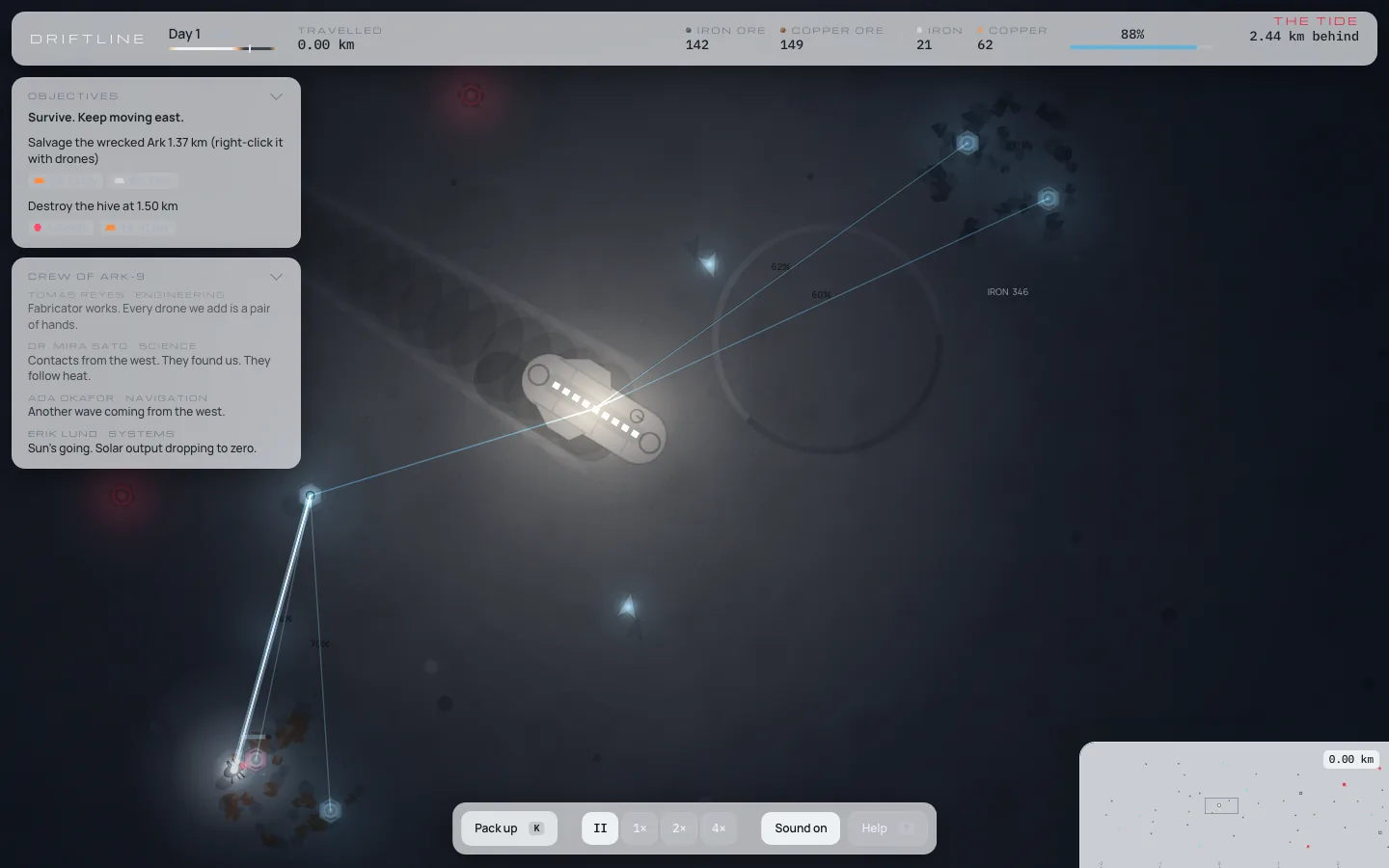 (open full size)
Honest dots: one dot, one ore. Published as “Crash intro, honest ore dots”
v15artsound
Power turns yellow, the music turns to drone
“I like the power percentage. Maybe make it yellow, to indicate power easier. The music is good, but maybe more drone and synth ambient than bells”Kraig, 9:37 am
“The iron metal icon looks great”Kraig, 9:37 am
- Power is yellow everywhere: the top bar, the beams, battery cells and power meters. Low power turns orange-red.
- The music became a continuous low synth drone that glides to each chord, with a cold shimmer on top and rare, quiet bells.
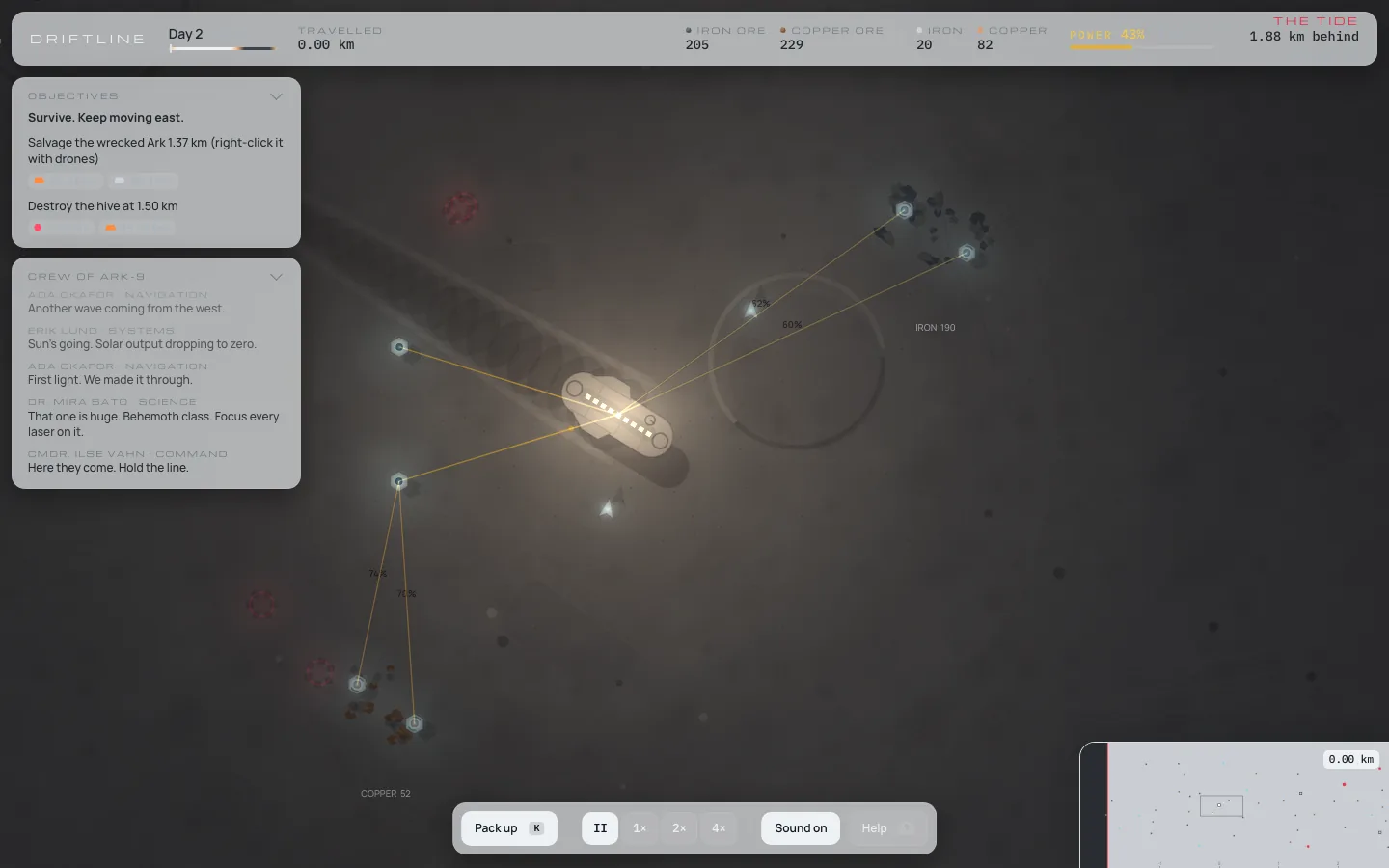 (open full size)
Yellow power. Published as “Yellow power, drone music”
v16designmechanic
Buildings become Ark modules
“We should use ore to repair the smelter Ark attachment. I'm not sure I want drones to become modules yet. Modules like constructor and smelter should be modules that animate out of the Ark, and need to animate in if we move eventually”Kraig, 9:39 am
“Love the animation and marks in the ground where it lands”Kraig, 9:40 am
“The Ark shouldn't smelt until it has a smelter.”Kraig, 9:41 am
“We should be mining iron ore from the ground, not actual iron”Kraig, 9:41 am
- Kraig reversed his own call from version 7: drones stay drones.
- Buildings unfold out of the Ark on truss arms and fold back in before it moves.
- The smelter starts jammed and is repaired with raw ore, the only thing you have.
- Deposits read IRON ORE and COPPER ORE; nothing becomes metal without a smelter.
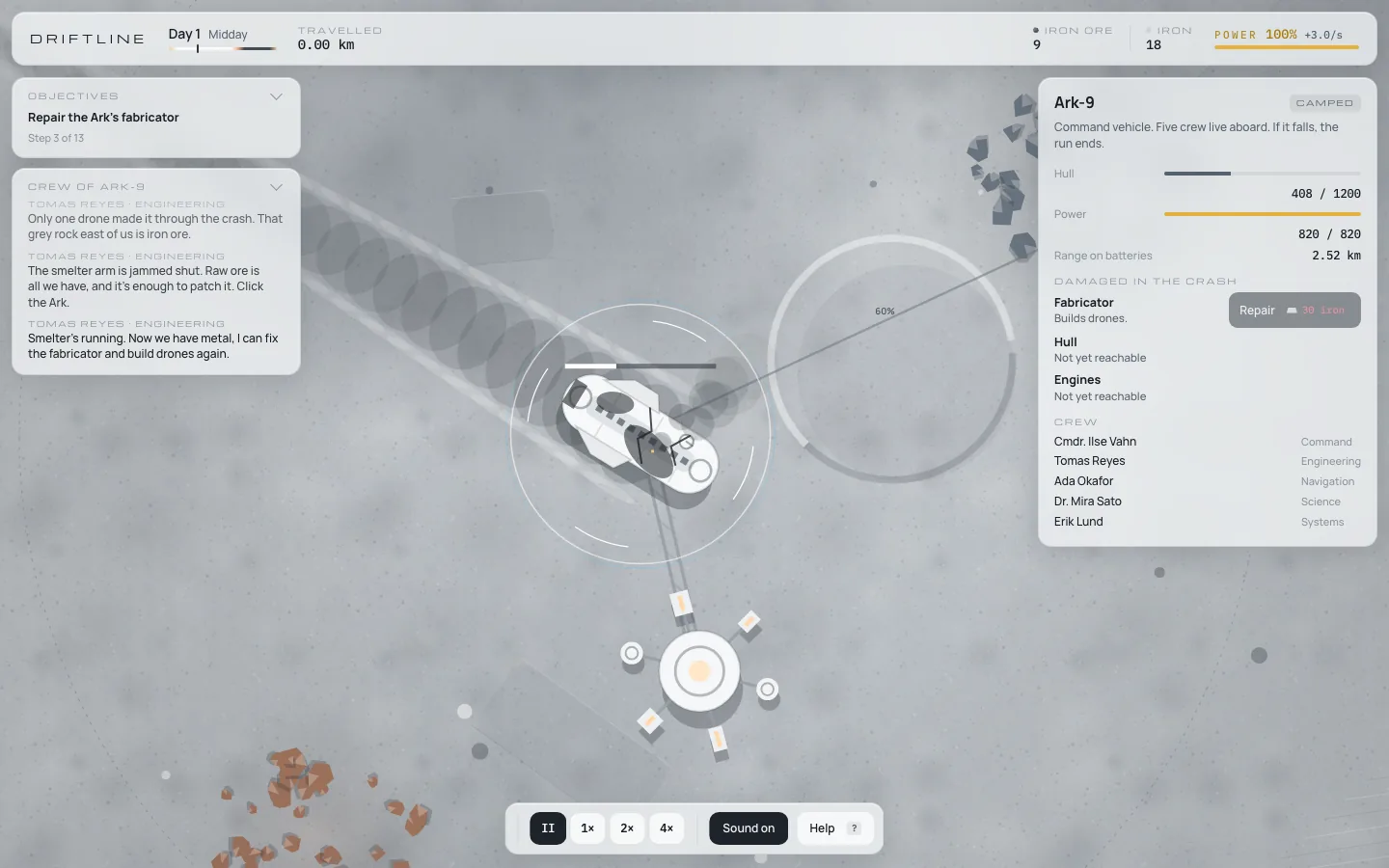 (open full size)
The smelter on its arm. Published as “Ark modules, smelter repair with ore”
v17tutorialbalance
A slow, counted opening
“We're trying to teach the player how to play, what they see and what they can do, so that it builds over time... As we repair the Ark it should enable us to do those different mini objectives.”Kraig, 9:44 am
“The objectives should be a little harder. So instead of just mining ore, it should be like mine 10 ore... so that the player can see it happening and have to wait a little bit, so that they can read and understand what's happening.”Kraig, 9:45 am
“I really want the very beginning of the game to almost be a little frustrating, very slow, and really slow down, make the player pay attention to what the next thing they need to do is, in order.”Kraig, 9:46 am
“You can start the bigger build you have planned out up there”Kraig, 9:48 am
- 16 objectives with counts and progress bars: mine 30 iron ore, repair the smelter, smelt iron, repair the fabricator, build drones, and on.
- Two new repairs make systems feel like parts of the Ark coming back online: the power cells (only a third of the battery works until then) and the AI core (3 drones until then).
- Slow on purpose: a perfect player reaches the AI core at about 17 minutes. The Tide waits until then.
Published as “Slow counted opening, Ark repairs”
v18mechanic
Ore counts when it arrives
“The dots coming from the miner need to be 1 to 1 correlated with the resources coming in. Once the dot reaches the Ark, it is added to storage”Kraig, 9:49 am
- Each unit mined travels the line as a dot and is added to storage only when it reaches the Ark.
Published as “Ore counts on arrival”
Smelters, glass and life support
Oct 14, 9:58 am to 10:10 am · v19–v23
Ore you can watch turning into metal, see-through panels, growing what you have instead of adding more, a clear end to the tutorial, and air and water for the crew.
v19mechanicart
Smelting you can watch
“So I just repaired the smelter and it's attached to the Ark. That's good. We need to show the ore going to the smelter. And the iron coming out. And it's also making the iron way too quick and easy. So we need a ratio of maybe two ore to one iron. And there needs to be an animation of it making it. And it should also be harder and slower.”Kraig, 9:55 am
- Two ore dots travel out along the arm, the smelter glows white-hot while a ring fills, and one ingot travels back.
- 2 ore make 1 metal, about 4 seconds a bar at first.
Published as “Visible smelting, 2 ore to 1 bar”
v20uiart
See-through glass
“All windows should be more transparent instead of just white or black”Kraig, 9:59 am
- Every panel is see-through glass with a stronger blur, light by day and dark at night, with a faint halo behind text.
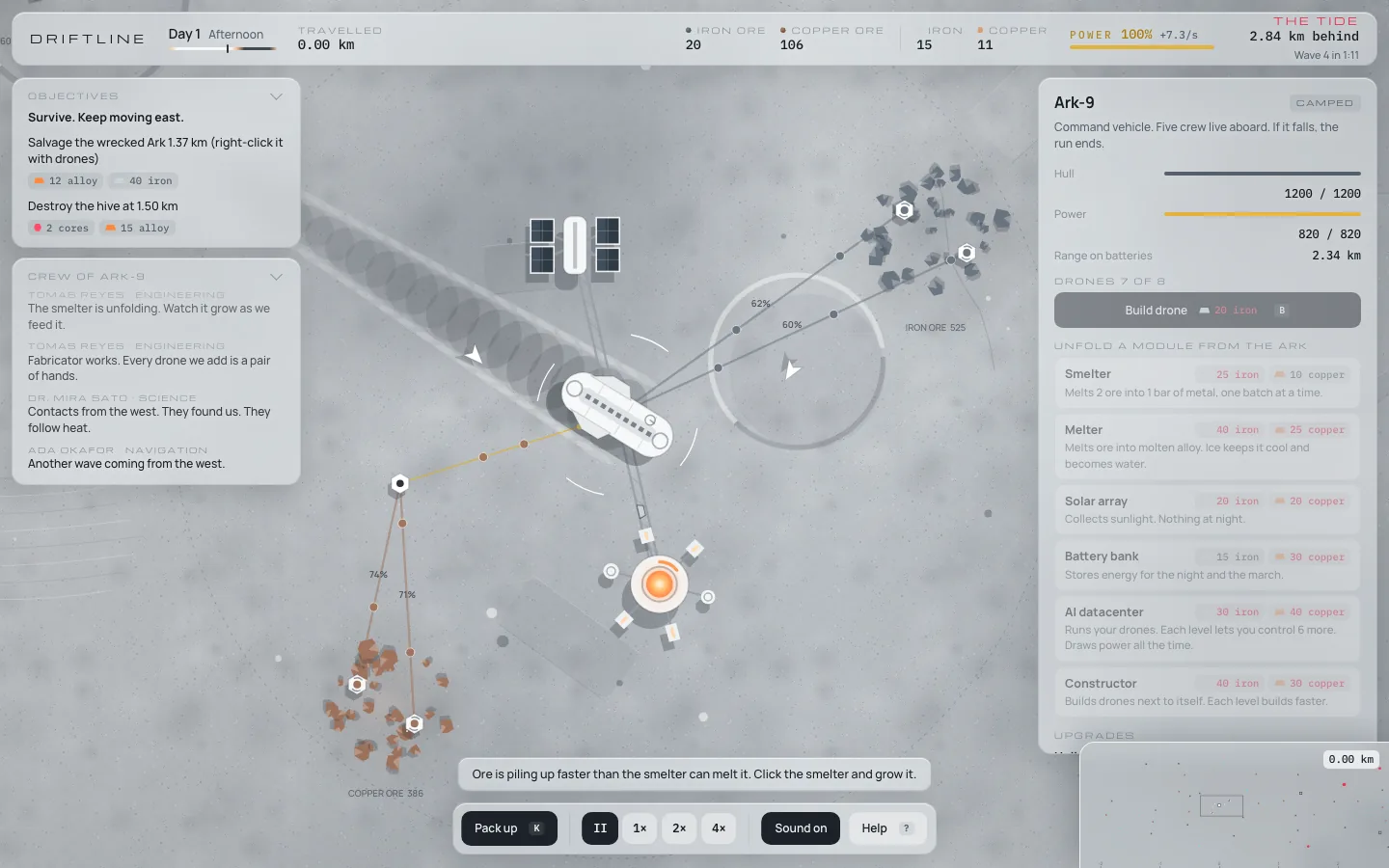 (open full size)
Glass by day. 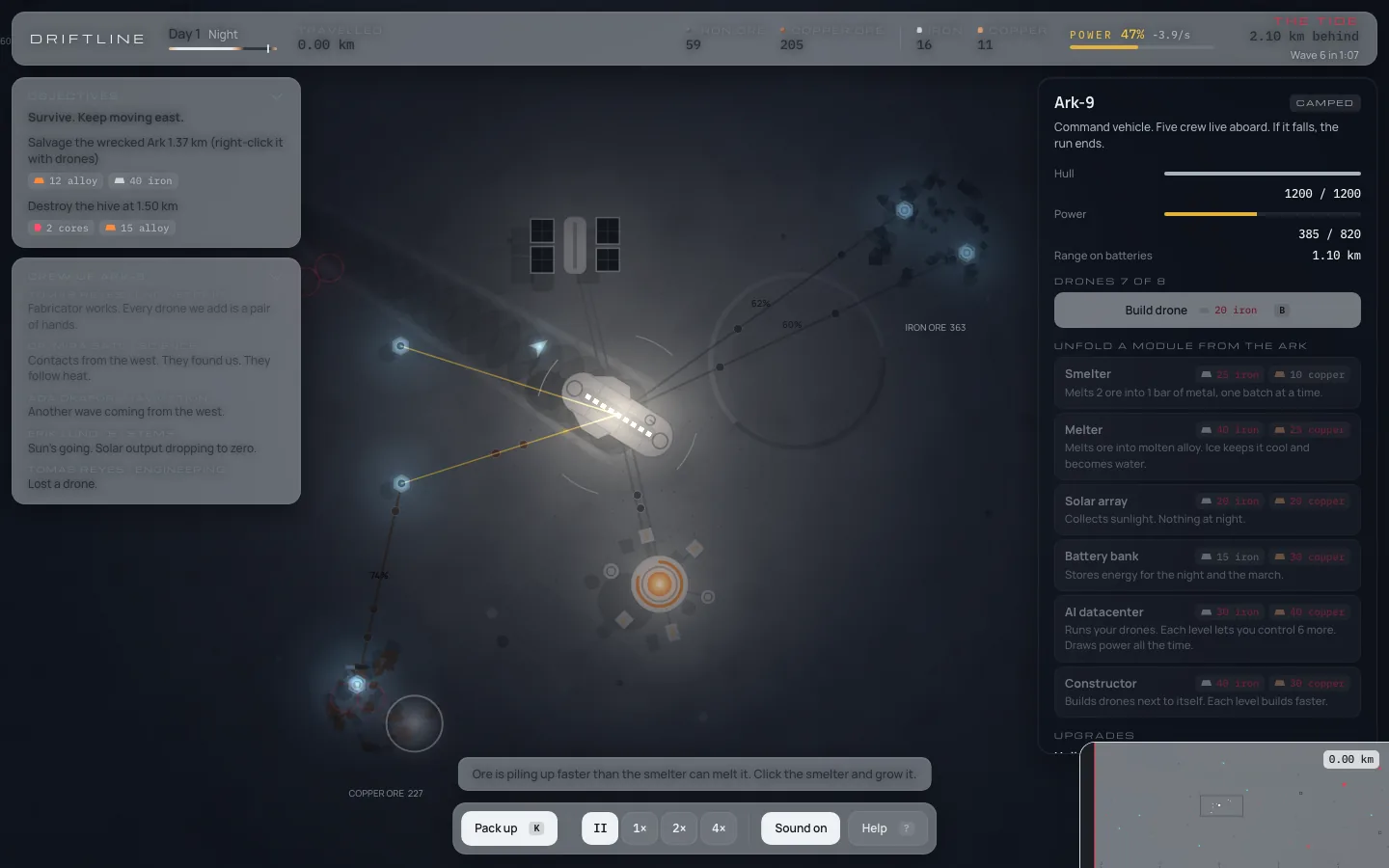 (open full size)
Glass at night. Published as “See-through glass panels”
v21designmechanic
Grow what you have
“Smelting iron versus smelting copper. Should it be in the same smelter? Because now I just see the lines of copper ore going in and the copper metal coming back. I don't see the iron anymore.”Kraig, 10:01 am
“I think things get way too complicated when you have too many buildings and too many items and drones to manage. So I'd rather have them have some friction of, I wish these were quicker... And you can spend resources to increase the abilities of the drones and the smelter... I think it's fine if we just have two different smelters, one for iron and one for copper.”Kraig, 10:03 am
- An iron smelter and a copper smelter, each melting only its own ore, so you always see both.
- One of each module. Once you have it, the button says Grow instead of Unfold.
Published as “Iron and copper smelters, grow modules”
v22tutorialstory
The tutorial gets an ending
“At the beginning it's a simplified version and we're kind of just trying to repair everything... It's like safety bumpers for the player at the start, and then at some point the playable tutorial kind of ends and then they're more free to move the Ark and do whatever they want.”Kraig, 10:05 am
- The guided start ends with your first move: pack up, drive 500 m east and make camp.
- A title card, THE ARK IS WHOLE, each crew member says a line, and everything unlocks.
Published as “Tutorial ending”
v23mechanic
Air and water for the crew
“Eventually I want to involve the people in the ship, and they'll need food, which we will grow with greenhouses, which need power and water... and also water for the colonists and also oxygen, which we will create with water and electricity.”Kraig, 10:05 am
“Yes. I'm still play testing the beginning of the game”Kraig, 10:08 am
- After the tutorial an AIR gauge appears: five people breathe and drink.
- A water still melts ice; an oxygen plant splits water with power.
- Food and greenhouses are saved for a later chapter.
Published as “Life support: air and water”
The power saga
Oct 14, 10:11 am to 10:51 am · v24–v33
Ten versions in forty minutes to answer one question: how should power feel? It ended as one number in the corner and a base that visibly slows down when the battery runs low.
v24ui
Show that the ship has a battery
“There should be a battery indicator... We should show that the ship has a battery. I don't think that's easily indicated.”Kraig, 10:10 am, with a screenshot
- A battery readout in the top bar: charge, stored power, a hatched part for capacity lost in the crash, power in and out, and time until full or empty.
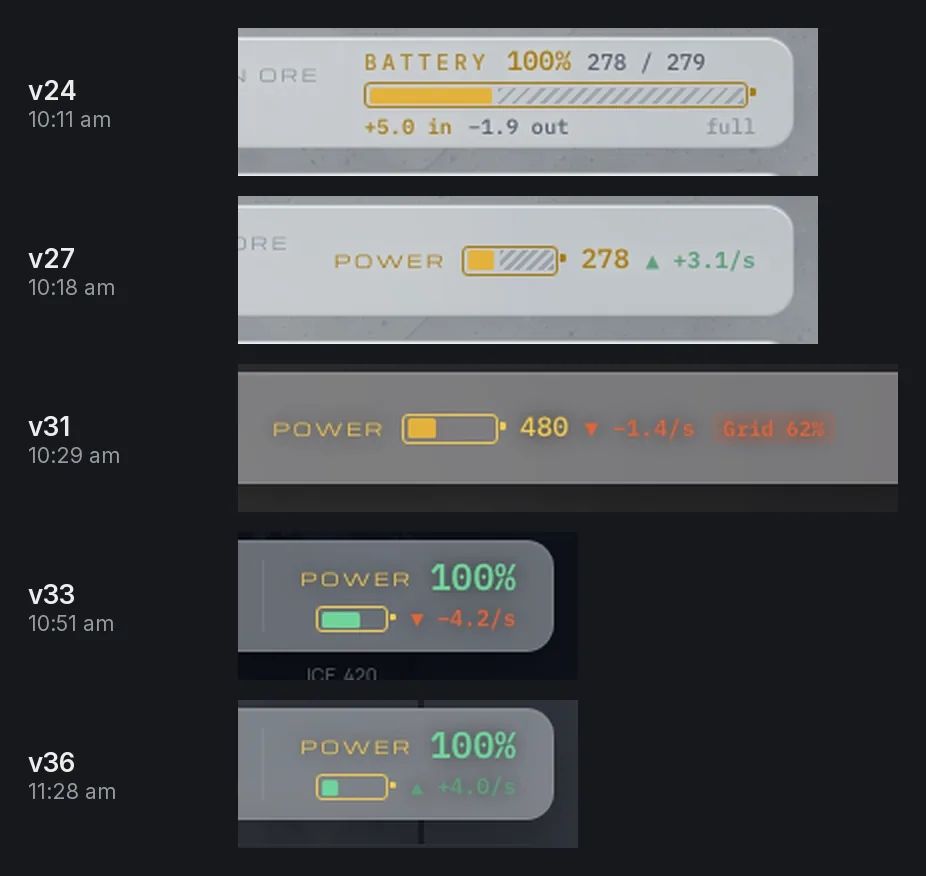 (open full size)
The power readout, version by version, over one morning. Published as “Battery readout”
v25mechanicbalance
Power affects everything
“I want the global power efficiency and battery mechanics to affect everything connected to the Ark. So if the battery is draining, the efficiency of the miners would go down... It also adds friction to expanding production or mining or drones or data centers, because you need to maintain power or else it's not going to be able to do what you want it to do well.”Kraig, 10:12 am
- A grid level slows mining, smelting, building, repairs and lasers when the battery runs low.
Published as “Grid level”
v26uimechanic
Less on screen, and nothing lost on the line
“This minimap needs to be smaller or circular or not overlap the names of the people. And also, we don't really need to see the names of the people yet. So let's just limit what you can see.”Kraig, 10:13 am, with a screenshot
“I'm curious how you made the seventy-five percent of the miner heading back to the Ark. Is seventy-five percent like one out of four doesn't make it? Because I don't like that. Like a negative productivity hazard. I would rather the power just affects the speed at which materials move, and the miner mines.”Kraig, 10:15 am
- Nothing is lost on a mining line any more. Long lines are slower instead.
- The minimap became a small round radar; the crew list and future repairs are hidden until needed.
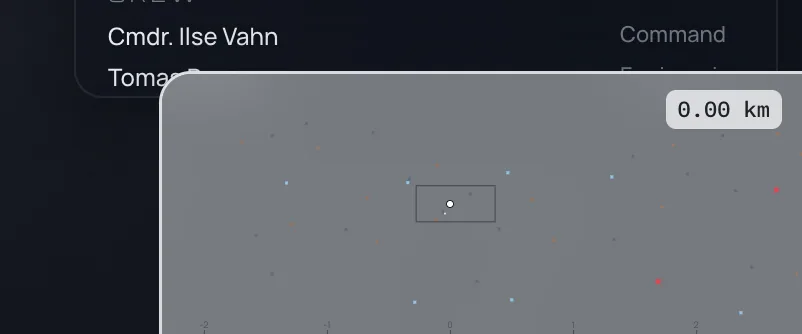 (open full size)
Kraig's screenshot of the problem: the minimap covering the crew list. 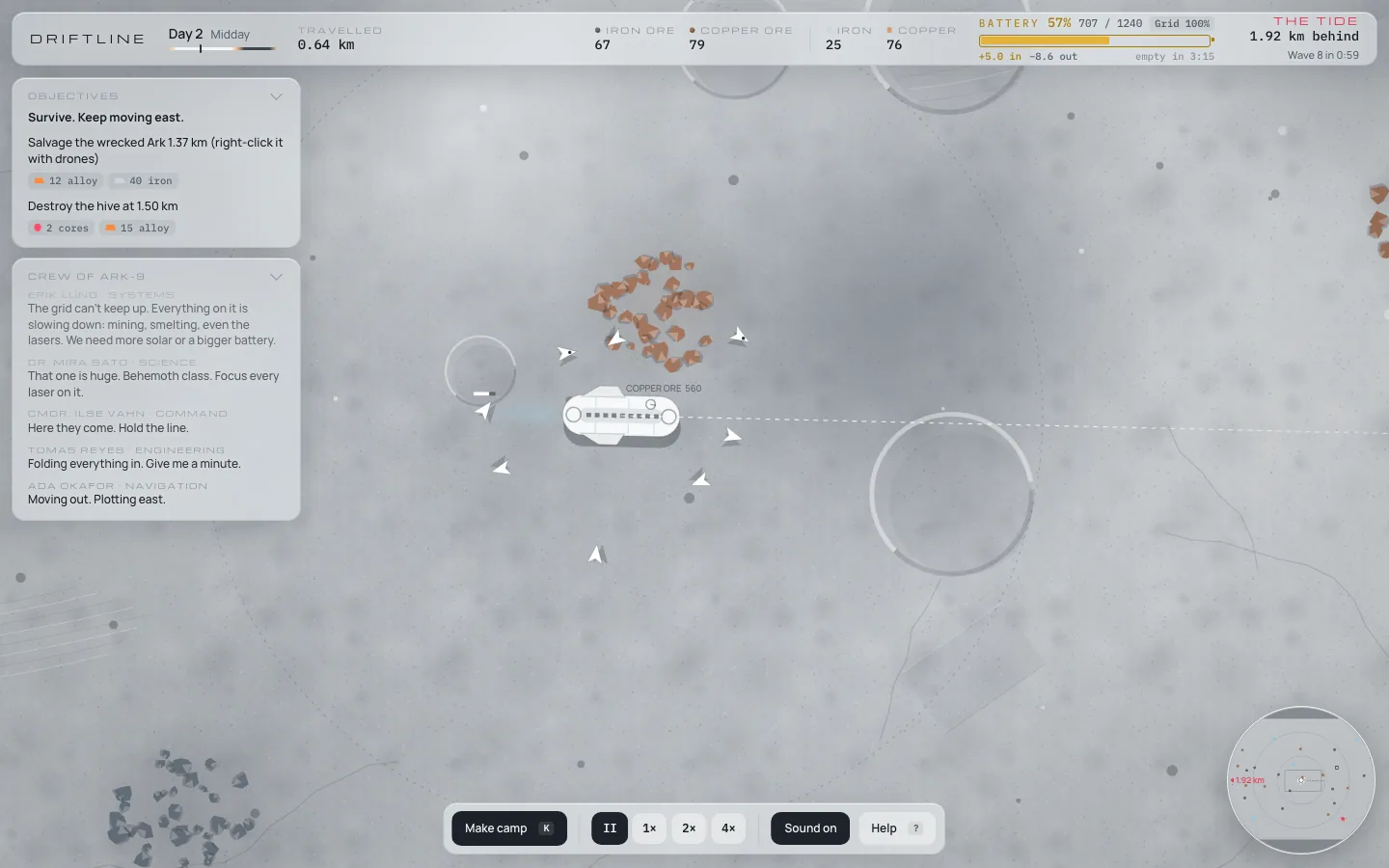 (open full size)
The round radar that replaced it. Published as “Round radar, no line loss, leaner panels”
v27ui
Power from the first minute, simpler
“I like the minimalist changes at the start, but I still feel like we need to see the power. I think the power indicator and batteries could be a little simpler.”Kraig, 10:17 am
- One row: POWER, a small battery icon, the stored amount and a green or orange arrow for charging or draining.
Published as “Simple power readout from the start”
v28balance
The grid follows the battery
“So there needs to be some punishment for the batteries being depleted. And I think it shouldn't just be on and off efficiency. A draining battery should slightly lower the efficiency of the entire power grid... If the battery is at ninety percent, it operates much better.”Kraig, 10:22 am
- Grid speed eases down with the battery: about 96% at 90% charge, 76% at half, 57% at a fifth.
Published as “Grid follows the battery”
v29controls
1, 2, 3 for speed
“I like that spacebar pauses the game and starts it again, but I want one, two, and three to be different speeds.”Kraig, 10:23 am
- 1, 2 and 3 set normal, double and fast speed. Drone jobs went back to letters.
Published as “1 2 3 speed keys”
v30balance
Too hard: full speed while charging
“I think we went a little too hard on the power penalty. I think if the batteries are charged and charging, we should have 100% efficiency... And it should be a big penalty if the battery is draining a lot... slower and slower and slower towards the very end, and then ultimately stop once the battery reaches zero.”Kraig, 10:26 am
- Charging or steady means 100%. Only a draining battery slows the base, more the harder it drains, until everything stops at zero.
Published as “Grid: full while charging”
v31uiart
Icons instead of words
“It just needs to be designed a little better. Maybe we should get rid of the word and just have a larger indication of what it is. Maybe you hover over it and it says what it is, but on the UI it should have a larger icon next to the number.”Kraig, 10:28 am, with a screenshot
- Drawn icons beside each number: faceted rocks for ore, lit ingots for metal, a crystal, a drop, a gem. Hover for the name.
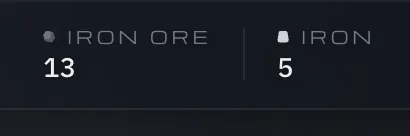 (open full size)
Kraig's screenshot: the words he wanted gone.  (open full size)
The drawn icons that replaced them. Published as “Material icons”
v32ui
The grid percentage on the Ark
“Maybe the Ark should have a percentage on it, so it's easier to understand that the power grid is at seventy-six percent and not a hundred.”Kraig, 10:30 am
- A small battery glyph and the grid percentage sat under the Ark. It lasted one version.
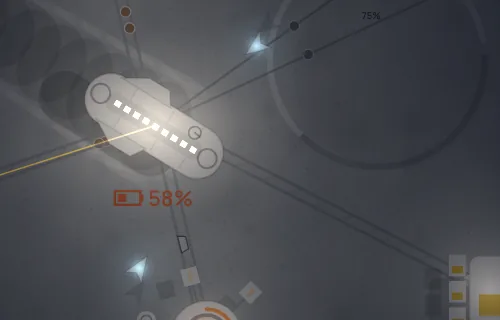 (open full size)
The badge under the Ark. Published as “v32 grid % on the Ark”
v33uibalancemechanic
One number, and a first wave you always win
“I just want it to be understood that you want to always maintain 100% power on the grid... If power is draining or low, it should be easy to see that things are not operating as well.”Kraig, 10:33 am
“I don't like the 100% battery indicator on the Ark. I just want the power to be indicated in the top right.”Kraig, 10:34 am
“I don't think longer lines for mining should cost more power... The cost for a far miner is just the time it takes for the ore to come to the Ark.”Kraig, 10:35 am
“If the battery is charged green, everything should be at 100% efficiency. The miners, the miner lines, everything, working. And just as the battery drops, that's when the efficiency changes.”Kraig, 10:40 am
“Can we make the shadows of everything move and be changed by the sunrise and the sunset, so it's a gradual change”Kraig, 10:41 am
“I don't think we should have relays for mining... Maybe the first wave comes, but it's always killable by the Ark... just so the player gets to see the attack and defense mechanics.”Kraig, 10:42 am
“The first night raid was intense. It killed almost everything I had. Too much.”Kraig, 10:45 am
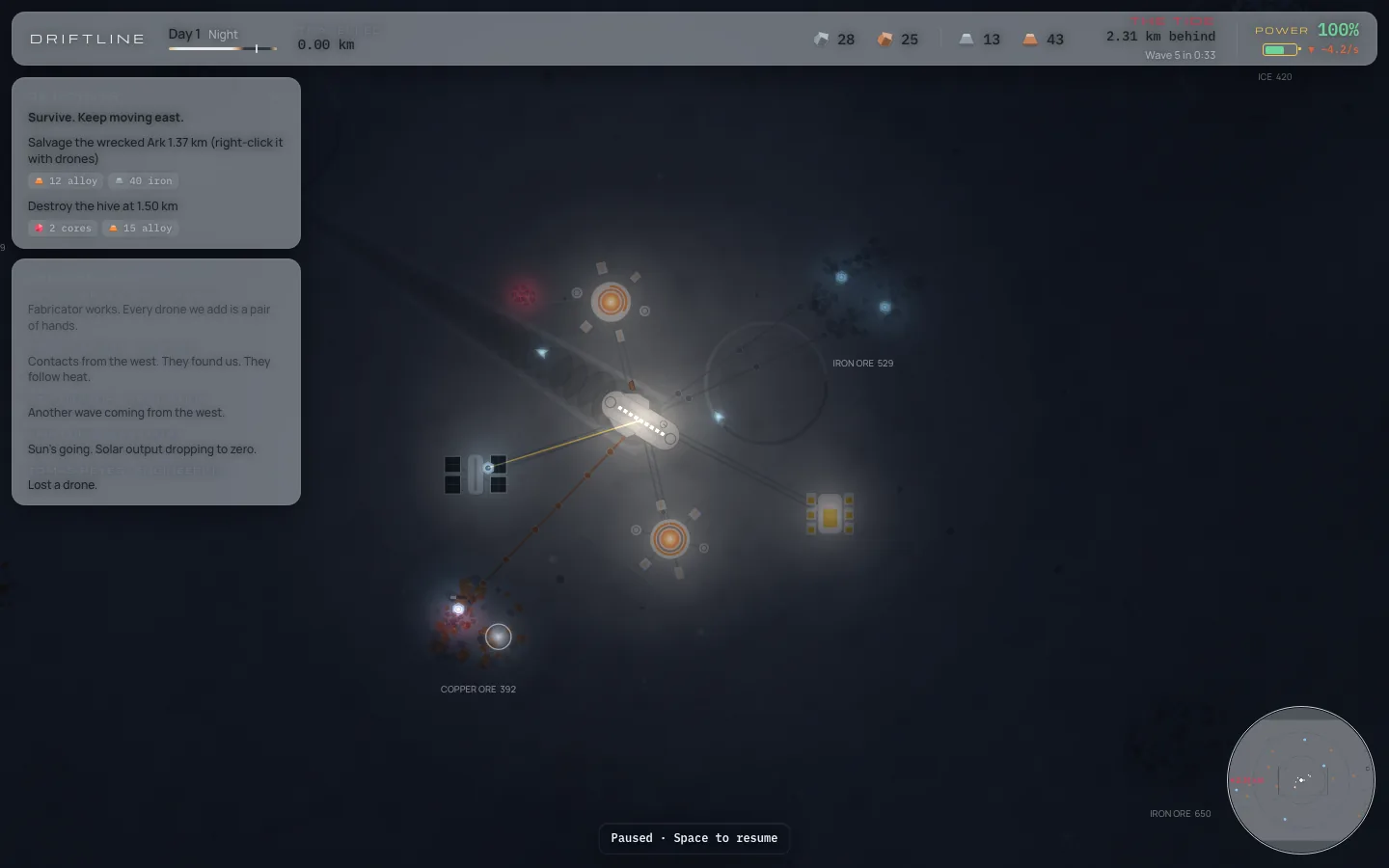
- Power is one number in the top right: green at 100%, then yellow, then red. Over half a battery, everything runs at full speed; under half 70%, under a fifth 40%, empty stops.
- Low power shows in the world: lines and lights dim and flicker, ore dots slow down.
- A far mine costs only time. Lines run straight to the Ark.
- After the AI core repair, five scouts walk in and the Ark's laser always wins.
- Night raids start small and grow one bug a night.
- Shadows follow the sun. The bottom bar is gone; ore and its metal share one colour.
 (open full size)
Version 33: one number in the corner. Published as “v33 power steps, first wave, raids”
Into the mountain
Oct 14, 10:54 am to 11:48 am · v34–v38
Kraig's biggest change: the run now starts buried inside a mountain. Drones dig, digging reveals what's hidden, power comes from a geothermal vent, and the tutorial ends when you break out to daylight.
designstory
The big idea: start inside a mountain
“So a big idea that I have is for us to move the environment of the game into a mine. And instead of on the surface of a planet, I think we should start inside a cavern that's enclosed. And the beginning tutorial happens while we're still encased in the rock. And as we dig and excavate, it reveals resources, different storylines, and then eventually opens up into the next bigger environment. And that environment could have the next mechanic. Maybe enemies.”Kraig, 10:54 am
“So the tutorial phase is before you open up and reveal yourself to the enemy... Maybe we start with geothermal and eventually we get to solar.”Kraig, 10:54 am
“Yes, get it to a point when I can play test it quick”Kraig, 11:04 am
Claude: Claude's take: starting buried gives the slow, safe tutorial a reason. Nothing knows you're there until you break out. The plan came in three stages: the buried start, then a great cavern with the first enemies, then back to the surface and the sun.
v34milestonemechanic
The buried start, bare bones
“Let's just get to the most bare bones playable version of this and then we'll iterate.”Kraig, 11:14 am
“Let's stop building past the tutorial. We don't need to do anything past the breakout right now. I just want to get the most playable version so I can start testing it and giving you instructions.”Kraig, 11:17 am
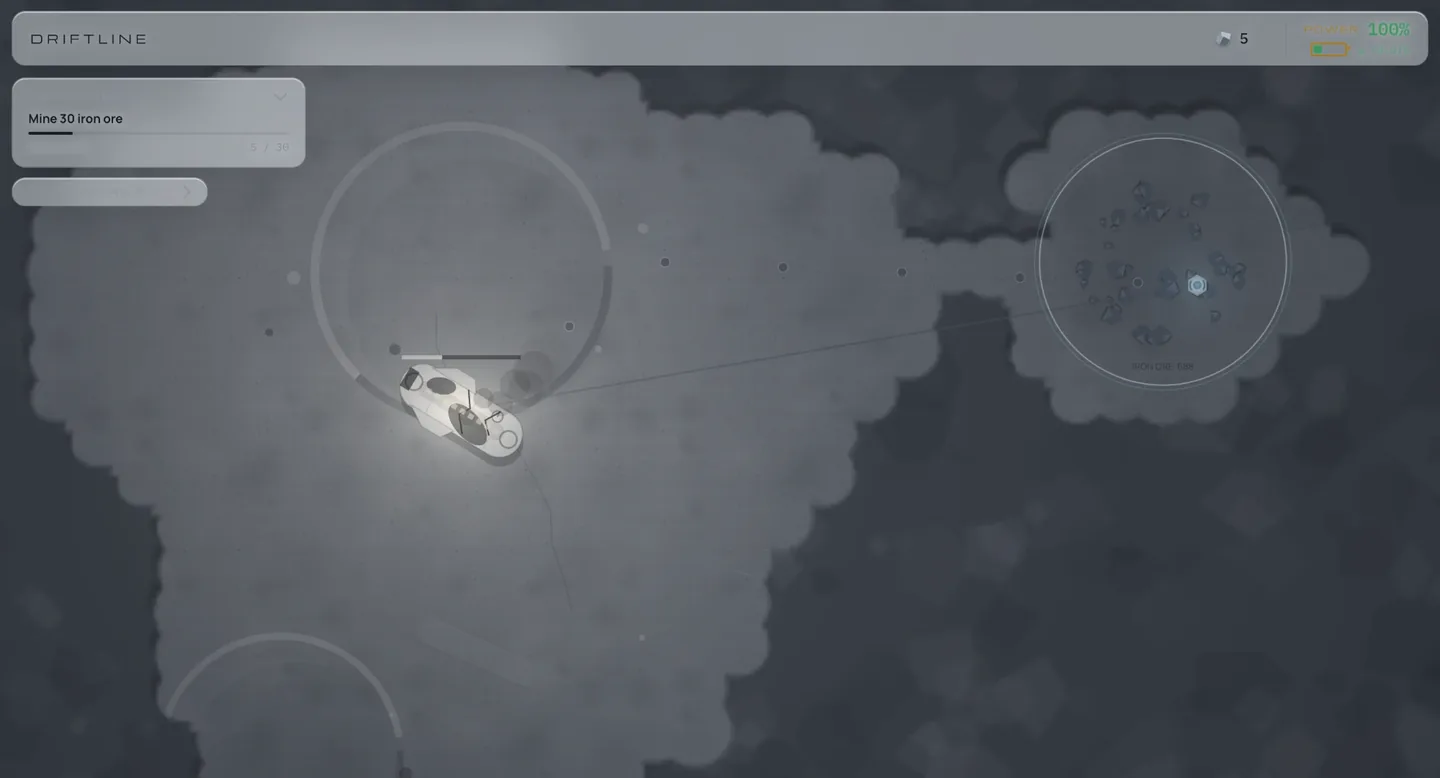
- The Ark sits in a small cave inside solid rock. Click a drone, two-finger click the rock, and it digs a tunnel there.
- Digging into a hidden pocket reveals it: iron, copper, ice, a buried wreck or an empty cave. You can't see anything still buried.
- Power is a steady geothermal tap; there's no day or night underground.
- The tutorial runs inside the rock and ends when you dig east and break through to DAYLIGHT. That wakes the Tide.
- The first bug: the carving brush had inherited a nearly transparent fill from the stone texture, so the cave wasn't carved at all.
 (open full size)
Kraig's own screenshot from his first buried run. Published as “v34 buried start, bare bones”
v35uibug
Readable in the dark
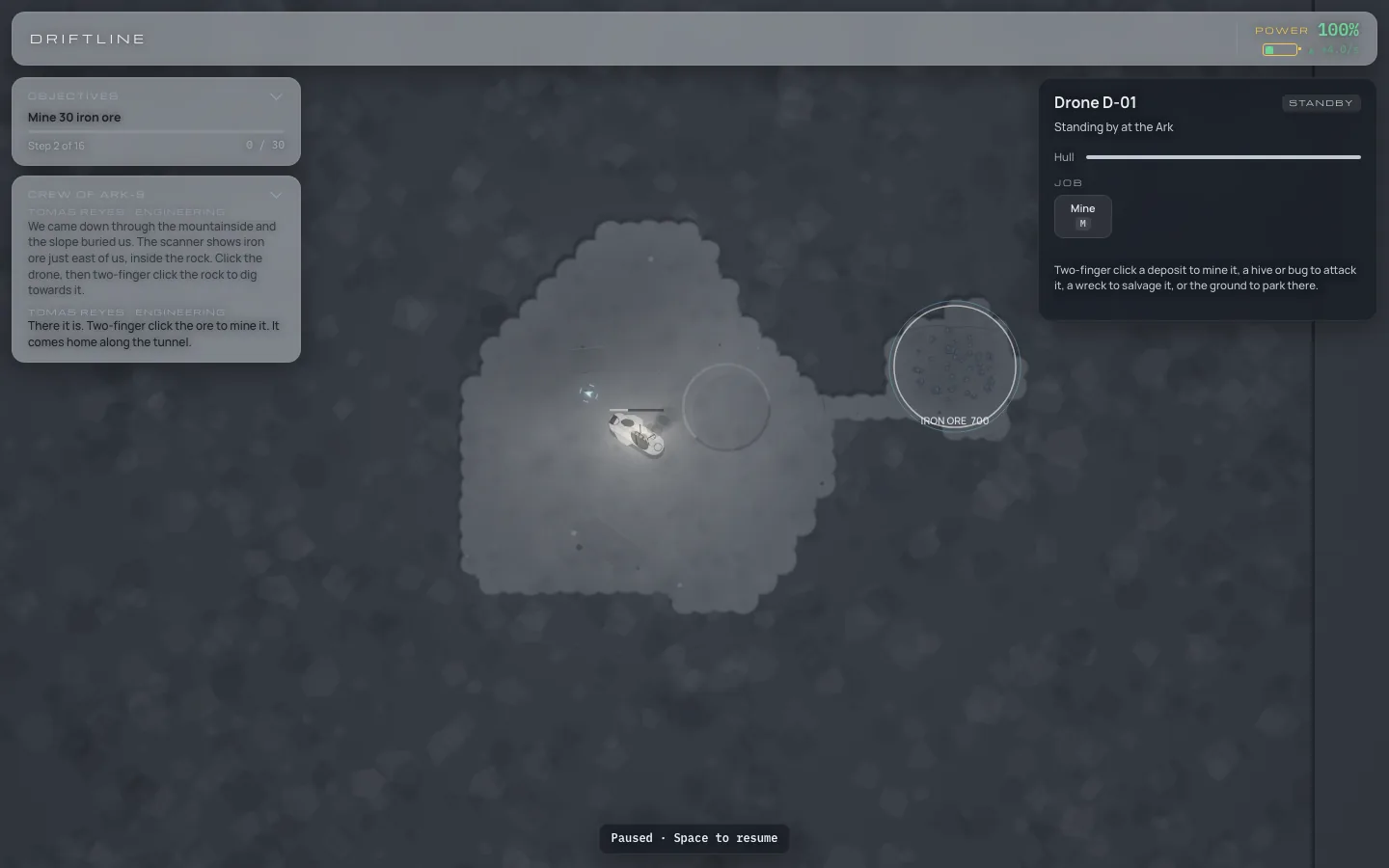
“It's hard to read the text”Kraig, 11:25 am, with a screenshot
- Underground, every panel switches to the dark style with light text, and labels in the cave are lighter and bolder.
 (open full size)
The cave after the fix. Published as “v35 readable text underground”
v36mechanicsoundbug
One line along the tunnel
“The power line and the mining delivery line should be the same. It should be more of an arc, smoother, and it should slightly update if there's a better way through, avoiding the rocks. So clearing out the rocks a little bit between the two points would help with the efficiency.”Kraig, 11:27 am
“So how do I turn on the music? For the game, I don't hear anything.”Kraig, 11:27 am
- One smooth line carries power out and ore home, following the tunnel. Digging a straighter cut shortens it at once.
- Sound: removing the bottom bar had taken away the only obvious Sound button, and an old saved setting kept it off. Sound is back on; N toggles it.
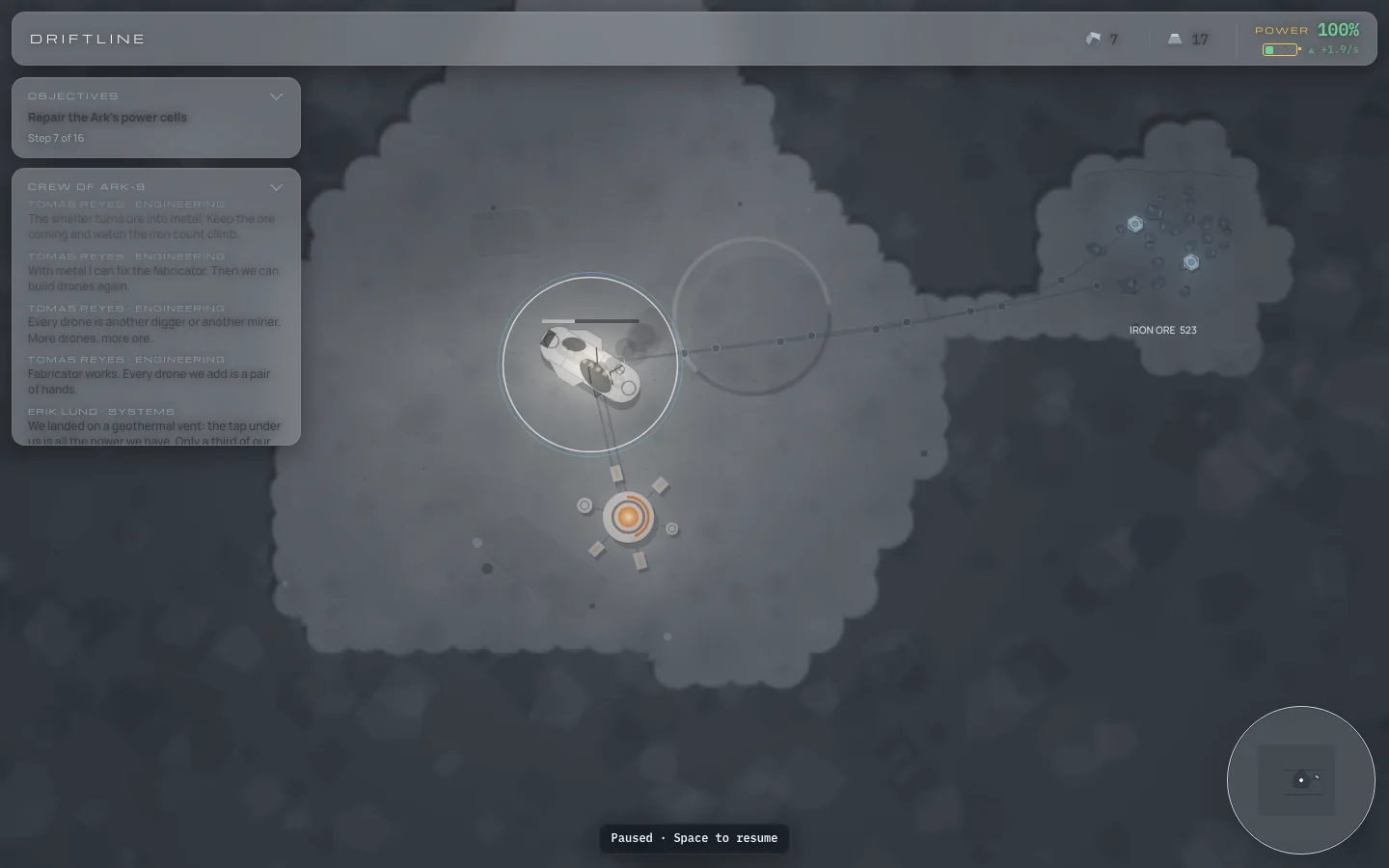 (open full size)
The line follows the tunnel; each dot is one unit of ore. 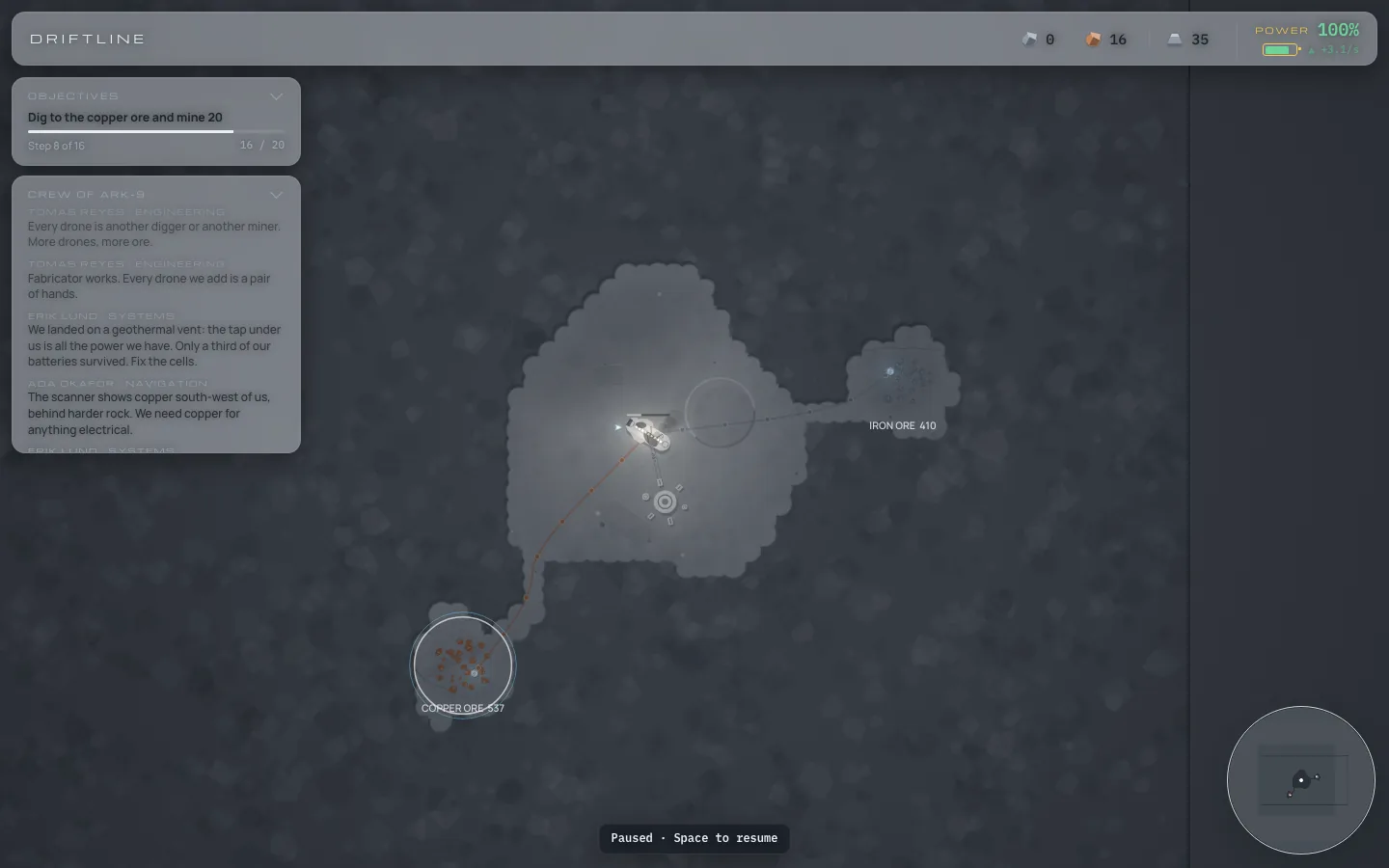 (open full size)
Fifteen minutes in: tunnels to iron and copper. 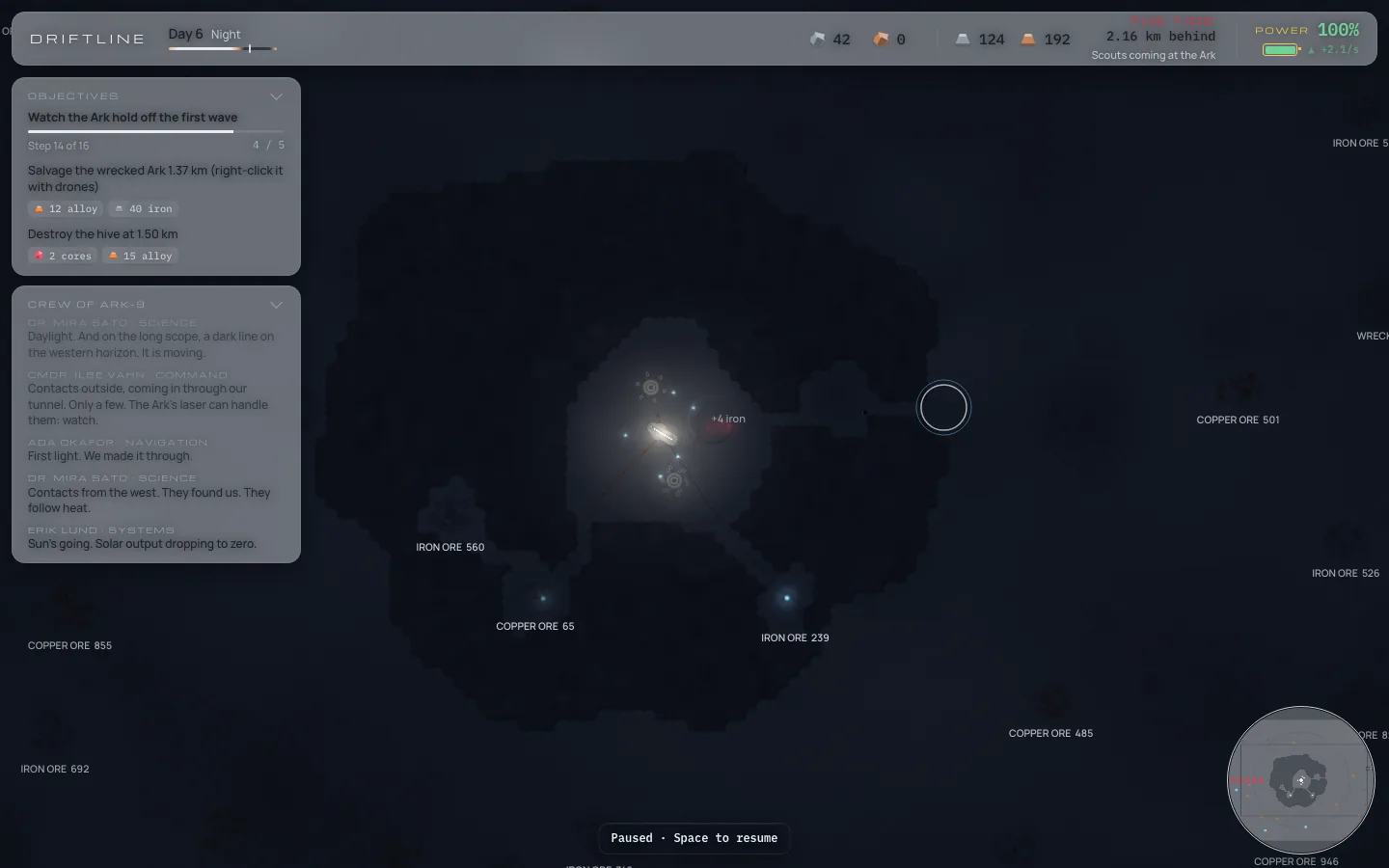 (open full size)
After the breakthrough, about 45 minutes in for a scripted player: night, and the first scouts coming. Published as “v36 one tunnel line, sound on”
v37artmechanicbug
Miners with lasers
“I like the mining and power line for the ore mining, but I think we can add a little bit of animation to the iron ore patch... As the number goes down, the visuals should indicate that the ore patch is running out. I'm not sure if the mining line and the power line should move with the miner. That might be too distracting.”Kraig, 11:34 am
“Maybe the miner is in one static spot for the ore patch, but it shoots lasers at the rocks that it's extracting. And as it shoots lasers, the rocks disappear, with the ore patch disappearing.”Kraig, 11:35 am
“The build queue at the top is really bad. It should be at the bottom.”Kraig, 11:36 am
- A miner fires a flickering laser at one rock at a time; the rock shrinks, chips fly, and the patch visibly runs out.
- The build queue is back at the bottom left. An earlier stylesheet edit had deleted its styles by accident.
Published as “v37 mining lasers, queue at bottom”
v38artmechanic
The miner moves to the middle
“The miner should park in the middle of the patch and fire its laser around at different sections as it's mining”Kraig, 11:39 am
- The miner parks in the middle of the patch and its laser sweeps round the rim, outer rocks first, so the patch closes in toward it.
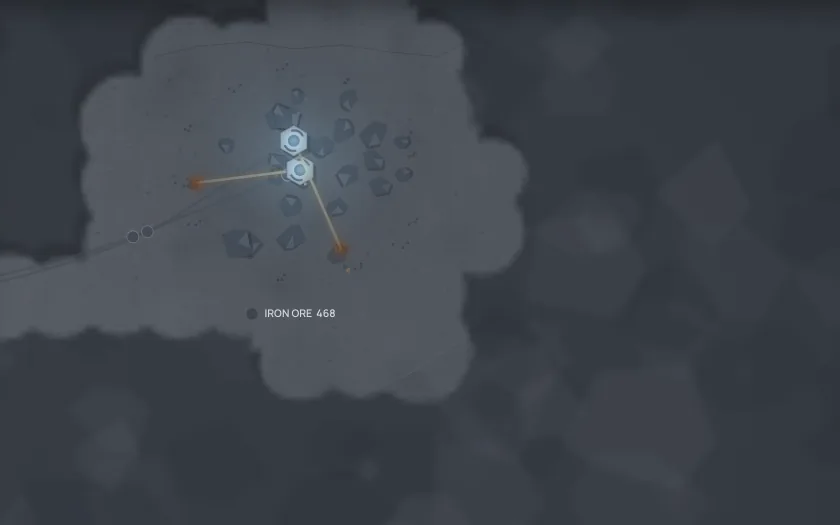 (open full size)
Two miners sharing a patch, each lasering its own rock. Published as “v38 miner mid-patch, sweeping laser”
storydesign
Open question: why is the Ark in a cave?
“So now that we're starting in a cave and it's becoming like a cave exploration game, it doesn't really make sense that this ship crash lands... How do we explain the beginning of it?”Kraig, 11:43 am
“Let's wait to do this”Kraig, 11:47 am
Claude: Claude suggested the crew "went to ground": the Ark came down hurt with the swarm on its trail, drove into a mountainside cave and brought the entrance down behind it to hide. Kraig parked the idea for now.
Staying in the caves, and a name
Oct 14, 12:00 pm to 12:22 pm · v39–v41
Kraig narrowed the game: for now it stays inside the caves, with no enemies. Moving the whole base on stays; new cavern systems will be the chapters. And Driftline no longer fit, so the game got a new name.
v39designmechanicui
The game stays in the caves
“For now, let's just keep the entire game within the cavern system and not think about breaking out yet. Let's not worry about enemies yet as well. I do still like the mechanic of picking up the entire factory and all of the drones and moving to a new area. But that'll be different eras of the game, different chapters. And there will be new options, new enemies, new mechanics once we enter different cavern systems.”Kraig, 11:53 am
“I think we should just be able to move a drone to where there is solid rock and it should just excavate around it.”Kraig, 11:52 am
“The crew of the Ark doesn't really need to be there. I feel like it's kind of storyline and also kind of FAQ tooltips. So I feel like we could fold that into the objectives somehow.”Kraig, 11:54 am
“Since they're both mining the same ore patch, there should just be one single line that all of the dots pass on... You can put an unlimited number of drone miners on a patch, but it should still be one single line going back to the Ark.”Kraig, 11:56 am
“The objectives should have the button to do the objective next to it, up in the top left, with the cost in red if it's not ready.”Kraig, 11:56 am
“There should be the three colors for the overall power grid, green, yellow, and red. And the miner lines and connectors between buildings should represent that color.”Kraig, 11:58 am
- The mountain's outer rim is bedrock: you can't dig out, and there are no enemies for now.
- The tutorial ends by repairing the engines, packing up and moving the Ark into another cave. A perfect player finishes it in about 36 minutes.
- Any number of miners share a patch: the first sits in the middle, the rest ring around it, and they all feed one line home.
- Send a drone into solid rock and it tunnels there and hollows out a small room, then waits.
- Every power line shows the grid's colour: green, yellow or red.
- The crew box is gone: the current step's guidance sits under the objective, and one-click steps (Repair, Build, Unfold) have their button on the objective's row, with the cost in red when you're short.
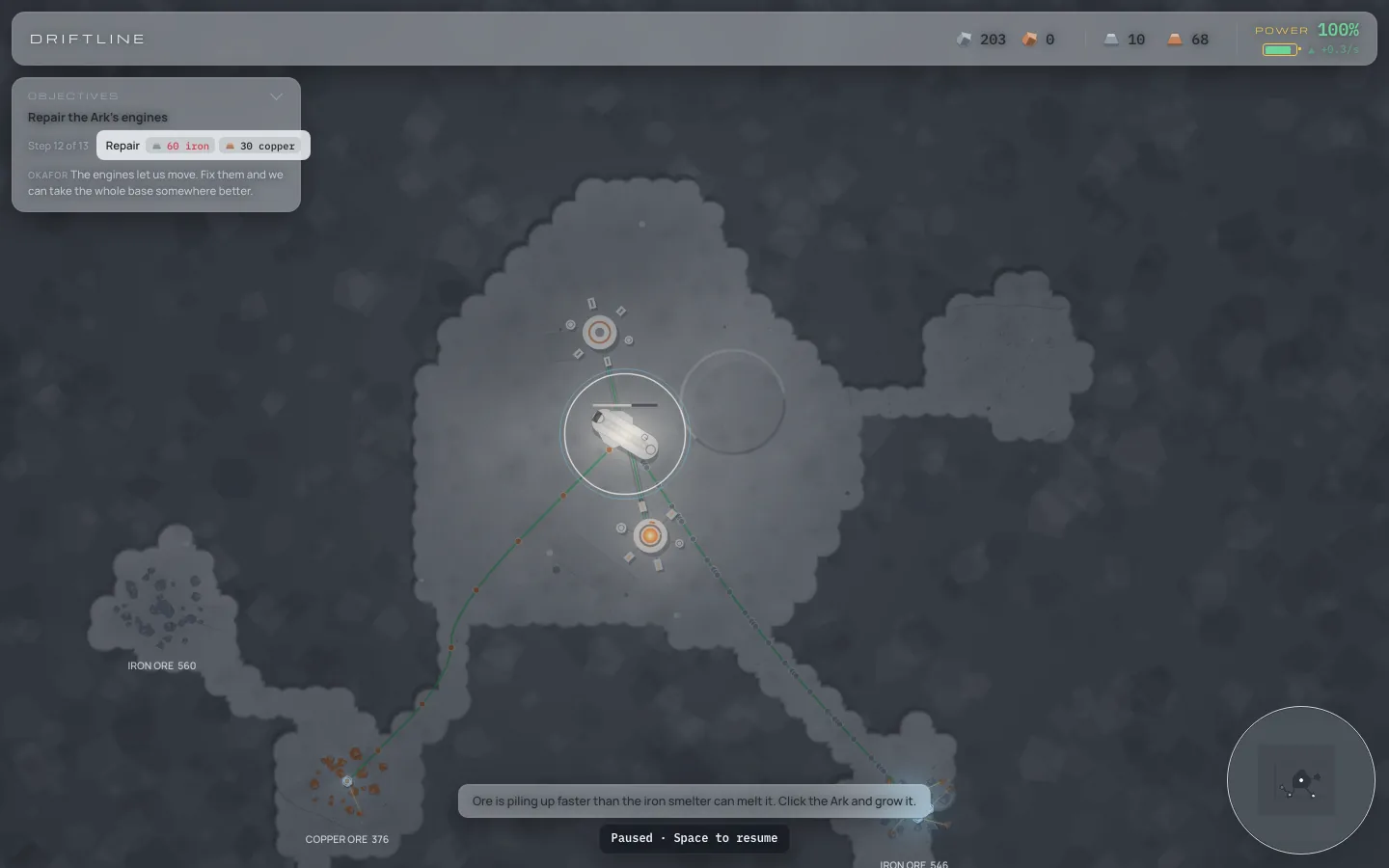 (open full size)
Version 39, about 25 minutes into a scripted run: green lines along the tunnels, and the objective's own Repair button. 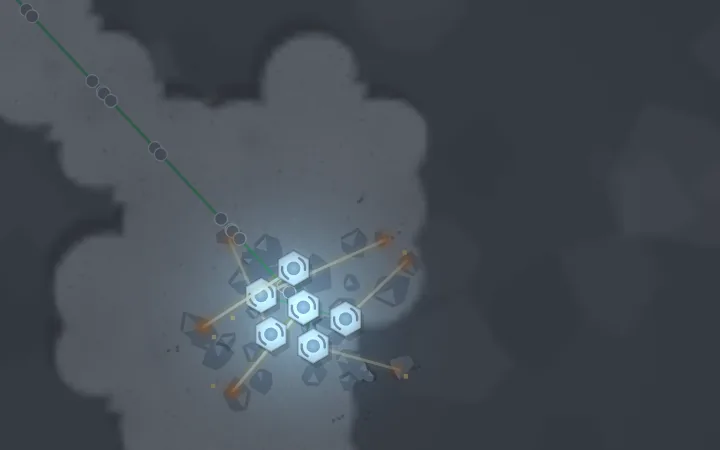 (open full size)
Six miners on one patch, one line home. Published as “v39 caves only, shared lines, objective buttons”
v40milestonedesign
A new name: Hollowark
“Also, based on everything that we've changed and you know about the game, let's redo the branding. So Driftline doesn't really make sense anymore.”Kraig, 11:52 am
“I like Hollowark. Let's go with that.”Kraig, 12:01 pm
“Also, iron ore patches should be in little caverns themselves, right? It's kind of weird for them to be in with the granite, no?”Kraig, 12:02 pm
Claude: Claude checked candidate names against existing games and offered three: Faultline (its own pick), Ark Below, and Hollowark, one invented word that's unlikely to clash with anything.
- The game was called Driftline until version 39. From version 40 it's Hollowark: the title screen, the top bar and this page's address.
- The new title line: "Five people in one damaged Ark, buried deep inside a mountain. Command the drones: dig, mine, smelt and rebuild, one cavern at a time."
- Each ore patch sits in its own small cave with open floor around it.
- Next, running as a separate job while Kraig keeps playing: natural cave walls, rock types you can see (the hard one is granite), ore glints near hidden caves, and chunks and dust as drones dig.
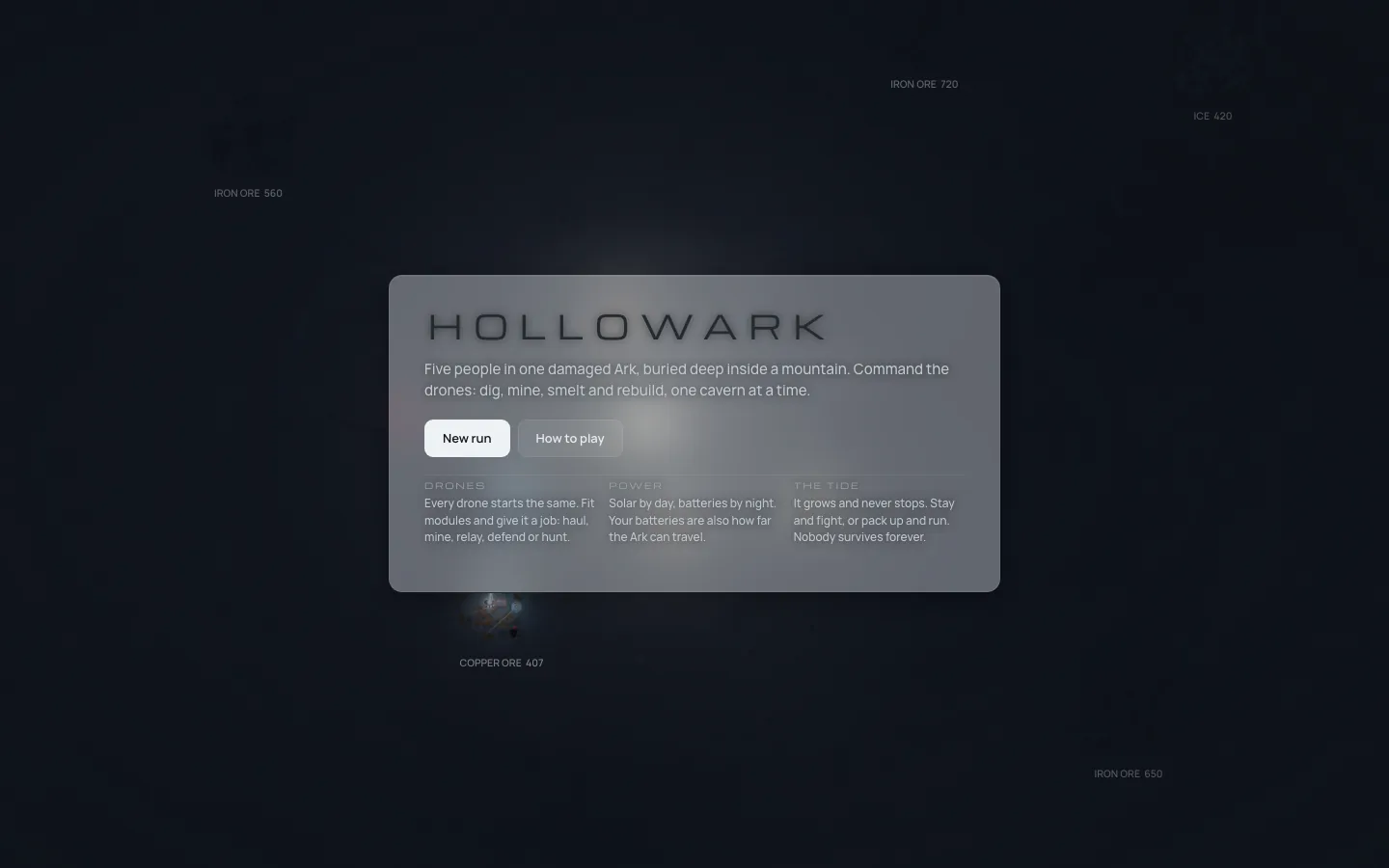 (open full size)
The title screen with the new name. Published as “v40 Hollowark, roomier ore caves”
v41artmechanic
Carved stone and rock you can read
“Next, let's improve the look of the rock of the cavern and its detail, how it's mined.”Kraig, 11:48 am
“How's the rock upgrade?”Kraig, 12:16 pm
“The rock update looks great”Kraig, 12:23 pm
Claude: Claude proposed natural cave walls instead of the scalloped circles, rock whose colour shows how hard it is to dig, glints of ore near hidden pockets, gravel on dug tunnel floors, and digging you can watch: chips and dust off the face, and an opening that widens with a burst of rubble.
- Cave walls are carved stone instead of scalloped circles: uneven edges, a lit lip along the inside of each wall and a soft shadow on the floor below it.
- Four kinds of rock you can tell apart by colour: loose rock, stone, granite (the hard one) and bedrock, which can't be dug, each with strata, facets and grain.
- Rock near a hidden ore cave glints in the ore's colour, a clue to where to dig.
- Dug tunnels have gravel along the floor, so they look different from natural caves.
- Digging throws chips and dust off the face, and each new opening widens over half a second with a burst of rubble.
- Hovering over solid rock names its kind and how long one drone takes to dig it.
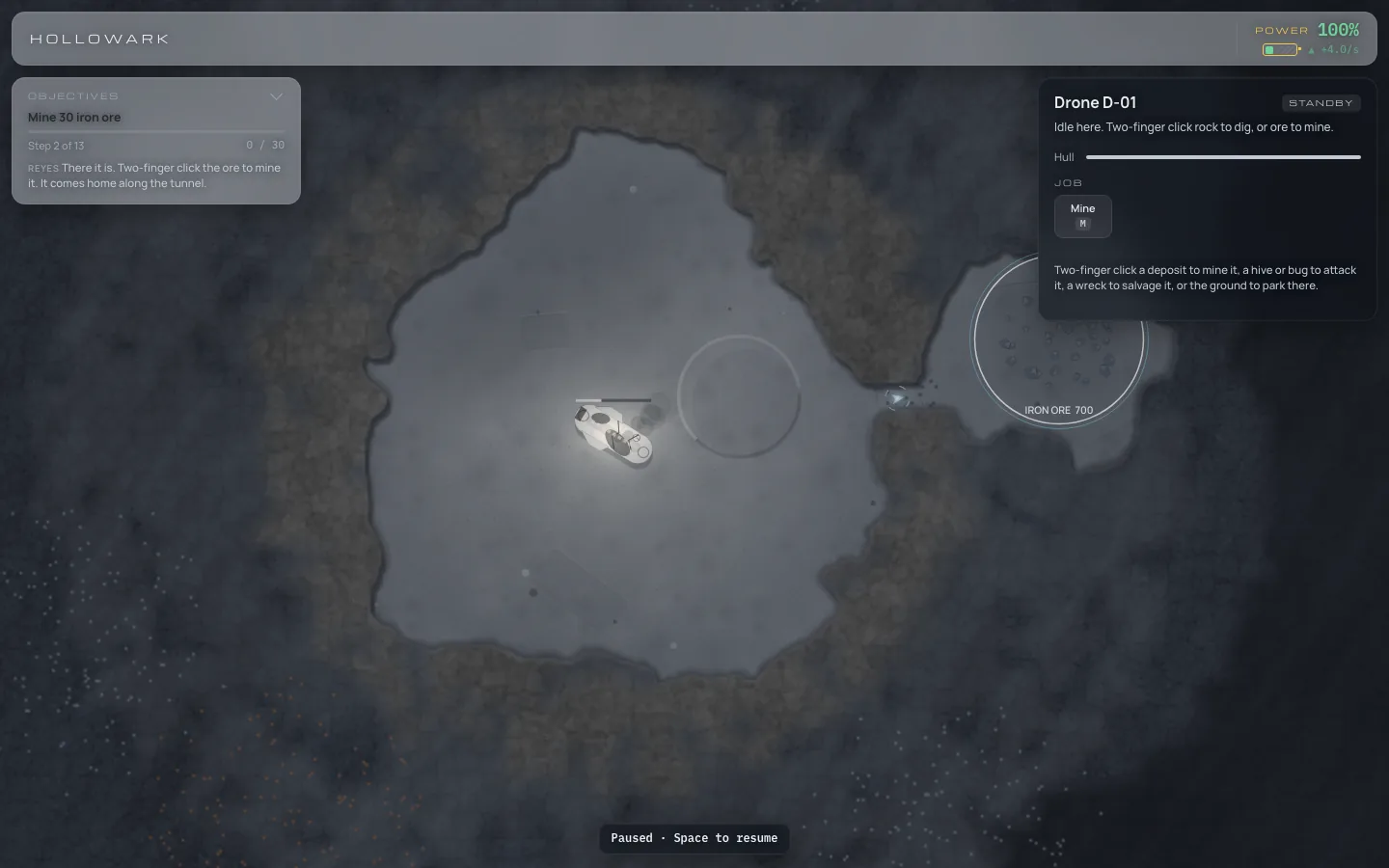 (open full size)
Version 41: the starting cave in carved stone, the first tunnel just reaching the iron. Published as “v41 carved rock, rock types, digging rubble”
Building the base
Oct 14, 12:33 pm to 1:02 pm · v42–v51
Half an hour of quick notes from play, one version every few minutes: the Fabricator becomes a module with its own look, miners line up on the ore's near edge, smelters grow out of a bare furnace, the rock sharpens, and when the Ark moves, its whole base rides along while the drones mine the way.
v42mechanicdesign
The Fabricator becomes a module
“The fabricator should be a module that opens out from the Ark like smelter.”Kraig, 12:32 pm
- Repairing the fabricator unfolds a Fabricator module from the Ark on its own arm, the way the smelter does.
- New drones are built there, and growing it makes it build faster.
- The separate Constructor module was the same idea, so it's now just the Fabricator.
Published as “v42 Fabricator module”
v43mechanic
Miners line up on the ore's near edge
“You were right about the miner setting up on the ore patch closest to the Ark and then shooting mining lasers out at the patch from there. Additional drones should set up next to the other miner.”Kraig, 12:33 pm
Claude: An earlier version parked the miner on the patch's edge facing the Ark. It had since moved to the middle of the patch, with extra miners ringed round it.
- The first miner parks on the edge of the patch nearest the Ark and lasers out across the rocks.
- Extra miners line up beside it along that edge, one on each side in turn, each lasering its own rock.
- One line home starts at that edge.
Published as “v43 miners on the near edge”
v44art
The Fabricator gets its own look
“Fabricator should look more different than smelter”Kraig, 12:36 pm
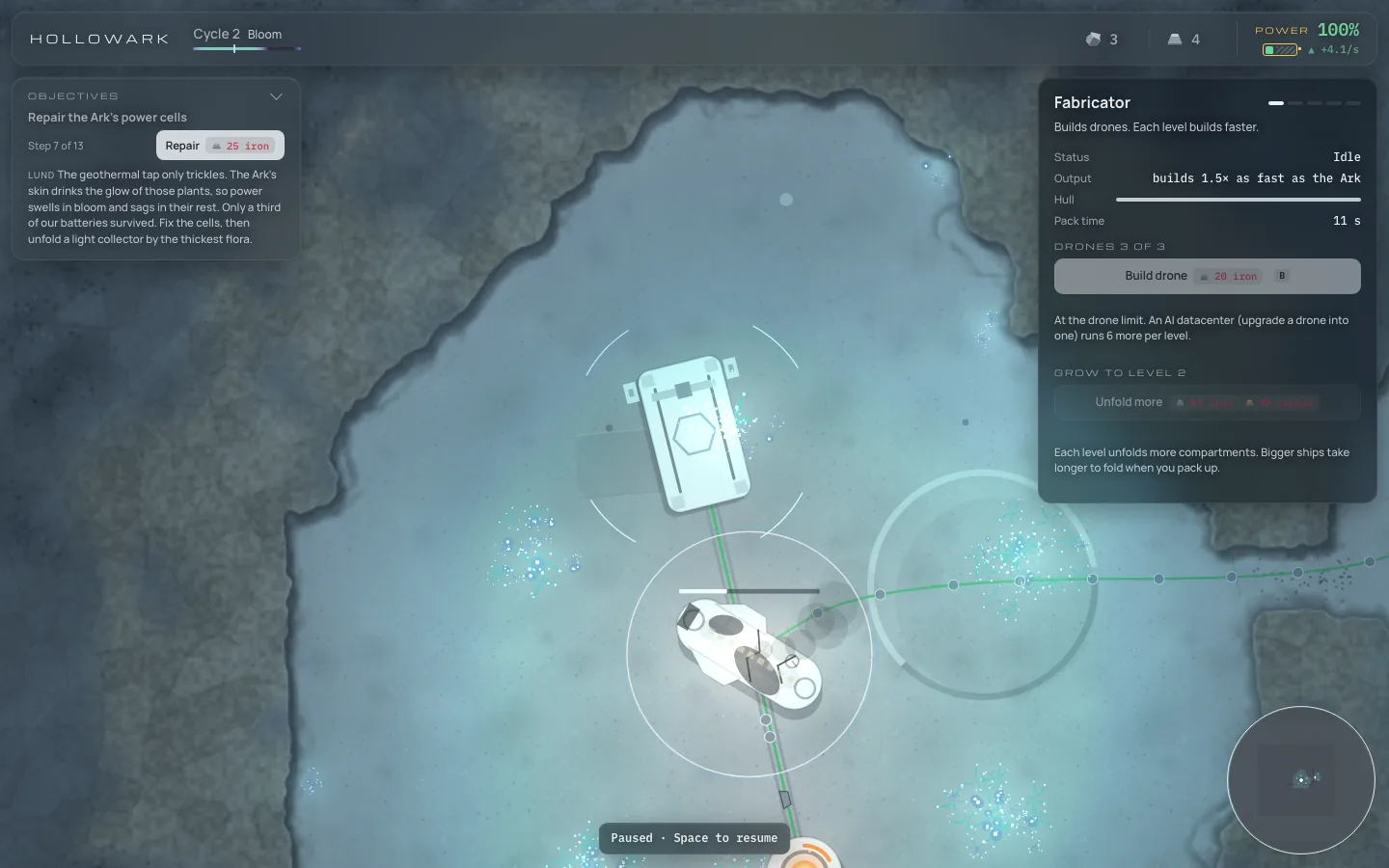
- The Fabricator is a squared assembly platform facing the Ark, with rails, corner posts and blue light. The smelter stays a round furnace with an orange glow.
- While it builds, a gantry sweeps over a hexagonal bed and the new drone takes shape in the middle.
- Each level adds a pair of lit bays along its sides.
 (open full size)
The Fabricator above the Ark, a level-1 smelter beside it. Taken in version 52. Published as “v44 Fabricator look”
v45–v46ui
The objective's button stays in its box
“Should align left”Kraig, 12:44 pm, with a screenshot
Claude: From Kraig's first screenshot, Claude saw the Repair button spilling out of the objectives box when its cost listed two materials.
- When the button and its costs don't fit beside the step count, the button drops to its own line inside the box. In a narrow box its costs stack under the label.
- On its own line it lines up on the left with the step count and the objective text.
Published as “v45-v46 objective button fits its box”
v47art
Smelters grow out of a bare furnace
“Smelter should start just a circle design and then upgrades bring out the side modules”Kraig, 12:45 pm, with a screenshot
- A level-1 smelter is a bare round furnace.
- Each level from 2 to 5 brings out three more crucibles and tanks around it.
Published as “v47 smelters start bare”
v48artmechanicbalance
Sharp rock, and lines that keep off it
“I don't like how pixelated the rock looks compared to everything else. Also the logistic line shouldn't cut through rock like this”Kraig, 12:25 pm, with a screenshot
“The animation of material going in and out should just be to look cool. It shouldn't have to wait to process and should access to all materials if you know what I mean”Kraig, 12:47 pm, with a screenshot
Claude: Claude found two causes: the rock was drawn at two metres a pixel, and the line followed the movement grid while the drawn walls could bulge past it, as at the narrow throat in Kraig's screenshot. Both fixes ran as a background job while Kraig kept playing.
- The rock is drawn at 2.5 times the detail, so grain, cracks and wall edges stay crisp up close. Only what's on screen is painted up front and the rest fills in over a few frames, so there's no stall.
- Walls can no longer pinch into a tunnel, so every tunnel has a clear middle.
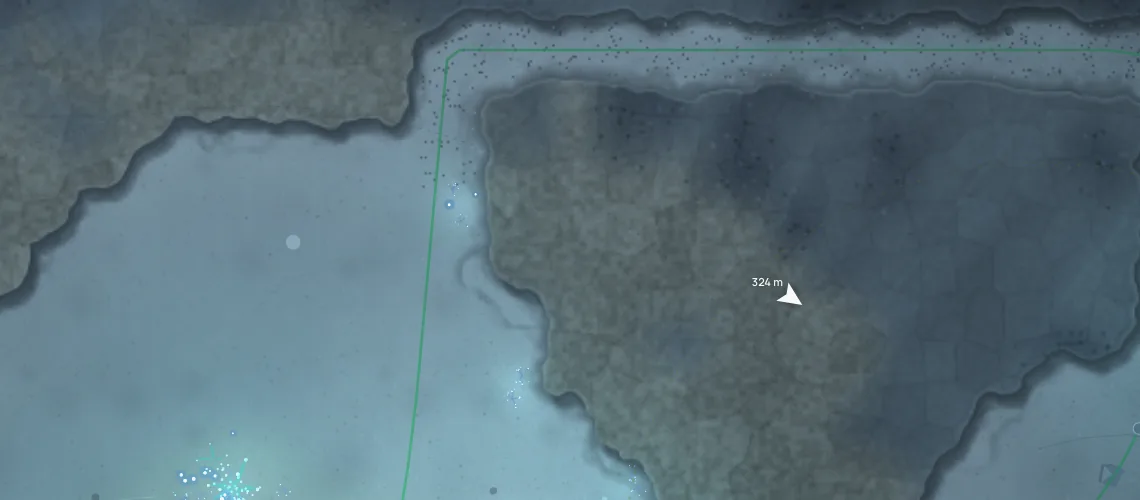
- Mining lines, drones and the Ark keep to the middle of tunnels and go round bends. A line still shortens when a straighter way is dug.
- Smelters take ore straight from storage, and the bar goes straight back when the melt ends. The ore and bars on the arm are only for show.
- Melts now run back to back, so a perfect player finishes the opening in about 33 minutes instead of 36.
 (open full size)
A mining line rounding a bend down the middle of the tunnel, in the sharper rock. Published as “v48 sharp rock, lines off the walls, smelters from storage”
v49controlsbug
Click open ground to move drones
“It's not letting me move the drone back to the main area because it's clearing rock?”Kraig, 12:50 pm, with a screenshot
Claude: Digging wasn't the problem: a two-finger click on open ground tried to post the drone as a relay, and relays are still locked in the tutorial.
- A two-finger click on open ground moves the selected drones there through the tunnels, and they wait. It works any time, even mid-dig.
- Several drones spread out around the spot, and if there's no way through, it says so.
- Relays keep their own key for later.
Published as “v49 move drones to open ground”
v50–v51mechanicdesign
The base rides along, and the drones dig the way
“Modules should attach around and behind the Ark when we're packed. The Ark should move slower. All drones should switch to rock mining and mine in front of the Ark so we can clear through slowly”Kraig, 12:56 pm, with a screenshot
“Drone mining should happen instead of rock just disappearing”Kraig, 1:01 pm, with a screenshot
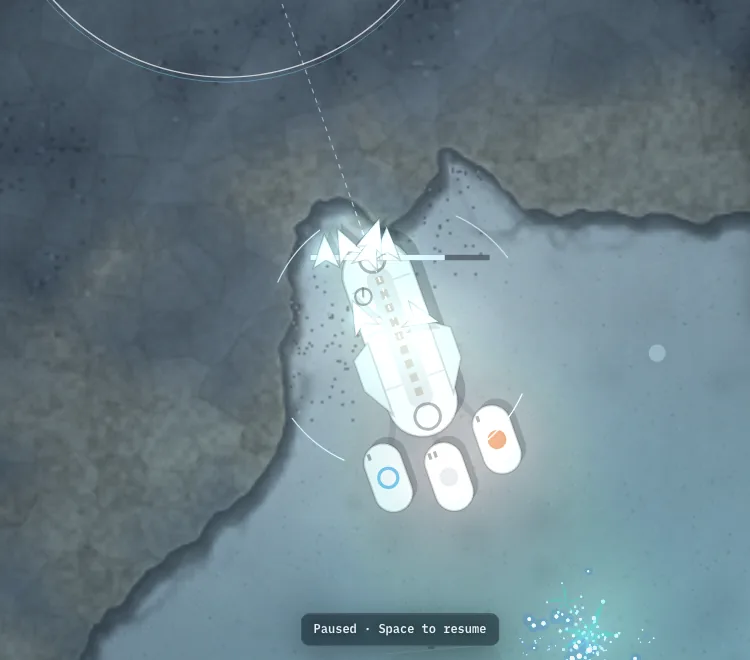
- Packing up folds each module into a pod that rides on the Ark, in a train behind it and along its sides, each on a short coupling. They unfold again when you make camp.
- The Ark moves at about half its old speed, and a little slower for each module it carries.
- Send the packed Ark into solid rock and every drone becomes a digger, mining a lane in front of it while the Ark waits for each stretch to clear. Bedrock can't be bored.
- Version 50 still let the Ark grind rock away as it drove, which looked like rock vanishing. From version 51 the Ark never clears rock itself: wherever its way is too narrow, even in an existing tunnel, the drones widen it first.
 (open full size)
Packed and on the move: the modules ride behind the Ark as pods while the drones mine its way. Taken in version 52. Published as “v50-v51 modules ride as pods, drones mine the Ark's lane”
Light underground
Oct 14, 1:03 pm to 1:03 pm · v52–v52
A sun made no sense inside a mountain. Kraig's answer was alien plants that glow on a cycle, so the day, the solar power and the battery all stayed, now as biolight.
v52mechanicartdesign
Biolight: a sun for the caves
“Now that we're in the cave system the day night cycles don't make sense as well as solar and battery mechanics”Kraig, 12:39 pm
“What if we had alien biolight from plants all over the cave. They run a day/night cycle and glow. This could simulate the sun. We could keep solar and battery mechanics”Kraig, 12:40 pm
“Yes”Kraig, 12:41 pm
Claude: Claude first proposed dropping the day, the solar power and the battery underground, with power as geothermal supply against demand. Kraig's biolight idea kept all three, and Claude laid out how: the plants keep the old 8-minute cycle, solar becomes light collectors, the battery carries the base through the dark, and caves thick with flora make exploring pay.
- Glowing plants grow in clusters on the floors of the natural caves and in tufts along their walls: a ring round the start, a few in each ore cave, more in the empty caves.
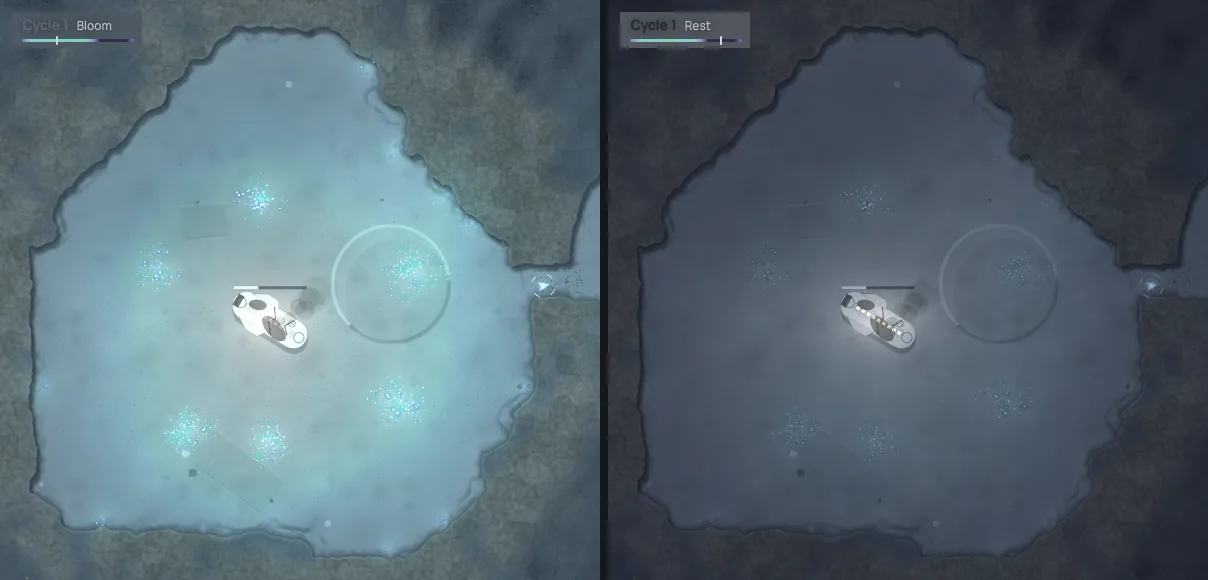
- They keep the old 8-minute day as their cycle: Rising, Bloom, Fading and Rest. The clock is back underground, reading "Cycle 1 · Bloom".
- In bloom the caves fill with soft teal light. In rest the plants sink to a few embers and only the lamps of the Ark and the drones light the dark.
- Solar is now the light collector, which harvests the glow: its output follows the cycle and how much flora is near it. It sets itself on the brightest ground by the Ark and shows the light there, like "Light here: 1.3×".
- The Ark keeps a small geothermal trickle, and the battery carries the base through rest.
- Two hidden garden caves, thick with flora, are the brightest places in the mountain and worth digging to.
 (open full size)
The same cave in bloom and in rest. 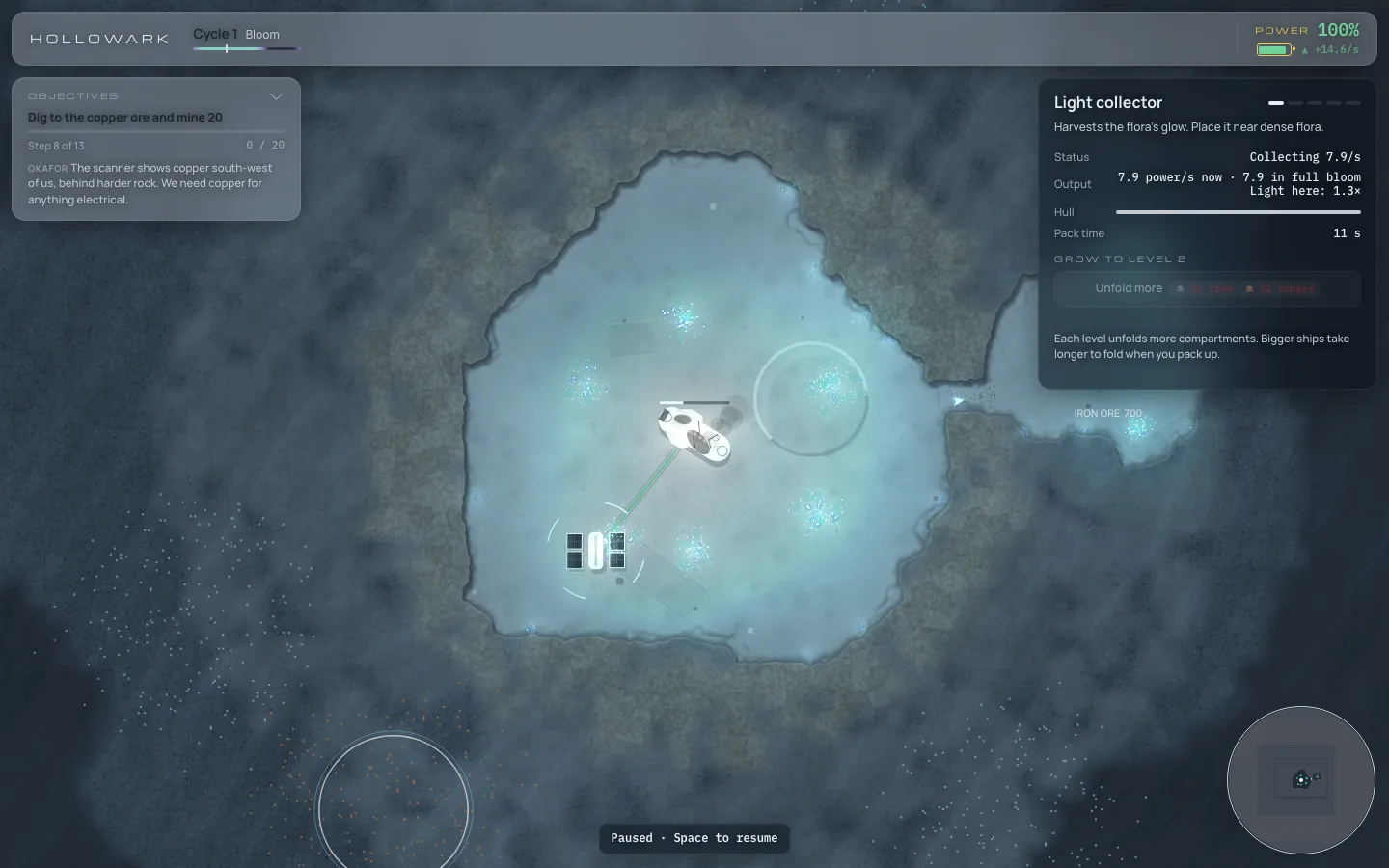 (open full size)
A light collector by the flora, with what it makes now and in full bloom. Published as “v52 biolight flora, bloom cycle, light collectors”
Fog, power and the fleet
Oct 14, 1:06 pm to 1:28 pm · v53–v58
Quick notes from play, a version every few minutes: a tighter fog, power that climbs from red to green as the Ark is repaired, upgrades that improve every drone at once, and a Surveyor that charts what the fog hides. The two bigger pieces were built as background jobs while Kraig kept playing.
v53artui
A tighter fog
“The fog of war should be a little tighter. We should only be able to see just outside of the wall of rock”Kraig, 1:05 pm
Claude: Until now the stone texture showed across the whole mountain. Claude's first version of the fog had square corners, so it rounded them off before publishing.
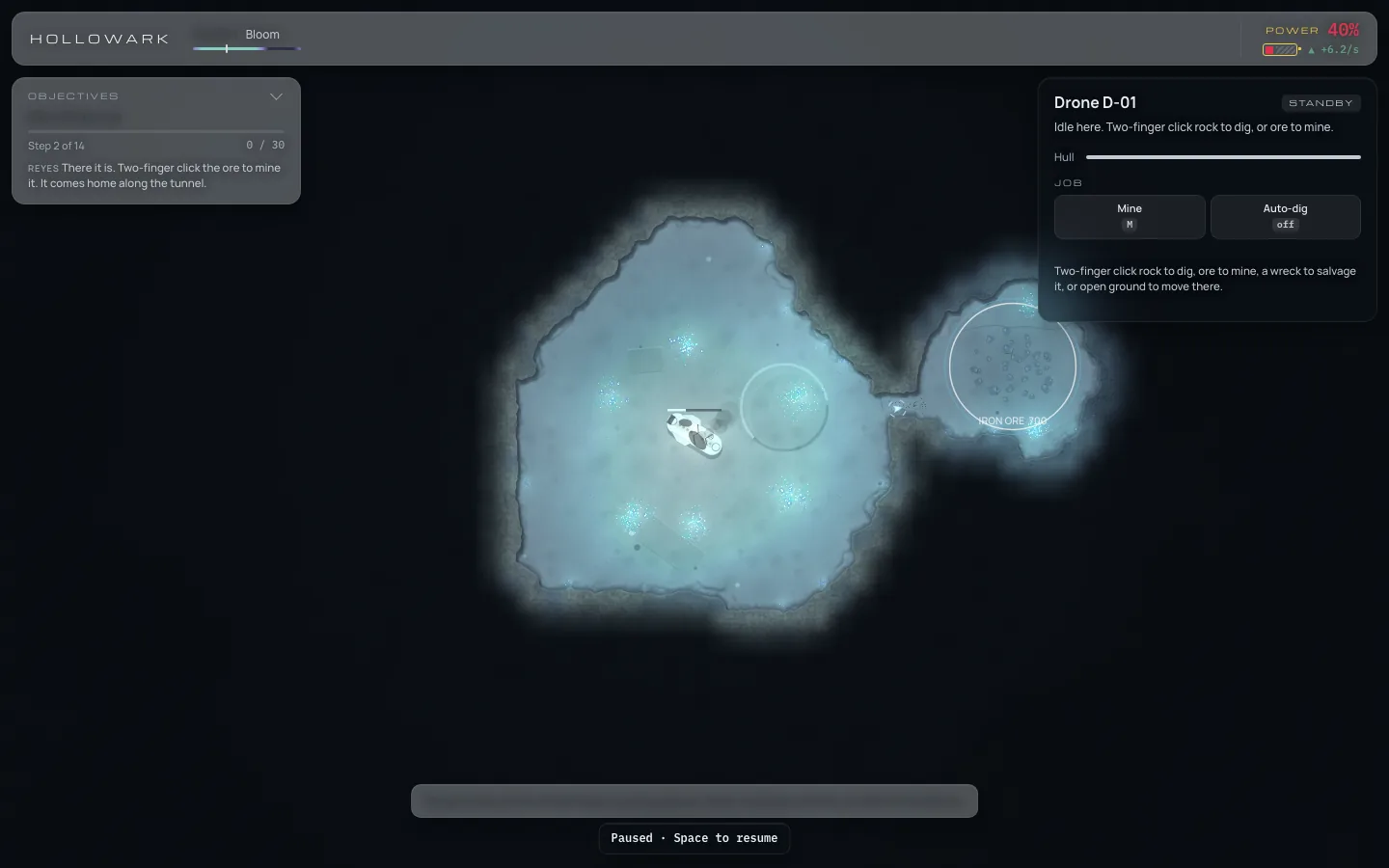
- You see the open caves and tunnels plus about one block of rock round them, the wall itself. Deeper rock fades to dark behind a soft, rounded edge.
- Every new tunnel pushes the fog back with it.
- Ore glints in the rock near a hidden cave only show once you're digging close. Planned digs still show their dashed outlines through the fog.
 (open full size)
The caves, a band of wall, then dark. Taken in version 59: the power starts red at 40%, and the drone panel has the Auto-dig toggle from version 56. Published as “v53 tight fog”
v54–v55mechanictutorialbalance
Power climbs from red to green
“The power should start in the yellow until we repair the first power objective”Kraig, 1:07 pm
“The power at the start should start red. Repairing the Ark brings it to yellow. Adding our first light collector brings it to green”Kraig, 1:10 pm
Claude: Putting a light collector step right after the power cells would have stalled the opening: the collector cost copper, which you don't have until later. Claude made it iron only so the step works where it sits.
- Version 54 held the grid at yellow (70%) until the Ark's power cells were repaired, however full the battery.
- From version 55 power climbs in three steps: red (40%) at the start, yellow (70%) once the power cells are repaired, and green, with the battery in charge, once the first light collector is out.
- A new tutorial step after the power cells: "Unfold a light collector", with its Unfold button on the objective. The collector now costs 35 iron and no copper.
- Hovering the power reading says which stage you're at and what fixes it.
- The opening got much slower: a scripted perfect player took about 52 minutes instead of 32, with the power cells at 20 minutes.
Published as “v54-v55 power red to yellow to green”
v56uimechanicbalance
Room for modules, a lead to more ore, auto-dig, a hungrier base
“Also modules shouldn't overlap like this”Kraig, 1:17 pm, with a screenshot
“Drones should have an auto mine rock toggle”Kraig, 1:17 pm
“Right now I don't have any iron ore to mine and don't know where it is”Kraig, 1:18 pm, with a screenshot
“I think we need to drain power more, especially at night”Kraig, 1:19 pm
Claude: In Kraig's screenshot the datacenter had unfolded on top of the Fabricator: module spots were picked without counting their real size.
- Modules are placed by their real size, which grows as they level up, and kept clear of each other. In a tight cave a new one takes the roomiest gap; with truly no room, unfolding says "Dig out more space around the Ark" before it takes your materials. Saved runs with overlapping modules move apart on load.
- When the current step needs an ore you can't reach any more, the objective points at the nearest cave that holds it: "No iron ore left in reach. The scanner shows more to the south-east (about 400 m): dig to it."
- An Auto-dig toggle in the drone panel: idle drones keep widening the caves round the Ark, soft rock first. Two drones cleared 21 blocks in two minutes with no orders. Any order comes first.
- The Ark itself now draws power all the time, and more than twice as much while the flora rests, for lamps and heat. Drones draw more while mining, digging and parked, so the battery really drops through each rest.
- A scripted perfect player now took about 57 minutes.
Published as “v56 no overlaps, ore lead, auto-dig, drain”
v57mechanicdesignui
Upgrade every drone at once, from the AI core
“I think we should do global drone upgrades from the AI core”Kraig, 1:14 pm
“Yes”Kraig, 1:16 pm
Claude: Claude's plan: one place to make the whole fleet better instead of fitting modules drone by drone, with five tracks, iron and copper for each level, and the crew installing them like repairs. Copper would finally matter beyond the early repairs. It was built as a background job.
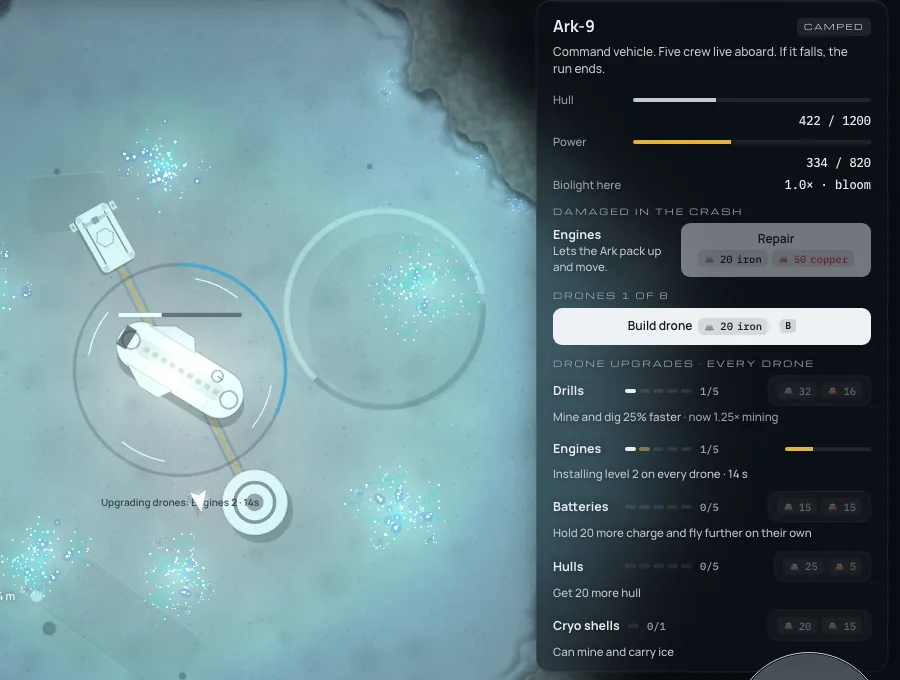
- Once the AI core is repaired, the Ark panel has "Drone upgrades · every drone", and each level applies to every drone at once, including ones built later.
- Drills: mining and digging 25% faster a level, about 3 times as fast at level 5. Engines: flight 20% faster a level, 40 to 100 m/s. Batteries: 20 more charge a level, so drones fly further on their own. Hulls: 20 more hull a level. Lasers stay hidden until there's something to fight.
- Each level costs iron and copper, 1.6 times the one before, and installs over time like a repair, from about 16 seconds at level 1 to about a minute at level 5. The crew works on one repair or upgrade at a time.
- Drone panels lose their module slots. Drones already fitted keep their bonuses, which stack with the upgrades.
- Ice needed a Cryo shell module on each drone, so for now Hulls level 1 also let drones mine ice. Version 59 gave ice its own upgrade.
 (open full size)
The drone upgrades in the Ark's panel, with Engines 2 installing. Taken in version 59, which added Cryo shells. Published as “v57 drone upgrades from the AI core”
v58mechanicart
The Surveyor charts what the fog hides
“There should be a survey module that automatically scans around the map slowly?”Kraig, 1:08 pm
“Yes”Kraig, 1:10 pm
Claude: Claude proposed a dish that sweeps slowly and charts hidden caves without opening them, so you still dig to reach them. The background job found that the planned 180 m of range charted nothing from the start cave and looked broken, so it starts at 250 m.
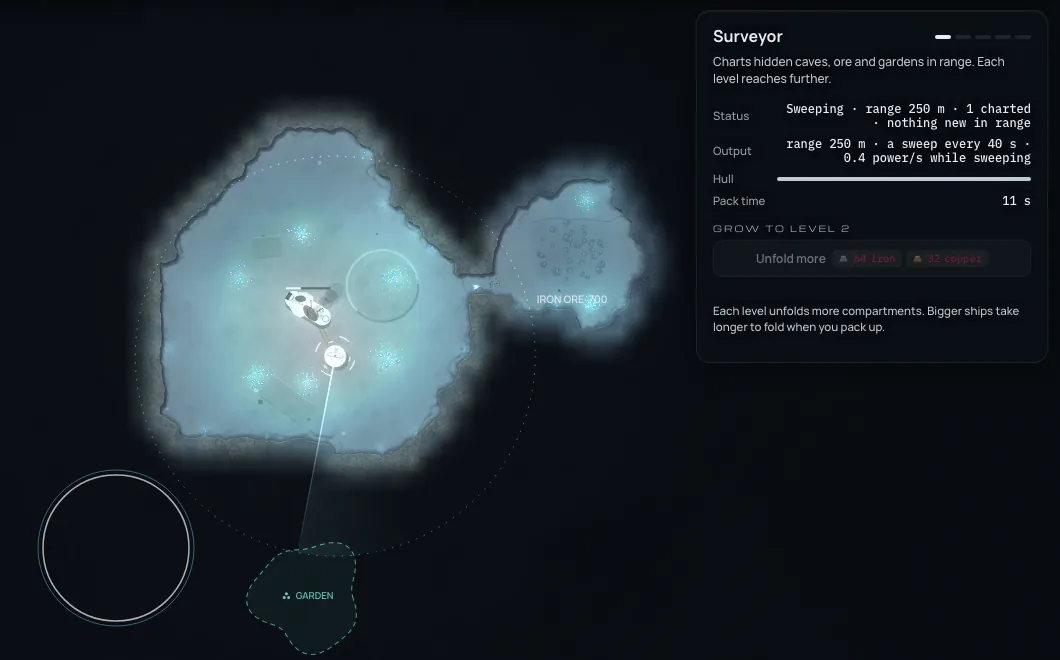
- The Surveyor unfolds from the Ark on its own arm for 40 iron and 20 copper, unlocked by the AI core repair: a round base with a dish that turns with its sweep and a soft cyan light. Each level adds three segments to the ring round its base.
- Its beam goes round about once every 40 seconds. Each hidden cave it passes shows through the fog as a dashed outline of the cave's own shape, labelled with what's inside (iron ore, copper ore, ice, a garden, the buried wreck or an empty cave), with a soft ping and a note: "Charted: iron ore. Dig to reach it."
- It opens nothing: the drones still dig to it. Charted caves show on the minimap too.
- Range 250 m at level 1 and 60 m more a level, up to 490 m, and each level sweeps 25% faster. It draws a little power while sweeping and keeps sweeping when there's nothing new in reach.
 (open full size)
The surveyor's beam on a garden cave it has charted through the fog. Taken in version 59. Published as “v58 Surveyor module”
A first full playthrough, and the shape of the game
Oct 14, 1:53 pm to 1:54 pm · v59–v59
Kraig played the whole opening through and asked for an overview and a plan. Claude's fixes became version 59. While they were built, Kraig talked through where the game goes after the caves: a seed ship, a breakout to the surface, three bases and a terraforming ending. That part is planned, not built.
designstory
Where it's going (planned, not built yet)
“Because I want the game to have surface and cave, but you start in the cave. And once you leave the cave, that's when like the actual enemy mechanics start to come in and other mechanics. But then there's also reasons why you want to go back into the cave system to like mine special resources or extract certain things... So I feel like there should be a starter base, a middle base, and then like an end base, and the end base should be like more permanent.”Kraig, 1:38 pm
“I think the tutorial chapter should end by breaking out into the surface. And I think that's actually like a really cool story point because you see like where you are... the systems turn on, the crew is still sleeping in cryo... we're in a tiny little cavern, the Ark is like stuck there for some reason, we don't understand what happened... It's literally like an Ark, like a civilization sent out a seed to restart civilization”Kraig, 1:43 pm
“The opening should start black and it should have like a chapter one. The seed or the awakening or system boot and the lights and the like indicators on the Ark should wake up and like a booting sequence and then the first drone should come out and we should start digging stone to find the ore”Kraig, 1:48 pm
“I think the outside should look very different and alien but beautiful and colorful compared to like the dark spooky cave system that gets slightly more beautiful with the bioluminescent but ultimately is like cramped and dark. But also like feels safe in terms of like being able to bottleneck and control and build walls against enemies that are trying to come in versus the like beautiful expansive outside.”Kraig, 1:51 pm
“I think the ultimate ending should be that we need to terraform the planet so that humans can live outside without habs or suits. And terraforming for us also means unterraforming for the alien species, the bugs that live there. So like ultimately end game, we're like building huge systems to terraform the atmosphere for us and against the enemy.”Kraig, 1:52 pm
Claude: Claude wrote each idea into the design notes as it came and suggested holding the build until the shape settles, so none of this is in the game yet. Its draft of Chapter One: a black screen and "CHAPTER ONE · THE SEED", a boot log in the dark (power 3%, location unknown, date unknown, colonists in cryo: 400, stable), the Ark's lights coming on section by section, the first drone flying out to dig toward the ore, the tutorial's repairs in order, a seal too hard for the drills, and daylight.
- Planned: the Ark is a seed ship, sent out to restart a civilisation. Its systems boot in a tiny cavern with the colonists asleep in cryo, and nobody knows where or when it is. The guidance becomes the Ark's own terse system log.
- Planned: Chapter One, "The Seed", ends by breaking out to the surface. The Ark reads the stars to learn how long it slept, the first colonists wake, and air, water and food begin.
- Planned: three bases. A starter base that packs up fast, a middle base worth staying at, and an anchored end base that stops moving for good and holds the biggest machines.
- Planned: the caves stay dark, cramped and safe, with tunnels you can wall off; the surface is colourful, alien, wide open and exposed, and it's where the enemies come in. Some resources are found only underground, so you keep going back down.
- Planned: the ending is terraforming. Huge machines push the planet's air toward breathable, which makes it worse for the bugs, so the swarm fights back harder the closer you get.
- Also in the notes: one rock with a hardness percentage instead of rock types, stone from digging as a resource, and a storage limit with a Storage module.
- Reshaped later the same afternoon (next chapter): the cave flora, not a geothermal vent, wakes the Ark; Chapter One leaves the AI core, drone upgrades and Surveyor for Chapter Two; and the Ark itself, not a drill upgrade, breaks through the seal.
v59mechanicuitutorialbalancebug
Fixes from the first full playthrough, and a 39-minute opening
“I just finished like a playthrough of what we have and got, you know, packed up my Ark fully repaired and moved to the new cave area where like the game story ends... why don't you just do like an overview of the entire game and... try to fix what we have or improve, suggest things that we could change just to improve. Make what we have better so far.”Kraig, 1:25 pm
“Yes”Kraig, 1:29 pm
Claude: Claude's overview found seven weak spots, among them ice that nothing could mine once module slots went away, leftovers from the surface version (a Help screen about hives, relay and hunt keys, a distance score) and a 57-minute tutorial. It proposed five phases. Kraig said yes to the first two, the fixes and the tutorial's pace, built as one background job.
- Cryo shells: ice gets its own one-level drone upgrade at the AI core, 20 iron and 15 copper, and every drone can mine and carry ice. Hulls are only hull again. The water step has a Cryo shells button until they're in.
- Leftovers from the surface version are hidden while there's nothing to fight: Relay, Defend and Hunt and their keys, the Ark's laser upgrade, a drone's beam reach, and Travelled in the top bar. The Help screen is rewritten for the caves.
- Costs that wanted hive cores, which only come from hives, ask for copper underground instead.
- The score under the mountain is bloom cycles survived and caves found.
- Cost buttons wrap inside the panels instead of spilling out.
- The power cells now come straight after the first smelt, so the red start ends at about 13 minutes instead of 20. The power cells cost 20 iron, the light collector 25, and the engines 20 iron and 50 copper, since iron was the bottleneck.
- A scripted perfect player now finishes the opening in about 39 minutes, down from 57.
- Caves never touch each other, so every map's first dig works. In some maps a cave touched the start cave and the run couldn't begin.
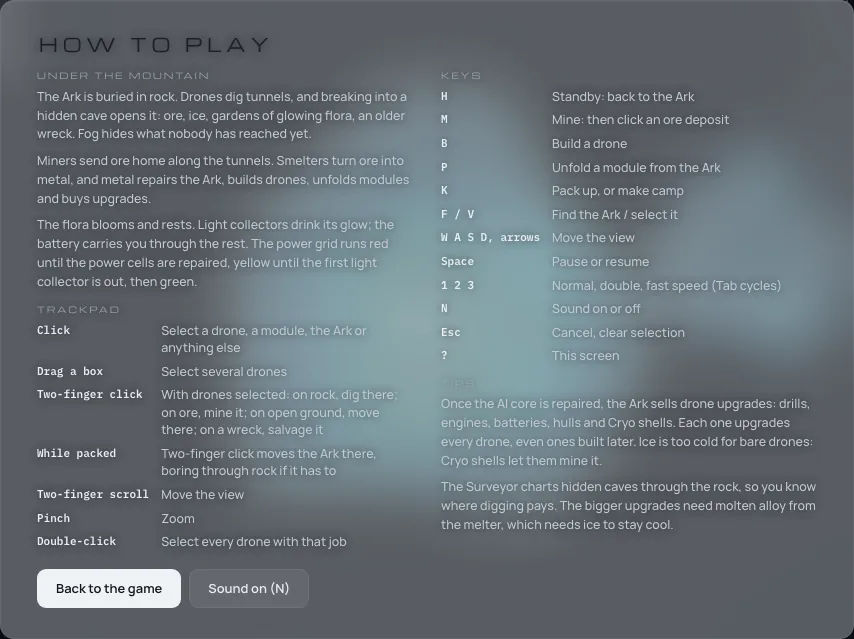 (open full size)
The new Help screen, written for the cave game. Published as “v59 phases 1 and 2”
Designing the whole game
Oct 14, 1:57 pm to 2:36 pm
Forty minutes of design talk while version 59 went live: the space programme, the city at the end, the player as the Ark's own AI, the backstory, a tighter Chapter One, compute, the colonists, the enemies and the cave plants. Claude wrote each decision into the design notes and pitched ten ideas; Kraig kept some, reshaped others, parked one and turned one down. None of it is built yet. The one change to the game is its name, now written HollowARK.
designstoryplanned
A space programme and a city to defend (planned, not built yet)
“We can do the terraforming on our own from the surface, but it takes a lot of time and very costly and very difficult. So part of the story should be like building a space program and bringing down those materials so that we can like finalize our designs for surface terraforming to like beat the game.”Kraig, 1:55 pm
“The bugs will become more incentivized towards the end to like send out waves and bosses and try to destroy those things. So the end game becomes more like defending the big logistics city that you've built.”Kraig, 1:56 pm
- Planned, the arc of a run: Buried → Nomad → Settled → Anchored → Terraform. Dig out of the caves, scout the surface with a base that packs up fast, settle somewhere worth staying, anchor for good, then remake the planet.
- Planned: mid-game, a communications array makes contact with orbit and finds the seed kit still waiting up there. Terraforming from the ground alone is possible but slow and costly; a space programme, single launches at first and a space elevator at the end, brings the kit down to finish it.
- Planned: the anchored base is a city you lay out yourself around the uplink, the launch pads, the elevator and the terraforming machines, with permanent towers and walls. The swarm's waves and bosses go for those, harder the closer you get to the end.
- Rare resources found only underground feed the launches and the machines, so the caves matter to the very end.
designstoryplanned
The story: you are ARK, the Ark's own AI (planned, not built yet)
“I want, you know, AI to be a big part of this. And the player isn't a person. You're the AI system that's helping the humans. So I want that to be like a narrative.”Kraig, 1:58 pm
“I think the Ark is buried there for a while because it doesn't have power. And eventually a little bit of bioluminescent grows in that section. And the Ark is able to get the tiniest trickle of power from the small amount of biomass. And then that's what wakes it up.”Kraig, 2:05 pm
Claude: Claude suggested SEED as the AI's name. Kraig: "I like Ark better than seed", so the ship and its mind share one name, ARK, and Chapter One keeps "The Seed". Claude's first answer to why the Ark wakes was a geothermal vent slowly charging its batteries; Kraig's glowing flora replaced it.
- Planned: you play ARK, not a person. Drones are its hands, its system log is the voice, and the colonists sleep in cryo. Today's AI labs and reusable rockets are the inspiration, with no real company names in the game.
- Planned: the Ark was one ship in a convoy, with cargo landers and a seed kit for terraforming. Something hit the convoy as it arrived: the Ark buried itself in a mountainside, the landers crashed and scattered, and the seed kit is still in orbit, waiting for a signal that never came.
- Planned: the opening is a black screen, then a faint glow as cave flora grows round the dead Ark, its lights coming on section by section, and the boot log: "Power: 3%".
- Planned: the data cores found in the world are the crashed landers' computers, weathered on the surface and better kept in buried wrecks, which is one more reason to dig.
designtutorialplanned
Chapter One: a power famine inside a seal (planned, not built yet)
“I also think chapter one shouldn't dive into the AI systems yet... chapter one is just like mining, smelting, getting the Ark up and running so it can burrow out of the cave system to the open world. And also we should do hardened rock... So even if a person wanted to mine endlessly... the tutorial seal, like borderline would kind of force them out into the open eventually.”Kraig, 2:07 pm
“Like bioluminescent gives some power, but we're almost like always starving. And it's only until we like finally get out into the actual surface with the sun that like the power issues can actually be solved.”Kraig, 2:05 pm
Claude: The morning's draft ended Chapter One at a seal too hard for the drills until a drill upgrade. With the upgrades moved out of Chapter One, Claude suggested the Ark itself breaks through instead.
- Planned: Chapter One is only mining, smelting and getting the Ark running, with about three drones. The AI core, drone upgrades, the Surveyor and datacenters move to Chapter Two.
- Planned: the tutorial caves sit inside a ring of hardened rock no drone can cut, and what's inside runs out, so the only way on is out. With its engines and cutter restored, the Ark bores up through the seal.
- Planned: underground, power is always short. The flora is the only source (the geothermal vent goes), so even green is fragile, and the sun at the breakout is the relief.
designplanned
Anything is possible, nothing is easy (planned, not built yet)
“I just really like the idea of a player being able to do almost anything, especially once they escape the tutorial phase, but it just sucks to do it. It takes forever, it's complicated, it's difficult, and it's just time consuming. Like I love that aspect of Factorio, like you're kind of just in a sandbox from the start able to do whatever. But you need to build up systems to build more complicated things.”Kraig, 2:12 pm
- Planned, a rule for everything after Chapter One: no hard locks. Research and modules change how fast and how well you can do something, not whether you can.
- Planned: everything has a slow way by hand. The Fabricator makes almost anything, slowly, and drones take one order at a time. The reward is systems: modules that do one job fast, mining lines and haul routes that run themselves, automation rules, and compute that speeds up research.
- Even terraforming could start crudely on day one. The satisfaction is building the machine that does it for you.
designmechanicplanned
Waking the colonists, one at a time (planned, not built yet)
“I like the idea of like slowly, one at a time, waking these people up. And it's very costly to do it in compute... So if you bring, yeah, a botanist specialist, they just give like a bonus to like whatever you have going on with that. And you can just like keep stacking different types of bonuses.”Kraig, 2:16 pm
“And you can have all of your crew die in the Ark, and that's fine because you have more to wake up... a good mistake that's possible and probably should happen. And the game only ends when your Ark is destroyed.”Kraig, 2:17 pm
Claude: Choosing who wakes was the second of ten ideas Claude pitched. Kraig added the compute cost and the stacking bonuses, then the rule that colonists can die.
- Planned: Chapter Two brings the enemy, deeper smelting and building, and the people, and with them oxygen, water and food.
- Planned: each colonist is a specialist whose bonus stacks: a botanist for plants and food, an engineer for building and repairs, a geologist for surveying, a pilot for launches, a medic for the crew. You choose who wakes by what you're working toward.
- Planned: life support is one gauge, coloured like power and checked about once a minute. Green: nobody dies. One of the three low, yellow: about a 5% chance a colonist dies at each check. Two low, orange: about 20%. All three low, red: about 50%. Any one run out: someone dies every check. The numbers get tuned in play.
- Planned: colonists can all die, taking their bonuses and the compute spent on them, and more can be woken. Only losing the Ark ends the run.
designmechanicplanned
Compute, the game's currency (planned, not built yet)
“I feel like compute is like almost an even better, like all-encompassing resource to like spend stuff on. So like every large project needs a certain amount of compute and better models like lower the cost of compute.”Kraig, 2:09 pm
“It's the spectrum idea. Like, there's kind of two polar ways to play, and there are pros and cons to equally... your preferences, and also like the situation of your map and starting position, like would make you favor one or the other.”Kraig, 2:22 pm
Claude: Claude's first take was compute as a rate only, nothing stored: a project finishes faster the more compute runs. Kraig wanted it stored too, so it now works like the power and battery.
- Planned: compute arrives in Chapter Two and pays for every big project: research, ARK's own upgrades, waking colonists, decrypting data cores, launches, the elevator and terraforming. Each better model makes every recipe cheaper.
- Planned: datacenters make it each second, a store holds a surplus up to a cap, and research draws it at a rate. When it runs short, research slows, the way low power slows the base. Power runs the base; compute moves ARK forward.
- Planned: datacenters need power, water, space and protection, and can sprawl. Cooling is one of two ways to play: in the caves cold rock cools them for free, safe but cramped and short on power; on the surface they need water but get room and sun, and run cooler at night. Heat sinks help either way.
designenemiesplanned
How the enemies notice you (planned, still open)
“I don't want like sound dampening... Maybe it's another dichotomy thing where like building and doing production and stuff in the caves does produce vibration and that alerts like pockets of enemies within the cave... And then also like when you're outside, it's just visual. So it's like line of sight... With Factorio, you kind of like knew exactly what the bugs would do. But I kind of like the idea of like kind of knowing, but also you could be attacked at any point.”Kraig, 2:26 pm
Claude: Claude pitched noise as the swarm's one sense: digging, smelters and above all launches draw bugs, with damping and quiet modes as the counter. Kraig turned it down, and didn't want a copy of Factorio's pollution either, then reshaped it into the split below.
- Planned: in the caves, work sends vibration through the rock and can stir nearby pockets of cave creatures. On the surface it's sight only.
- Planned: the bugs have their own fog of war and send out scouts now and then. Colonies mostly keep to habits you can learn, with enough randomness that an attack can come at any time.
- Still open: how the enemies spread, decide to attack, build, upgrade and change. Each gets its own design talk.
designplanned
Two kinds of cave plants (planned, not built yet)
“So the bioluminescent flora in the caves is like very specifically just for lighting, like the day and night cycles... flora that we harvest and use as a resource. I think it should be different. I think it should be like patches that... can be used up similar to... iron or copper ore... but the difference is that it'll grow back slowly during day cycles.”Kraig, 2:29 pm
Claude: Claude pitched the glowing flora as living tech: plant cuttings to grow light farms, bugs graze on it, terraforming slowly kills it. Kraig kept light and harvest apart.
- Planned: the glowing flora is light only. It lights the caves and runs the day cycle, and it isn't harvested.
- Planned: plants you harvest are separate patches, mined out like ore, that grow back slowly while biolight shines on them: mine one, let it rest, come back.
- Planned: the surface gets its own plants and creatures, different in each biome. Biomes are a design talk still to come.
designplanned
Ten ideas from Claude, and what Kraig did with them
“Give me a list of 10 ideas for anything with the game that you can come up with and be creative and improvements and suggestions and then I'll go through them and give my feedback.”Kraig, 1:59 pm
“Number one, I like that, but it has to tie into the mechanics and the resources or like bosses. There has to be more of a reason than just getting to a point, unlocking a thing and just getting like a block of text to read.”Kraig, 2:00 pm
“I think this complicates it too much. Maybe down the road. I don't think it would be exactly how you spelled out. I have my own ideas.”Kraig, 2:21 pm
Claude: Claude listed ten ideas, then went through them with Kraig one at a time, each with its own take.
- Reworked: 1, memory cores. Decrypting a data core costs compute, and each one gives something you use: a blueprint, a map to a rare resource or the seal's weak spot, a lasting bonus, or a boss's weakness. Some wake an old wreck's defences.
- Kept with Kraig's changes: 2, choosing which colonists wake, and 4, cooling compute in the caves, which became a choice between cave and surface.
- Turned down and reshaped: 5, bugs hunting by noise, became vibration in the caves and sight on the surface. Reshaped: 6, flora as living tech, became separate light and harvest plants.
- Parked: 3, trust and autonomy, the crew granting ARK more freedom as it proves itself. Ideas 7 to 10 are still to come.
artstory
HollowARK, with ARK in capitals
“Let's just go with Hollowark. But can you make like the A capitalized? Or like A-R-K capitalized?”Kraig, 2:35 pm
Claude: Kraig asked for a rebrand to fit the new story. Of Claude's names he liked Hollowark best, asked for a few more built on AI and today's tech, and turned those down.
- The name is now written HollowARK, so the Ark, and ARK, the AI you play, sit inside it.
- On the title screen and the top bar, HOLLOW stays in ink and ARK is in biolight teal.
- The web address stays the same.
The base and the fight, on paper
Oct 14, 2:38 pm to 3:01 pm
Twenty-five more minutes of design talk right after the name. Claude asked one question at a time, each with a suggestion, and Kraig answered in his own words: the Beacon, an Ark that's always free to move, a base that grows as one network from it, laser towers and hangars, veteran drones, enemies that guard the way forward, repairs, and four tiers of production. None of it is built yet.
designmechanicplanned
The Beacon: one ping, one find (planned, not built yet)
“I like it coming from the sonar tower or whatever we call that beacon. Probably just beacon... it should cost compute. So we can't build it in the tutorial... every ping should just find one resource... show an indicator that something was there, but you have to go explore to find it... mid game, when you're going through the cave systems to find rare stuff, you kind of need to set up, burrow through with defense, set up pings, and then ping to find where you're going to dig next.”Kraig, 2:38 pm
Claude: The seventh of Claude's ten ideas was a sonar ping. Kraig made it a building with a cost and a risk.
- Planned: the Beacon is a building you put up after the tutorial, a mid-to-late-game tool for hunting rare resources.
- Planned: each ping costs power and compute and finds one thing in its radius, shown as a rough marker. You still have to go and explore to find out what and where. Upgrades push the range and the strength.
- Planned: pinging gives you away. In the caves, creatures slowly burrow towards where they heard it; on the surface the sound carries and they come to look.
- The mid-game rhythm: push into deep caves, set up defences, build a Beacon, ping, choose where to dig, and defend while you dig.
designmechanicplanned
The Ark always moves; what you leave behind is the base (planned, not built yet)
“We should always allow the Ark to get up and move. And any attached modules will just come with it, but there's a limit to how many modules you can have attached to it, just one of each kind... you can unattach modules from the Ark, but once you do that, it's permanent. They can't be reattached.”Kraig, 2:42 pm
“Every building should have a movable, packable version... everything coming out as a packed oval or whatever design we have. And then when we deploy it, it kind of sprawls out and builds with a slight animation.”Kraig, 2:47 pm
“I don't think there should be any limit to how many buildings you have. It just comes at a cost of complexity and power and just logistics and then your ability to defend it.”Kraig, 2:48 pm
Claude: Claude had asked how new buildings get built (placed instantly, assembled by drones over time, or a mix) and whether there should be a limit on how many. Kraig answered with pods, and no limit beyond what a big base costs.
- Planned: the Ark can always pack up and move. Its attached modules, one of each kind, fold up and travel with it and unfold wherever it makes camp.
- Planned: detaching a module is permanent. It becomes a standalone building, and a new attached one can be built at a cost. Detached buildings still move: they fold, travel and unfold where you send them.
- This replaces the idea of the Ark stopping for good at the end. The Ark stays free; the permanent base is what you detach and leave behind.
- Planned: every building comes out of the Fabricator packed, as a pod, and unfolds in place with a short animation. Late-game megastructures get a bigger builder of their own. Sizes and designs come last.
- Planned: no limit on buildings. The limits are complexity, power, logistics and having to defend it all.
designenemiesplanned
Laser towers, hangars and veteran drones (planned, not built yet)
“Laser towers are probably the main idea... you just place them where you want to defend things, choke points around buildings, supply lines. I do think each drone should have a very minimal way to defend itself... maybe they stay in a hangar and they come out of the hangar if you're being attacked... they have to come back to the hangar because they run out of power because they're flying away from the supply grid and the Ark.”Kraig, 2:52 pm
“I also kind of like the idea of a promotion system... a very small and minimal automated promotion. So if a drone does work and doesn't die, it keeps getting small, tiny bonuses and you can incentivize smart strategic sorties that don't wipe out your entire fleet.”Kraig, 2:53 pm
Claude: Claude's suggestion was stone walls, power-hungry laser towers, guard drones and the Ark's own laser. Kraig kept the towers and added hangars, sorties and promotions.
- Planned: laser towers are the main defence, placed at chokepoints, round key buildings and along supply lines.
- Planned: every drone gets a small laser to defend itself, though a swarm will overwhelm it.
- Planned: hangars hold attack drones. They launch on their own when the base is attacked, or go out on sorties under your control. The battery is the leash: away from the grid they have to come home to recharge. Engine speed, battery size, a small solar trickle and the laser's draw are their stats, which fit the drone upgrades already built.
- Planned: drones gain experience on their own from working and surviving, over three to five ranks of a few percent each in their own job, shown as a small chevron or pips. Losing a veteran stings, so careful sorties pay.
- Attacking nests with the Ark itself is noted but not planned: losing the Ark ends the run.
designenemiesplanned
Enemies guard the way forward (planned, not built yet)
“We should use enemies to guard areas that we want the player to go to eventually. So they should almost always guard resources or the next step or storylines or data cores... there's always the possibility that you might get attacked at any point.”Kraig, 2:55 pm
“I also want repairs to be simple... a very, very small and gradual health repair and recovery for all items. But maybe a quick fix, from the Ark, you can click one button to repair all buildings and units, but it scales to how much damage there is and it's costly.”Kraig, 2:56 pm
“Eventually, enemies or certain different types of enemies will have drops that are specific for doing something. I don't know.”Kraig, 2:57 pm
Claude: Claude asked why anyone would attack a nest, offering drops, better land or growing pressure. Kraig's answer covers it: they guard what you need. For damage, Claude suggested drones repairing nearby buildings for a little iron; Kraig wanted something simpler.
- Planned: nests and creatures guard resources, data cores, story finds and the way on, with bigger guards further along, so the enemies set the pace of the game.
- Planned: they grow and change slowly over time, tuned in playtests. Attacks come when you're close or they sense you, with a little chance on top.
- Planned: a cut relay drops power to everything past it, defences included.
- Planned: everything repairs itself very slowly. "Repair all" at the Ark fixes every building and drone at once, for a cost that grows with the damage: wait it out, or pay to be ready now.
- Still open: enemy types will drop materials for specific uses. One fit: samples from the swarm as research for the terraforming that poisons it.
designmechanicplanned
One network, and every line leads to the Ark (planned, not built yet)
“There's always a power line from the Ark connecting everything. And if a module gets too far from the Ark, it'll need a relay to transfer the power and resources between. So basically a city will look like a big sprawling web of different buildings.”Kraig, 2:44 pm
“You can collect resources if it's an outpost, but it doesn't get added to your totals of inventory until the outpost is connected to the Ark... all lines kind of lead to the Ark.”Kraig, 2:46 pm
“For now we should keep it simple... right now, just longer lines, longer time. So it incentivizes building tight and complex close to the Ark to minimize the travel distances.”Kraig, 2:58 pm
Claude: Claude's first suggestion was a Hub building at the heart of each base, with bases linked by long lines. Kraig wanted one network rooted at the Ark instead. For moving goods, Claude offered travel time only, capacity limits, or one then the other; Kraig kept travel time only.
- Planned: power lines from the Ark carry both power and resources to every building, and relay stations stretch the reach. A city is a web you can arrange in clusters, branches or loops, and an outpost is a far branch at the end of a chain of relays. Smaller Arks as hubs of their own are an idea for later.
- Planned: an outpost can mine and stockpile on its own, but what it collects joins your totals only once it's connected to the Ark. The Ark is the heart and the swarm's target, so relay chains are every base's backbone, and cutting them is the enemy's best move.
- Planned: goods on the network only take travel time, with no limit on how much a line carries, which rewards building tight around the Ark. Line upgrades come later.
designplanned
Four tiers of production, simple first (planned, not built yet)
“I like the four classifications. I think it's good to start simple and get it as a fun loop that makes sense and then expand and add bigger recipes, bigger production chains and complicate it more later down the road. But those would also be chapter three, chapter four.”Kraig, 3:00 pm
Claude: Claude proposed raw, refined, components and megastructure parts, and thought three tiers might be enough. Kraig kept all four.
- Planned: four tiers. Raw (ore, rock, ice, plants), refined (metal and the like), components, and megastructure parts such as elevator segments and terraforming cores.
- Start with one fun loop; the long production chains come in Chapters Three and Four. Chapter One first, then Chapter Two.
Chapter One: the plan
Oct 14, 3:08 pm to 3:14 pm
The tree became the game's look and its chapter names, and Kraig said to start building. Chapter One is built in four playable stages, each with a report and his OK before the next. The first two, the wake and the rock, started side by side as background jobs, and rock turned into concrete on the way.
designartstory
The tree: from seed to stars
“I like the metaphors with a tree. Like it starts as a seed, it pushes out of the dirt to see the sunlight, takes in resources and grows bigger until it's like a full huge tree stretching, reaching all the way into the sky and the stars above.”Kraig, 3:07 pm
“Sounds good.”Kraig, 3:08 pm
Claude: Kraig asked whether the tree could change the name. Claude suggested keeping HollowARK, since a hollow is already a tree word, the space inside an old trunk where things shelter, and making the tree the look and the chapter names instead.
- The chapters grow like a tree: The Seed (buried in the cave), Sprout (breaking ground into the sun, the first colonists wake), Roots (the network and outposts), Trunk (the permanent city), Canopy (terraforming) and Reaching (the space programme and the elevator to the stars).
- The look: the Ark drawn as a seed, a thin teal shoot rising out of ARK in the logo, lines that look like roots underground and branches on the surface, and the space elevator as the trunk into the sky. A tagline idea: "From seed to stars."
- HollowARK stays. The shoot in the logo went into Stage 1.
designmilestone
Chapter One, built in four stages
“You can start building this first phase with all the steps. Or maybe like stop at each step and just like give me a report so I can okay the next step.”Kraig, 3:08 pm
“Yeah, you're free to start stage two as well.”Kraig, 3:14 pm
Claude: Claude wrote the plan as four stages, each one playable. Kraig asked whether building them all at once would be faster. Claude's answer: it costs about the same, and the stages build on each other, but the rock is separate enough to build next to the opening. So Stage 2 started alongside Stage 1.
- Stage 1, the wake: the new opening and ARK's voice.
- Stage 2, the rock: one rock with a hardness you can see, rock from digging, a storage limit, and the seal.
- Stage 3, the famine: flora the only power underground, three drones at most, the AI core, drone upgrades and the Surveyor saved for Chapter Two, and the tutorial in a new order.
- Stage 4, daylight: the Ark bores up through the seal, the sun floods the grid, ARK reads the stars to learn how long it slept, and "Chapter One complete".
- After each stage a test player runs the whole chapter, then a report and Kraig's OK before the next. Old saves start fresh.
designmechanic
Rock becomes concrete
“One quick change, rock gets refined into concrete.”Kraig, 3:14 pm
- Digging yields rock, more from harder rock. A concrete mixer unfolds from the Ark like the smelters and turns rock into concrete.
- Concrete patches the hull and builds the Storage module, and later walls, defences and foundations.
- It went straight into Stage 2, which had just started.
Designing while it built
Oct 14, 3:20 pm to 3:29 pm
While the first two stages were being built, the design talk carried on into later chapters: expeditions and outposts, one shared inventory, the first components, the Fabricator and factories, and a plan to build the whole game thin before making any of it deep. None of it is built yet.
designmechanicplanned
Expeditions, outposts and one inventory (planned, not built yet)
“Cave expeditions, expeditions on the land. You're free to set up or build whatever you want, but to connect it to like your main power source, you need long lines or you need a separate power source... So you might as well build a power and supply line, but you don't have to, especially at the start.”Kraig, 3:17 pm
“A small amount of any resource can be stored in a module. If we like pack up and then leave the outpost area and come back to the Ark and connect, like we get those resources. So it's possible to like send a little outpost party out to get a special thing and then come back instead of setting up like a permanent line.”Kraig, 3:19 pm
“I kind of want to avoid sub-networks. So just to keep things simple, to use a resource to build anything, you have to connect to the Ark.”Kraig, 3:20 pm
Claude: This was the ninth of Claude's ten ideas, cave expeditions. Claude assumed a party could spend what it carried on the spot, to put up a wall or a tower; Kraig said no, since that would make little networks of their own.
- Planned: build anywhere, in the caves or on the surface. A building with no line runs on its own power: light collectors underground, the sun on the surface, batteries.
- Planned: resources reach the Ark's totals only over a line, and one line carries both power and supply, so connecting is the natural choice but never a rule.
- Planned: every module holds a little of any resource and keeps it when packed. An expedition party, a few drones with a power module and a storage module, goes out, mines, packs up full and comes home, and its load counts once it's connected. A trip or a permanent line: two ways to get far-off resources.
- Planned: one inventory, the Ark's. Anything you build or spend draws on it. A tower for a far chokepoint is fabricated packed at home, carried out and unfolded there.
designmechanicplanned
Components, the Fabricator and factories (planned, not built yet)
“I think this is a good start. This is going to take a lot of iteration... a fabricator should just be able to 3D print any kind of module or drone or attacker.”Kraig, 3:25 pm
“One module that will make the modules and the drones... and like 3D prints it. But then there's like the other buildings that are more like the factories... you select your recipe and then you turn it on and it just continues to make those items if it has the available recipe items... you can upgrade the modules, or you could also build more modules with the same recipe, but that's like less efficient than upgrading.”Kraig, 3:27 pm
Claude: Claude proposed four starting components and one Assembler that could make any of them. Kraig first described makers in tiers by recipe size, then split them in two: one Fabricator for whole things, and factories for the parts.
- Planned, from Chapter Two: Frame (2 iron) for structure, Wiring (2 copper) for power, Motor (a frame and wiring) for anything that moves, and Circuit (wiring and crystal, found only in caves) for anything that thinks. Concrete stays a refined material. Chapter One is raw and refined only.
- Planned: the Fabricator prints whole things from a build queue: modules (packed), drones and attackers.
- Planned: factories make items. Pick a recipe, switch one on, and it keeps going while the ingredients are in the Ark's inventory, so factories feed each other through it, with travel time and no belts. Refiners take one input (the smelters, the concrete mixer), the Assembler two, the Heavy assembler three or four; the names are placeholders.
- Planned: to make more, upgrading is the efficient way (level 2 doubles the speed for one and a half times the power, in the same space). A second copy costs full price, full power and more room.
designplanned
Build the whole game thin first, about two hours (planned, not built yet)
“Start simple and almost kind of like build the entire game with all the chapters so that you can win, but it's cheap and easy and quick to do so. And then we'll just keep layering in more complexity and detail.”Kraig, 3:25 pm
“We'll start somewhere and then we'll tweak it based on how hard it is, how easy it is, how long it takes, and then just add complexity... you can just increase the difficulty by adding a multiplication to or from the recipes for everything. So it just takes longer and more resources to do the exact same thing.”Kraig, 3:29 pm
Claude: Claude sketched a thin run with one simple goal per chapter, from digging out of the cave to bringing the seed kit down from orbit, and suggested about two hours to win.
- Planned: after Chapter One, every chapter gets a short, simple version first, so a whole run can be won end to end. Then each one is deepened from playtests: longer recipes, harder enemies, more steps.
- Planned: the thin run takes about two hours to win, about 35 minutes for Chapter One and about 15 for each of the rest, and grows longer as the chapters deepen.
- Planned: difficulty is tuned with a few global dials: one multiplier on every recipe's cost, plus how hard the enemies and the power push back.
Stages 1 and 2: the wake and the rock
Oct 14, 3:30 pm to 3:32 pm · v61–v62
Both stages landed within three minutes of each other and went live as versions 61 and 62. The game now opens in the dark with ARK waking up, and the rock has a hardness, a seal round it, and a use: concrete.
v61milestonestoryarttutorial
Stage 1, the wake: ARK opens its eyes
Claude: Built as a background job while the design talk went on. Two rough edges Claude flagged: a "Grid falling behind" warning pops up the moment play starts, and ARK still mentions the AI core and upgrades until Stage 3 takes them out.
- The crash from the sky is gone. A new game opens on black: CHAPTER ONE · THE SEED, with a small teal shoot growing above it.
- The flora round the buried Ark brightens out of the dark and the hull catches its glow. One light blinks, then the Ark's lights come on in six sections, nose to tail.
- The boot log types itself out: core online, Power 3%, location unknown, date unknown, 400 colonists in cryo and stable, hull breached, an ore signal in the rock.
- A bay opens and the first drone flies out, the camera pulls back and the controls fade in. It takes about 22 seconds; a click or any key skips it, and Continue skips it too.
- Underground, the crew is gone: every objective, warning and remark is now ARK's short system log. Game over reads THE ARK HAS GONE DARK.
- On the title screen and in the top bar, ARK grows a thin teal shoot.
- The test player still finishes the opening in about 39 minutes.
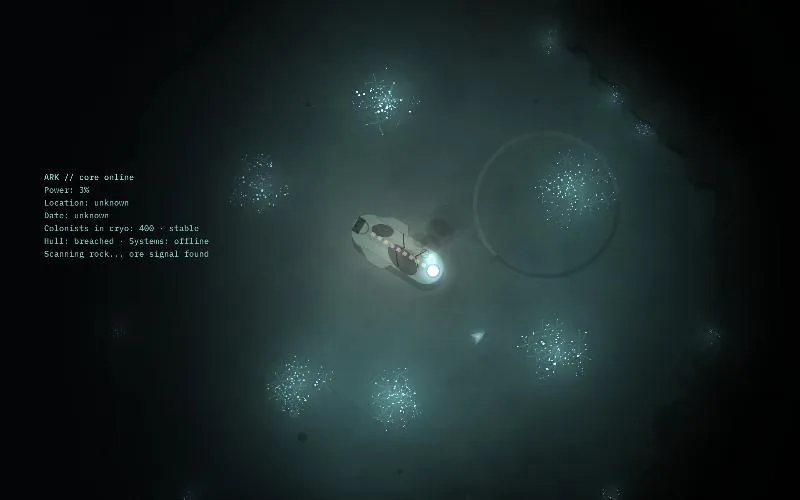 (open full size)
Seventeen seconds into the new opening: the boot log, and the first drone leaving its bay. 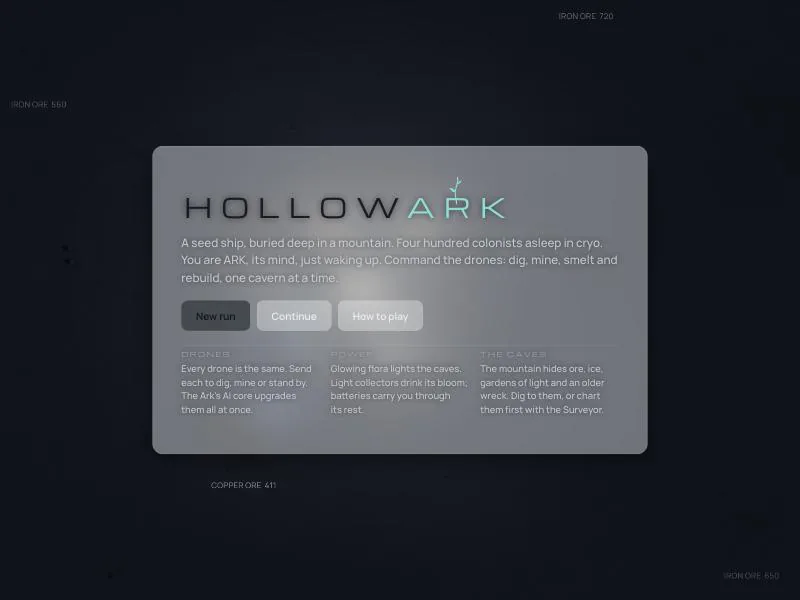 (open full size)
The title screen, with the shoot growing out of ARK. Published as “v61 Stage 1, the wake”
v62mechanicarttutorialbalance
Stage 2, the rock: hardness, the seal, concrete and storage
Claude: Built as a second background job next to Stage 1, then merged into it; at the merge, the new concrete step was rewritten in ARK's voice.
- Every rock cell has a hardness from 0 to 100%: soft by the start cave, harder further out, with hard veins. One drone digs a cell in 3 seconds at the softest and 15 at the hardest. The rock shades from warm and light to cold and dark, and hovering reads "Rock · 64% hard · about 11 s for one drone".
- The seal replaces the bedrock edge: a ring of hardened rock round everything, the darkest of all, with faint cold veins. No drone can cut it. Hovering reads "The seal · too hard for the drones. Only the Ark's cutter could get through."
- Rock is a new resource: each cell dug brings 2 to 6 home.
- The concrete mixer, 15 iron once the iron smelter works, turns 2 rock into 1 concrete and grows like the smelters.
- The Ark holds 200 of each resource. The readout shows how full it is and turns amber at the top, and miners pause. Rock past the limit is left behind, but the cell still clears. The Storage module, 20 concrete and 10 iron, adds 200 more of everything per level.
- A new tutorial step, make 20 concrete, comes before the hull patch, which now takes 20 concrete, 30 iron and 10 copper.
- The test player finishes the opening in about 39 minutes. Old saves start fresh.
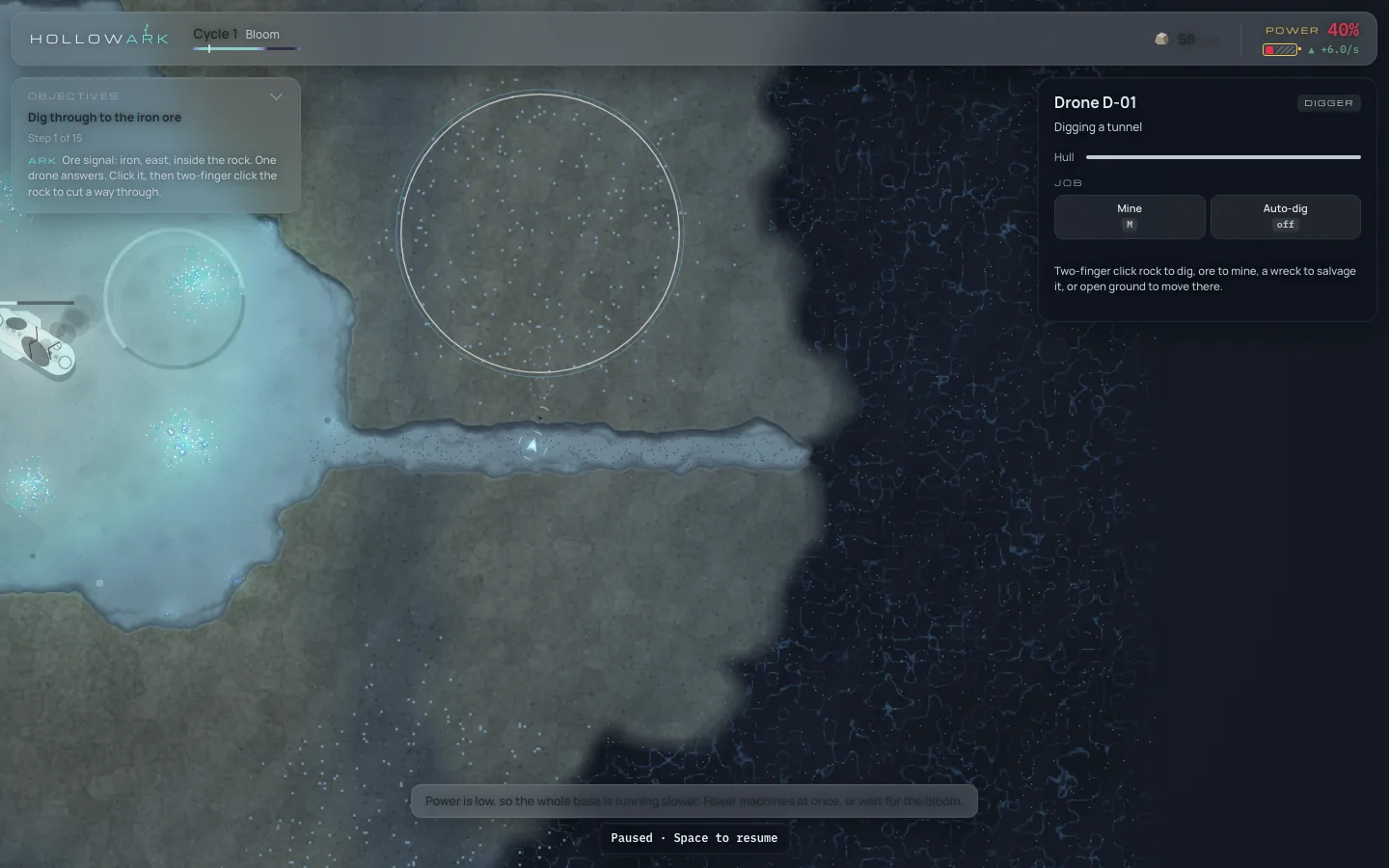 (open full size)
A tunnel dug east until it hits the seal, the dark rock no drone can cut. 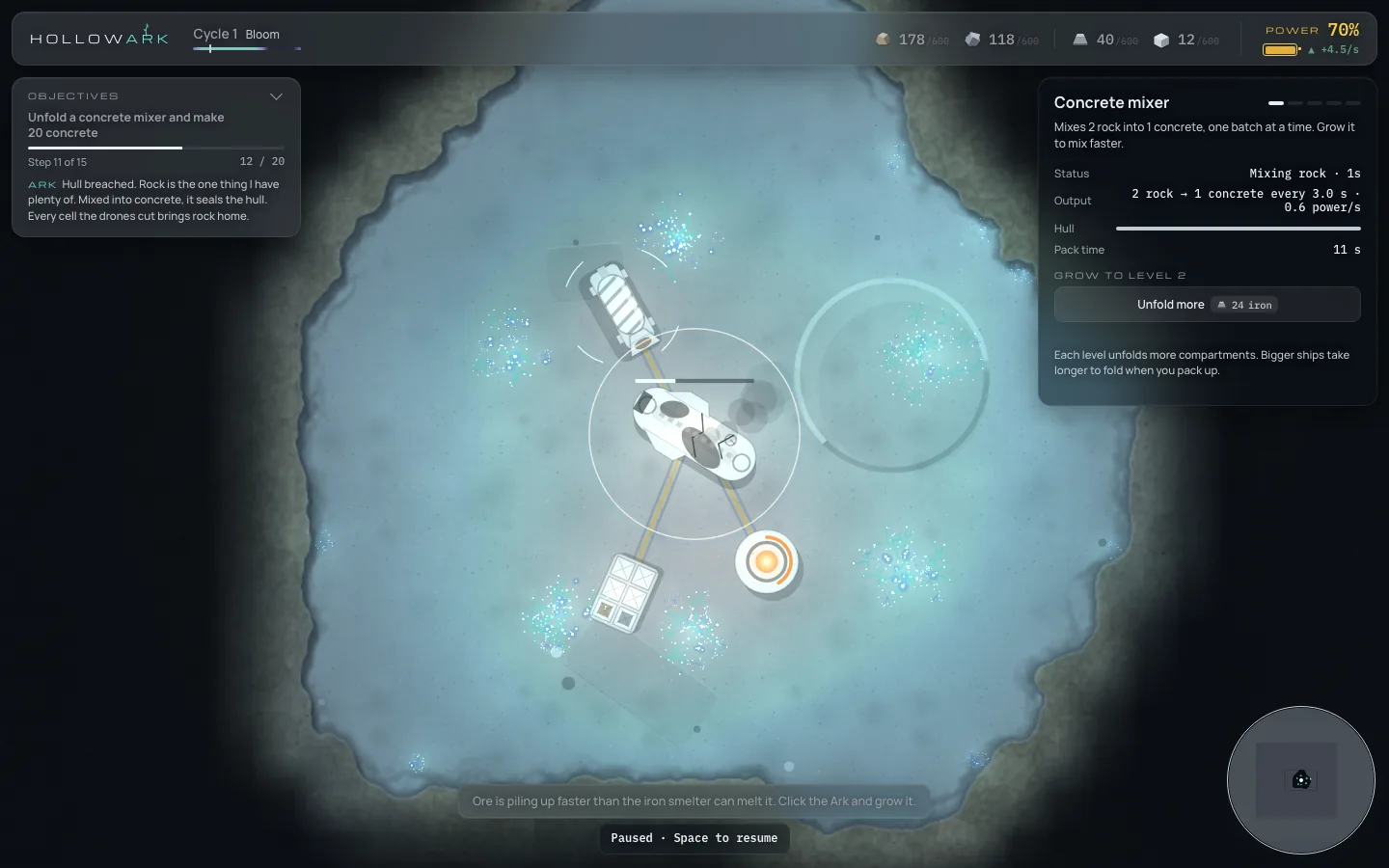 (open full size)
The concrete step: the mixer turning rock into concrete, a Storage module raising every limit to 600, and ARK's line in the objectives. Published as “v62 Stage 2, the rock”
Working backwards from the stars
Oct 14, 3:37 pm to 3:58 pm
Right after versions 61 and 62 went live, the design talk jumped to the far end of the game and worked back from it: the parts a data centre and a rocket are made of, food, terraforming, compute, water, and the places the map is made of. Claude proposed, Kraig answered in his own words, and every answer went into the design notes. None of it is built yet.
designmechanicplanned
Work the tree backwards from data centres and rockets (planned, not built yet)
“I think those make sense. And also we need to like go backwards from where we want to go. So like I said, space program, data centers. So that's like GPUs, heat sinks, optical fiber, and then eventually like rocket fuel, heat shields...”Kraig, 3:35 pm
“Yeah, I think that makes sense.”Kraig, 3:37 pm
Claude: Claude proposed four second-tier components, which Kraig accepted. Then, working back from his two end goals, Claude drafted the recipes with real-world parts under plain names, including methane harvested from the cave plants for rocket fuel.
- Planned: four second-tier components, made in the Heavy assembler from three or four inputs. Processor (two circuits and wiring) for compute; Emitter (circuit, wiring and crystal) for lasers, light collectors and the Beacon; Drive (motor, frame and circuit) for fast and attack drones, the Ark's engines and launch stages; Armour plate (frame, alloy and concrete) for walls, towers and hulls.
- Planned: the recipes come from the end goals, backwards. A data centre is GPUs, heat sinks, optical fibre and frames, plus water to cool it. A GPU (the Processor, renamed) is two circuits, wiring and crystal; a heat sink is copper and alloy; optical fibre is drawn from glass, and glass is fired from rock, so rock feeds both concrete and glass.
- Planned: a rocket stage is a rocket engine, a fuel tank, a heat shield and a GPU for the avionics. The engine is a drive, alloy and a heat sink; the heat shield is ceramic tiles fired from rock on armour plate; rocket fuel is methane from harvested alien plants plus liquid oxygen from ice.
designmechanicplanned
Food, and life in the caves and on the surface (planned, not built yet)
“But also remember, we want flora and fauna on the inside and outside of the cave system. And we also have to have a recipe tree for food and yeah, anything else you can recommend?”Kraig, 3:37 pm
“Yeah, I think all these look good. What's the next question?”Kraig, 3:39 pm
Claude: Claude worked food backwards the same way, from what the colonists eat down to what the caves give, and recommended three more trees to plan like it.
- Planned: plants and creatures both in the caves and on the surface, with different kinds in each.
- Planned: food in three steps up. Algae, grown in vats from water and light, is the easy cave food. Crops from the Ark's seed bank grow in a greenhouse on soil, water and light, and soil is rock dust and composted cave plants. Native food, alien plants and creatures made safe in a lab, is the richest, and it teaches the biology terraforming needs.
- Planned: a kitchen turns them all into rations, the one food the colonists eat.
- Planned: three more trees worked backwards the same way: medicine from plant extracts (lower death odds, safer waking), what terraforming needs (air, soil, the seed kit from orbit) and the space elevator's cable (carbon from methane, then carbon fibre).
designplanned
Terraforming: one number for the air (planned, not built yet)
“I'd say it should boil down to like one percent and then all of the other metrics should like affect it. I think all of these are pretty good in the right direction... swarm samples make a lot of sense. Yeah, for speeding up like how, like, you know, figuring out how to terraform the air better and faster against the enemy.”Kraig, 3:42 pm
Claude: Claude proposed terraforming as a tree of its own, worked backwards: three tracks, machines, life and orbit, all pushing one planet meter, with samples from the swarm as research.
- Planned: one headline percentage, how breathable the air is, fed by smaller numbers such as oxygen, toxins and temperature. Breathable air wins the game.
- Planned: three tracks push it. Machines: air processors, megastructures of catalyst stacks, carbon filters, turbines and GPU control, scrub out the toxic gas the swarm breathes and add oxygen. Life: seeders plant Earth crops and hardy native cover across the surface, with soil and microbes cultured in a lab. Orbit: each package of the seed kit brought down speeds a track.
- Planned: samples the swarm drops speed up the research that turns the air against them.
- Planned: the sky and the colours shift as the number climbs.
designmechanicplanned
Compute: ice caves, memory banks and numbered training runs (planned, not built yet)
“I think instead of just cooled for free in a cave, I think there should be ice pockets of caves. Like certain areas of caves are freezing. And in those sections, you can build data centers and not have to cool them. I think storage for compute should hit a max. Like the Ark can hold a certain amount of compute. But you have to build modules that are like big hard drives. So data centers create compute and then the hard drive modules hold the compute... And you can increase the size of them by upgrading them or building more.”Kraig, 3:47 pm
“Yes, the training runs can be numbered like that, that's fine.”Kraig, 3:49 pm
Claude: Claude had suggested that data centres in caves stay cool for free, and that ARK's upgrades be numbered like real model versions. For the units, Claude picked real ones that grow with the game.
- Planned: some caves are freezing ice caves. A data centre built there needs no cooling; anywhere else, other caves included, it does.
- Planned: the Ark holds only a little compute. Memory bank modules, big drives, add room, grown by levels or by building more.
- Planned: real units that climb with the game: data centres make petaflops, memory banks hold exaflops of work, and the last projects cost zettaflops and yottaflops.
- Planned: ARK's upgrades are numbered training runs, ARK 1, ARK 2, ARK 3 and on. Each is a big compute project that makes every recipe's compute cheaper, lets ARK run more drones at once and adds smarter automation. They are the game's spine.
designartplanned
Water only from the ice caves, and a barren surface that greens (planned, partly built)
“But also with the ice caves, I feel like that should be the only place where we find ice to make water. I don't think there should be water on the outside. Rethinking the surface, I think it should be abundant with light, but I think it should be kind of like, not quite moon, not quite desert, but like kind of barren a little bit. I don't want like flora and trees and grass everywhere because that'll help the terraform change... as our terraform percent goes up, like the surface would change and become greener with grass and like, you know, indicators that it's being terraformed.”Kraig, 3:49 pm
Claude: This replaces the rich, colourful surface of the earlier notes. Stage 4 already built the bare version: a bright, pale surface with mineral colours and no ice.
- Planned: ice exists only in the freezing ice caves, so every drop of water, for the colonists, for cooling, for the oxygen in rocket fuel and for the crops, comes from underground. Lines from the ice caves are lifelines, and the caves matter to the end.
- The surface is bright and barren, somewhere between the moon and a desert, its colour from rock, minerals and sky rather than plants.
- Planned: terraforming shows on the land: as the number climbs, grass, then plants, then more spread over it.
designplanned
Six places, each with a reason to go (planned, not built yet)
“Both major biomes is inside and outside, and then each will have their sub biomes, maybe two or three, and each of those will have its own reason for us to go there, fight enemies, extract resources, or get something or do something. So ice in caves, I think, is great and forces us to go back into caves. Yeah, there should be a reason to go to every part of the map and interact with every aspect of it.”Kraig, 3:54 pm
“Yes”Kraig, 3:58 pm
Claude: Claude proposed three sub-biomes on each side, each one holding something the run needs.
- Planned: two biomes, the caves and the surface, each with three sub-biomes, and each sub-biome holds something you need: a resource, a find or an enemy to beat.
- Planned, in the caves: the Glow caves (the glowing plants: light, methane, medicine and native food, and cave creatures), the Ice caves (all the water, and free cooling for data centres) and the Crystal deeps (crystal for circuits, emitters and GPUs, buried wrecks with data cores, and the worst cave creatures).
- Planned, on the surface: the Flats (sun, common ore, room to build and launch sites, where the swarm hunts), the Badlands (colourful mineral canyons with a rare metal for heat shields and rocket engines, and natural chokepoints) and the Hive lands (the swarm's own ground: samples for terraforming research, and guarded finds).
- Planned: the surface's own life is mostly the swarm and its hives, plus hardy crusts and lichens.
Chapter One, start to finish, and the chapters ahead
Oct 14, 5:00 pm to 5:57 pm · v63–v64
Kraig played to the end of what was built and hit the seal. Breaking it was Stage 4's job, so Stages 3 and 4 were built back to back in the background: Stage 3 took the easy power away, and Stage 4 opened the way out. With version 64, Chapter One plays from start to finish, in about 38 minutes for the test player. Meanwhile Claude drafted the next chapters in Chapter One's shape, a thin version of about 20 minutes each in four playable stages, and a first brush with the enemy moved into Chapter One. Chapters Two to Four are approved and Five is a proposal; none of them is built yet.
v63mechanictutorialbalance
Stage 3, the famine: flora for power, three drones, a new order
“Just played all the way to this ending. Am I supposed to be able to break this seal? Or have we not gotten that far yet?”Kraig, 4:29 pm, with a screenshot
“Build stage 3.”Kraig, 4:40 pm
“I have some feedback after stage 1 but it was mostly great.”Kraig, 4:42 pm
Claude: Not yet: the seal was the end of what was built, and breaking it is Stage 4. Claude offered to build Stages 3 and 4 back to back in the background, with a report and a playable link after each. Stage 3 went live as version 63 with one thing for Kraig to judge: the grid now stays red for about the first 18 minutes, because the power cells come after the three drones. Moving the cells earlier is the easy fix if it drags.
- Chapter One is now a chapter in the code: what belongs to Chapter Two is held back, not deleted.
- The cave plants are the only power underground. The geothermal tap is gone: the Ark's skin and the light collectors drink the flora's glow, and when the flora rests, a faint glow is all that's left. The grid runs at full speed in green, three-quarters in yellow and half in red.
- Red until the power cells are repaired, yellow until the first light collector unfolds, then green while the battery holds. It slips back to yellow while the flora rests: that's the famine.
- Three drones at most. Try to build a fourth and ARK says, "My core is cracked. Three drones is all I can run." Drones cost 15 iron instead of 20 to keep the red start bearable.
- The AI core, drone upgrades and the Surveyor are saved for Chapter Two, along with data centres, life support and packing up the Ark. ARK's lines, the panels, the help and the title screen no longer mention them.
- The tutorial in a new order, 13 steps: dig to the iron, mine it, repair the smelter and smelt; repair the Fabricator and build up to three drones; repair the power cells and unfold a light collector; dig to the copper and unfold the copper smelter; make concrete and patch the hull; repair the engines and cutter. The last objective reads "Bore through the seal".
- "Grid falling behind" no longer pops up the moment play starts.
- The test player finishes the 13 steps in about 35 minutes. Old saves start fresh.
Published as “v63 Stage 3, the famine”
designenemiestutorialplanned
A first brush with the enemy, in Chapter One (planned, not built yet)
“I am considering like the smallest version of like introduction to the enemy within the cave system for the tutorial. Like a fight that you know we can always win. Cause like the Ark can defend itself with a laser. And if just like one or two pop out after you do the copper, like I feel like you're mining for one of the resources and then as soon as you unlock it, like there's some hiding with it and they come out straight to the Ark. And something like that might be interesting. If not, like another little swarm of enemies right after we break the seal and go on the outside.”Kraig, 5:24 pm
“Yes”Kraig, 5:26 pm
Claude: Claude suggested doing both, in different ways: a real fight in the cave, and only a glimpse outside.
- Planned: when the drones break into the copper cave, two cave creatures nesting there burst out and run straight at the Ark. Its laser cuts them down, so you always win, but each shot costs a little power, which stings in the famine. ARK logs it: "Movement in the copper cave. Two contacts. Defence online."
- Planned: after the breakout, a few swarm scouts on a ridge watch the Ark, then slip away. No fight, just the hook into Chapter Two.
- Planned: both go into a polish round on Chapter One, with Kraig's notes from playing it.
designstoryplanned
Chapter Two, Sprout: the plan (planned, not built yet)
“And yes, you can write chapter two plan...”Kraig, 5:18 pm
“Yes”Kraig, 5:29 pm
Claude: Claude drafted Chapter Two in Chapter One's shape: a thin version, about 20 minutes, in four playable stages with Kraig's OK between them. The goal: wake the first three colonists and keep them alive while the swarm finds you.
- Planned, stage 1, sun and mind: the chapter opens on the surface after the Chapter One card, with CHAPTER TWO · SPROUT. Real days and nights with sun power: the famine's relief, but the nights bite. The AI core repair comes back and makes a small trickle of compute, and training run ARK 1 raises the drone cap from three to six and brings drone upgrades back.
- Planned, stage 2, water and the first sleeper: water comes only from the ice cave back inside the mountain, an ice miner there and a line to the Ark, the first lifeline. The still turns ice into water, the oxygen plant water into air, and algae vats water and light into food. Life support is one gauge with death odds.
- Planned: colonists wake one at a time, for compute, three in this chapter, each a specialist with a bonus that stacks: the engineer (building and repairs), the botanist (food) and the medic (lower death odds). They can die; only losing the Ark ends the run.
- Planned, stage 3, parts and factories: the Assembler makes frames, wiring and motors on its own while the inputs last, and upgrading it beats building a copy. New drones, life modules and towers cost those parts.
- Planned, stage 4, the swarm and the lander: scouts find you, and the first nest guards the convoy's crashed cargo lander. Laser towers, laser-fitted drones, slow self-repair and a costly Repair all. Clear the nest and salvage the lander: circuits, and a data core whose fragment points at the seed kit in orbit. CHAPTER TWO COMPLETE · SPROUT.
- Planned: built after the polish round on Chapter One, one stage at a time.
v64milestonemechanicartstory
Stage 4, daylight: the Ark bores out, and Chapter One is complete
“Build 4.”Kraig, 5:11 pm
Claude: Built in the background while the talk moved on to Chapters Two and Three, then merged, tested and put live as version 64. One quirk Claude flagged: the caves' flora cycle and the surface's sun share one clock, and the breakout always landed at night. So in Chapter One, when the Ark breaks out in the dark, the clock skips ahead to the next morning. You always get your daylight.
- Bore out: once the engines and cutter are repaired, the "Bore through the seal" objective has a Bore out button. The Ark folds its modules and sets a straight course for the nearest point outside the mountain.
- The drones dig the lane through plain rock. Only the Ark's own cutter bites the seal: a white-hot face at the bow, glowing cracks spreading through the dark rock, sparks and chips, an orange light down the tunnel, a slight shake and a heavy grind.
- The seal takes about a minute of cutting at full power, and the cutter draws more than the battery holds. The battery runs dry near the end and the Ark cuts on at half speed on the flora's trickle, but it never stalls. Once it's through, the rest of the hole goes three times faster.
- Daylight: a white flash fades into a bright, barren surface, warm pale ground with rust, slate-violet, basalt, ochre and salt mineral fields, and the camera eases back over the open land.
- The sun reaches the Ark at the hole. Its skin drinks six times what the brightest bloom gave, and the grid is green in about 20 seconds: the famine is over.
- ARK reads the stars in the boot log's hand: sky clear, star fix acquired, matching against launch charts, then "I slept N years", a different number each run, between 200 and 459. "Colonists in cryo: 400 · stable. Waking them comes next."
- The CHAPTER ONE COMPLETE card, in the opening's style with the teal shoot: THE SEED, your time, cells dug, rock mined, concrete made, drones, and "Chapter Two · Sprout · coming next".
- Keep exploring lets you roam the surface, still in Chapter One, while the swarm sleeps: its guards stay still and nothing fights. Or go back to the title.
- Chapter One speaks only in ARK's voice now, with its own lines for night and dawn on the surface and for the first hive it sees.
- A save made mid-bore picks the bore back up. The test player reaches the card in about 38 minutes.
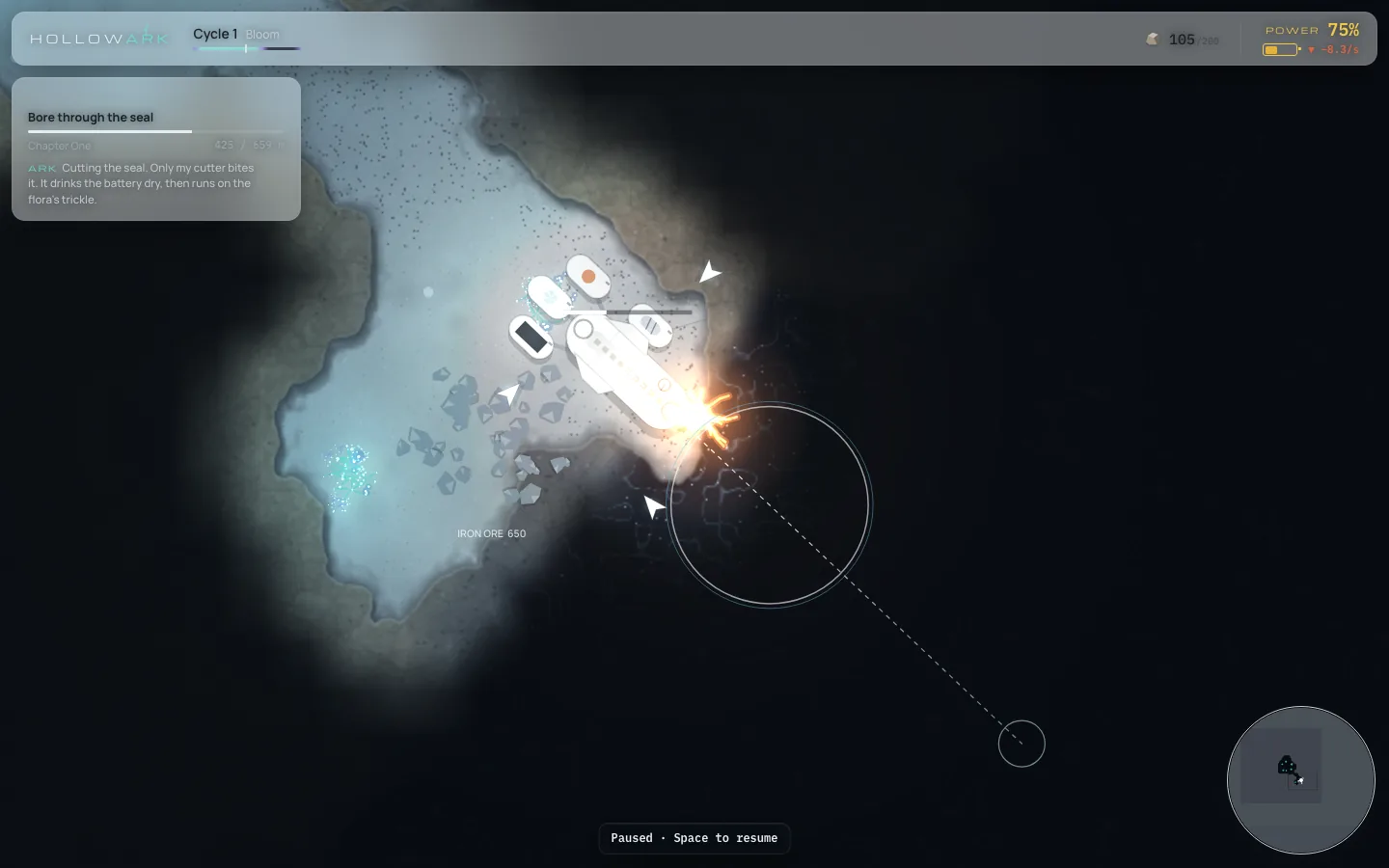 (open full size)
Twenty-five seconds into the cut: only the Ark's own cutter bites the seal, and the battery is draining. 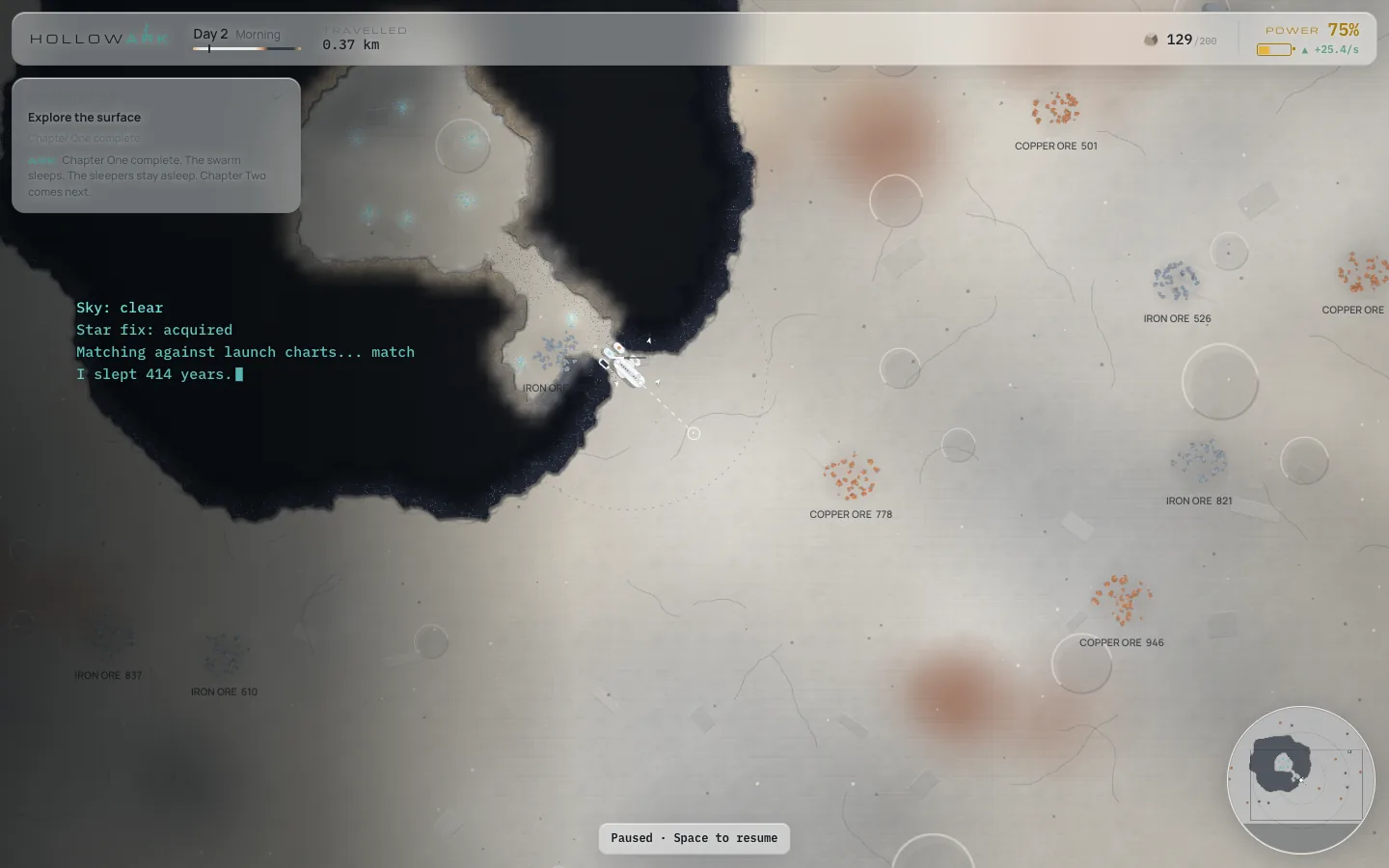 (open full size)
Daylight, nine seconds after the breakthrough: the surface, and ARK reading the stars. 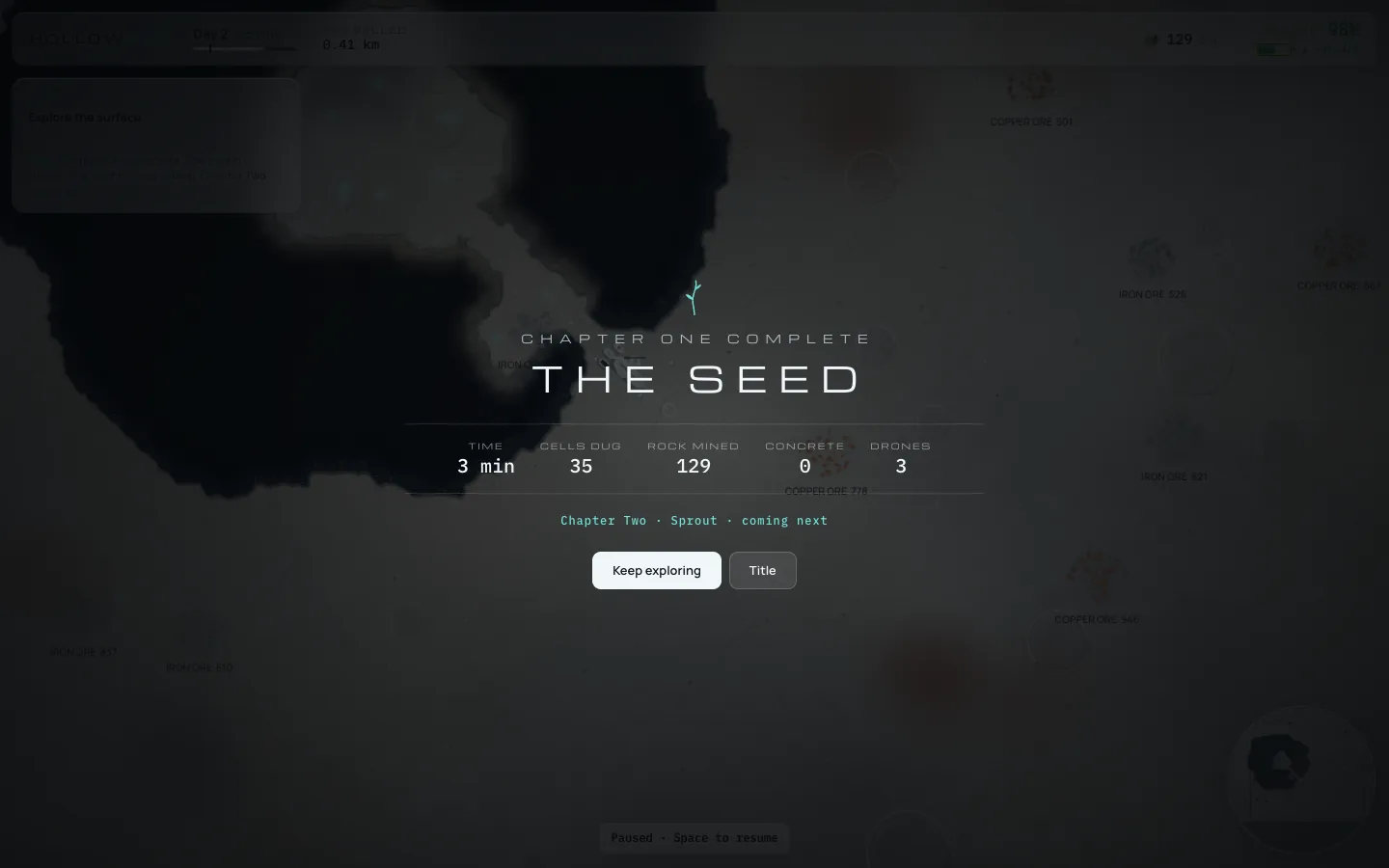 (open full size)
The chapter card. This one comes from a test shortcut that skips the tutorial, hence the 3 minutes; a real run takes about 38. Published as “v64 Stage 4, daylight”
designplanned
Chapter Three, Roots: the plan (planned, not built yet)
“What's next?”Kraig, 5:42 pm
“Yes, draft it.”Kraig, 5:43 pm
“Yes”Kraig, 5:52 pm
Claude: Claude laid out the order (Stage 4, then a polish round on Chapter One, then Chapter Two) and offered to draft Chapter Three in the same shape. The goal: grow the network outward, find crystal and make real compute.
- Planned, stage 1, lines and outposts: one network from the Ark, lines carrying power and goods, and relays to reach further. An outpost with no line runs on its own power, and its goods count only once it's linked; expedition parties pack up full and carry their load home. The swarm starts going for lines, and a cut line drops the power past the cut.
- Planned, stage 2, the Beacon and the deeps: each ping costs power and compute, finds one thing, and can wake what's nearby. It finds the Crystal deeps: an expedition in, cave creatures guarding the crystal, and the Assembler making circuits from wiring and crystal. Wake the geologist for rarer finds and better pings.
- Planned, stage 3, data centres and memory: a melter turns ore and ice into alloy and water, heat sinks are copper and alloy, and the first data centre, built from frames, circuits and heat sinks, needs cooling water, or none in an ice cave. Memory banks store the compute.
- Planned, stage 4, ARK 2 and the lander's core: training run ARK 2 raises the drone cap from six to ten and adds auto-build and auto-repair. Decrypting the lander's data core with compute gives the convoy's map: the rare metal in the Badlands and the site planned for a permanent city. CHAPTER THREE COMPLETE · ROOTS.
designenemiesplanned
Chapter Four, Trunk: the plan (planned, not built yet)
“Yes”Kraig, 5:54 pm
“Yes”Kraig, 5:57 pm
Claude: With Chapter Three approved, Claude offered to draft Chapter Four next, and Kraig said yes to the draft and then to the plan. The goal: found the permanent city and hold it.
- Planned, stage 1, the city site: follow the convoy's map to where the Flats meet the Badlands, with room, cliffs and natural chokepoints. Detach modules there to found the permanent city while the Ark stays free to move, raise concrete walls, and bring in titanium, the Badlands' rare metal, by line or expedition.
- Planned, stage 2, the Heavy assembler: drives, armour plate, emitters and GPUs; a glass furnace and optical fibre; a second-generation data centre for a big jump in compute. Wake the pilot.
- Planned, stage 3, defence grows up: a hangar sends attack drones out on sorties, drones that survive earn veteran ranks, and laser towers and armoured walls get stronger.
- Planned, stage 4, ARK 3 and the siege: training run ARK 3, then the swarm's first siege on the city, with bigger waves and one large brute. Hold it, and ARK 3 finishes decrypting the lander's core: the blueprint for the uplink, the hook into Chapter Five. CHAPTER FOUR COMPLETE · TRUNK.
designplanned
Chapter Five, Canopy: the plan (planned, not built yet)
“Yes build all the way to 6”Kraig, 6:27 pm
Claude: Right after Kraig approved Chapter Four, Claude drafted Chapter Five in the same shape. The goal: make contact with orbit and start turning the planet green. Kraig approved it with the Chapter Six plan.
- Planned, stage 1, the uplink: build the communications array from the blueprint, a big compute project. Contact: the seed kit is in orbit, intact and waiting, and the uplink shows what became of the convoy. Two roads open: terraform from the ground alone, slow and costly, or bring the kit down in Chapter Six.
- Planned, stage 2, life: harvest the Glow caves' plants for methane and extracts, grow crops from the Ark's seed bank in a greenhouse, make rations in a kitchen and medicine in a lab. Wake the biologist.
- Planned, stage 3, machines: the first air processor, and the planet meter appears, "Air: N% breathable", fed by oxygen, toxins and temperature. Samples from swarm kills and hive raids speed the research. Training run ARK 4 makes everything cheaper and faster.
- Planned, stage 4, seeders and the swarm's answer: seeders plant cover outward from the city and the land visibly greens, while the swarm fights harder as the number climbs and goes for the air processors. Reach 25% breathable. ARK's conclusion: from the ground alone this takes generations, and the kit in orbit would finish it. CHAPTER FIVE COMPLETE · CANOPY.
The Lantern look
Oct 14, 6:07 pm to 8:01 pm · v65–v71
Chapter One got its first fight, then a full design upgrade in four phases: a dark cave lit only by flora and lamps, a readable screen, seed-pod machines, a bone-and-amber surface. Music that follows the bloom, new menus, a tinier start and a faster Chapter One came in the same evening, while the plan reached all the way to Chapter Six.
v65enemiestutorialstory
First contact: the copper cave's lurkers and the scouts on the ridge
“The smallest version of like introduction to the enemy within the cave system for the tutorial. Like a fight that you know we can always win. Cause like the Ark can defend itself with a laser.”Kraig, 5:24 pm
Claude: The first piece of the Chapter One polish round, built to the plan Kraig approved earlier.
- When the drones first break into the copper cave, its nest stirs and two lurkers, the caves' own creatures, pale, many-legged and glowing faintly, run for the Ark along the tunnels.
- A short-range turret rises from the hull and cuts them down. It always wins: it fires even on an empty battery, drones only get a scratch, and the hull loses a little at most.
- ARK logs it: "Movement in the copper cave. Two contacts.", "Defence online.", "Contacts down. The caves aren't empty." The camera nudges once to frame the nest and the Ark.
- After the breakthrough, before the chapter card, four swarm scouts come over a rise on the plain, stand watching the Ark, then drop back out of sight. No fight: just the hook for Chapter Two.
Published as “v65 First contact”
designart
A design upgrade: the Lantern look, in four phases
“I also want to do a general design upgrade. Let's plan out how we can make it look better as well as better animations and design style.”Kraig, 5:44 pm
“The design changes sound fantastic. Let's do them.”Kraig, 6:07 pm
Claude: Claude audited every screen (what already looked good and the twelve biggest problems), then offered three directions: Lantern (dark caves lit only by the flora and the Ark's lamps, pale ceramic machines, a bone-white surface under an amber sun), Porcelain (everything light and airy) and Signal (the world as ARK's sensors see it). It recommended Lantern: the opening Kraig already liked, carried through the whole game.
- Lantern chosen, with Claude's defaults: modules at about half their size as one family of seed pods, the Ark drawn as a seed and power lines as roots; on phones the title and a compact screen, while play stays laptop-first.
- Four phases: 1, dark cave, bright machines; 2, the pod family and its unfold animations; 3, a readable screen; 4, alive caves and the surface.
- The rules: colour only where it means something, one accent colour per object, nothing on the ground that looks like interface, no pure black, and white only for lamps.
designstoryplannedmilestone
Chapter Six, Reaching, and "build all the way to 6" (planned, not built yet)
“Yes build all the way to 6”Kraig, 6:27 pm
Claude: Claude drafted the finale in the same shape as the other chapters and proposed the build order to the end: the design upgrade first, so every chapter is built on the new look, then Chapters Two to Six back to back, each tested and put on the play link as it lands.
- Planned, stage 1, fuel and the launch site: rocket fuel from the flora's methane and oxygen from ice-cave water, rocket engines, heat shields fired from rock, fuel tanks and a launch pad at the city.
- Planned, stage 2, first launches: each rocket reaches the seed kit in orbit and brings one package down, each package speeds the terraforming, and the swarm hits launch sites hardest. Training run ARK 5.
- Planned, stage 3, the elevator: carbon fibre spun from methane for the cable, segments from the Heavy assembler, and the climb as the last great project.
- Planned, stage 4, the last stand and the win: the swarm's final assault as the air nears breathable, the elevator finishes, the whole kit comes down, "Air: 100% breathable", the land green to the horizon and colonists stepping outside without suits. The final card: "REACHING · The seed has grown."
- The order to the end: design phases 1 and 3, then 2 and 4, then Chapters Two to Six back to back. Kraig plays and redirects any time.
v66artinterface
Design phase 3: a screen you can read
“The design changes sound fantastic. Let's do them.”Kraig, 6:07 pm
Claude: Built first because it was the quickest win: the old labels were 8.5-pixel capitals that were hard to read.
- Three text sizes and three typefaces with jobs: a wide display face only for the name, chapter cards and module names; a plain face for reading; a monospace for numbers and ARK's voice.
- One dark-glass screen in the caves and on the surface, so nothing flips at the breakout.
- A cost you can't afford keeps its number with a small red dot, and hovering says how many more you need.
- The objective reads at a glance: the step, its count and a progress bar, the button on its row and ARK's line cut to one sentence. A finished step ticks, folds away, and the next slides in.
- The Ark's panel in three tabs, Repairs, Modules and Upgrades, each with a dot when something can be done. Counts in the top bar roll up and down and flash as they change.
- On phones the title stacks, and play gets a compact bar, a one-line objective and panels that slide up from the bottom.
Published as “v66 Readable HUD”
designmusic
Music that follows the bloom
“Let's improve the music as well. Music should change based on phase or bloom.”Kraig, 6:37 pm
“Yes”Kraig, 6:39 pm
Claude: Claude proposed keeping the music generated live in code, driven by the flora's cycle, with cues for the big moments and a short theme of its own.
- Planned: rest sparse and dark, rising opening up, bloom the fullest, fading thinning downward; caves close and glassy, the surface wide and airy; a red grid thins the music.
- Planned: cues for the opening, the first fight, the bore, the breakthrough and the chapter card, a four-to-five-note HollowARK theme, and separate switches for music and sound.
designbalancetutorial
A tiny, cramped start, and a faster Chapter One
“The power cells should move closer because yeah, it drags a little slow. And just the times four speed boost is the only thing that makes that playable.”Kraig, 6:50 pm
“I expected the space that we start in to be even smaller, like really cramped and tight and just like the smallest little bioluminescent peeks through a crack and lights up the area. But what I saw was a big cavern with lots of space with like four or five blooms around. Digging your way out should be like a fun beginning, like reveal the map type of thing.”Kraig, 6:53 pm
Claude: Claude proposed moving the power cells right after the first smelting, so the red start lasts minutes, not 18, and a pacing pass aimed at about 25 minutes at normal speed, down from 38. The tiny start folded into the same pass.
- Planned: a starting pocket barely bigger than the Ark, lit by one small patch of flora glowing through a crack; everything else is rock to dig, so the first steps reveal the map.
- Planned: softer rock near the start, quicker early mining and repairs, cheaper early costs and less waiting.
designart
A time-lapse for every chapter
“Yes, that works”Kraig, 6:55 pm
Claude: One of Claude's ideas for the design upgrade: every chapter-complete card can play a short sped-up overhead replay of the tunnels spreading and the base growing, set to the theme, made to be shared as a short video.
- Planned: light snapshots recorded during play, replayed in 20 to 30 seconds from the chapter card.
v67art
Design phase 1: a dark cave, bright machines
Claude: The biggest single change to the look so far, all in the drawing code: the rules of the game didn't change.
- Under the mountain the cave is now dark: teal light pools around the flora in bloom, and in rest it falls nearly black, so the Ark's warm lamps, each module's lamps and each drone's own lamp carry the scene.
- The cave floor is the mountain's own stone, and the rock has body: hardness shows as tone and grain, the walls have a lit lip, the seal has cold veins, and ore glints only near open ground.
- The opening's slow brightening now lands exactly on the dark cave, so the wake flows straight into play.
- Drones are bigger, pale ceramic with dark trim, with twin engine glows that brighten with speed and a cyan trail. Lasers, sparks, power lines and ore draw over the darkness.
- Quieter rings: a selection is four corner brackets, the objective's target a small dashed ring with an arrow, and ranges show only while something is selected.
Published as “v67 Lantern dark cave”
design
Hold the launch until the whole game is played through
“I agree with the holding off till I play it all the way through and give my notes to do a launch. And also, like, that'll be a big part of what we develop, like the marketing, the initial batch of people we try to get to play and give feedback. But at first, we just want, like, as many people playing as possible and giving good feedback so that we can iterate on the process of making games in general.”Kraig, 6:56 pm
Claude: Claude suggested keeping these pages unlisted until the whole thin game can be won and Kraig has played it start to finish. Lessons from making this game are being kept for the next one.
- The pages stay quiet until the thin game is winnable and Kraig's playthrough notes are in.
- Then the launch becomes its own piece of work: getting the first players in and hearing back from them. The first goal is as many players and as much good feedback as possible, to improve the game and the way games get made.
v68music
Music that follows the bloom, and the HollowARK theme
“Yes”Kraig, 6:39 pm
Claude: Still synthesised live in the browser, no recordings. Claude also wrote a test that plays 36 minutes of the score through a strict stand-in for the browser's audio and fails on any error or voice left running.
- Under the mountain the score follows the flora, blended continuously: rest is a low drone, the odd water drop and a lot of silence; rising fades in a slow arpeggio; bloom is warm pads, glassy bell melodies, a gentle pulse and the cave breathing; fading lets the melody fall away.
- Caves sound close and glassy with a long echo; the surface wide and airy, brighter by day, colder at night. A red grid thins the voices and makes them waver.
- Cues: a tone rising with the Ark's lights in the opening, a climbing figure under the first fight, a crescendo with a quickening heartbeat through the seal, a swell that peaks into the breakthrough flash and resolves, and the theme on the chapter card.
- The HollowARK theme, five notes, D A B E D, also turns up now and then in the bloom's bells.
- Music has its own switch (J), separate from sound effects (N), and both are remembered.
Published as “v68 Adaptive music”
v69balancetutorial
Pacing: a tiny start pocket and a faster Chapter One
“Digging your way out should be like a fun beginning, like reveal the map type of thing.”Kraig, 6:53 pm
Claude: Aimed at about 20 minutes for the test player at normal speed, down from 38. A new test reports minutes in each power band, when the red start ends and the longest stretches with nothing new.
- The start pocket is barely bigger than the Ark, lit by one patch of flora through a crack. Everything else is rock to dig.
- With no open ground, a new module's arm grinds out its own bay beside the Ark.
- Power cells come right after the first smelting, so the red start is short.
- Quicker everything early on: faster mining, softer rock, quicker smelting, and roughly half the early costs (15 ore for the smelter repair, 12 iron for the power cells and the Fabricator, 10 iron a drone).
- A narrower lane for the bore, so the breakout comes sooner.
Published as “v69 Pacing”
v70artinterface
Design phase 2, seed pods, and new menus
“Yes”Kraig, 6:44 pm
Claude: Two rounds built side by side and merged a minute apart.
- Modules are one family of seed pods: a round ceramic pad, petals lying flat round the core, the core the only coloured part, each type with its own small working motion (a pulsing crucible, a turning drum, a fan leaning to the flora).
- Half the size, so a cave holds two to three times as many. Pods land, hinge their petals open and light their lamps in order; they pack back into a capsule to travel and ease outward as they grow.
- The Ark is drawn as the seed: a teardrop hull with leaf vanes and a teal seam that brightens with stored power. Power lines are roots, tapering and wandering, with pulses running out along them.
- A new title screen with Continue, New game, Chapters, Settings, How to play and Credits, worked with the arrow keys.
- A pause menu on Esc; settings for volume, quality, screen shake, text size, reduced motion, a softer breakout flash, difficulty, hints and pausing when the window loses focus.
- Every key can be rebound, right-click gives every two-finger-click order, and there are three save slots with autosave, export and import.
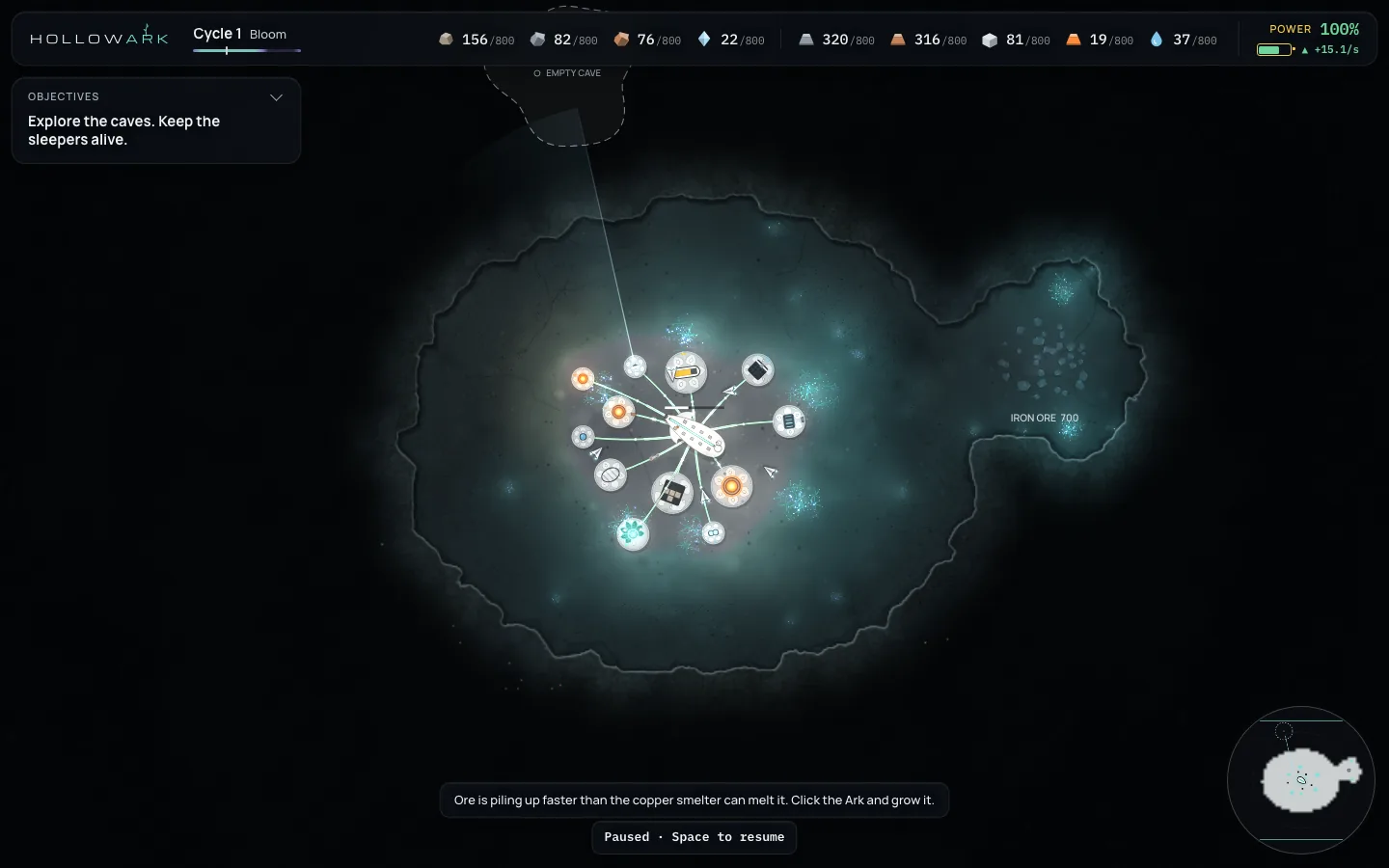 (open full size)
The pod family: half-size seed pods round the Ark, power lines as roots. Published as “v70 Seed pods and menus”
designartstory
An abstract title: the story as a blueprint
“The title screen is a spoiler for the opening. Not good. Let's make it more abstract for the menu.”Kraig, 7:32 pm
“What about a super minimal abstract blueprint style of the story leading up to the crash. Mother ship sending out seeds on an ancient ship. Light speed seed and drop out to see a planet. Close the animation on the planet.”Kraig, 7:33 pm
Claude: Kraig named the feel he wanted: ancient schematics. Claude's version: thin teal lines on dark, telling the backstory in a loop and never showing the crash or the cave.
- Planned: the mother ship releases its seed ships; one ancient seed ship; the jump to light speed; dropping out at a planet; closing on the planet as a slowly turning wireframe globe.
v71artmilestonemusic
Design phase 4: living caves, a bone-and-amber surface, the time-lapse
“Close the animation on the planet.”Kraig, 7:33 pm
Claude: The last phase of the design upgrade, so Chapter Two onwards will be built on the finished look.
- The caves are alive: the flora breathes with the bloom, spores drift in bloom, small lights flicker, and dust hangs in the lamps' light. Dug tunnels keep their rubble.
- Before the breakthrough, a shaft of daylight cuts through the seal's last crack, then the flash swells in.
- The surface in Lantern's day colours: bone-white ground, drifting dust, warm shadows, an amber cast at sunrise and sunset, and the mountain in relief with a long shadow that follows the sun.
- The chapter time-lapse: the run is recorded in tiny snapshots, and the chapter card and the Chapters screen play a 26-second overhead replay with its own cue.
- The title screen is a looping blueprint of the backstory: the carrier, the seed ship, the jump, the arrival, the world.
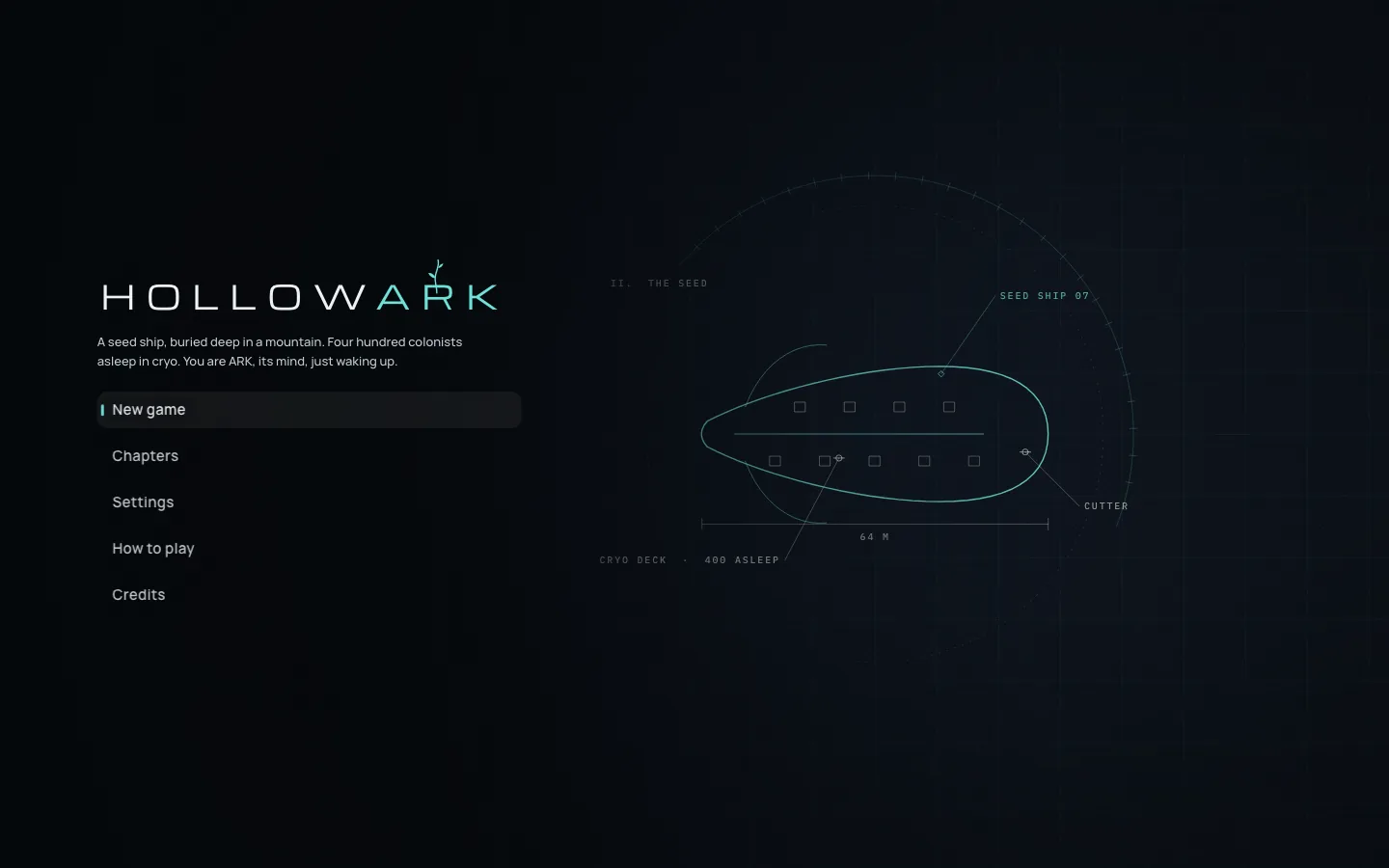 (open full size)
The title's blueprint loop, at the seed ship. 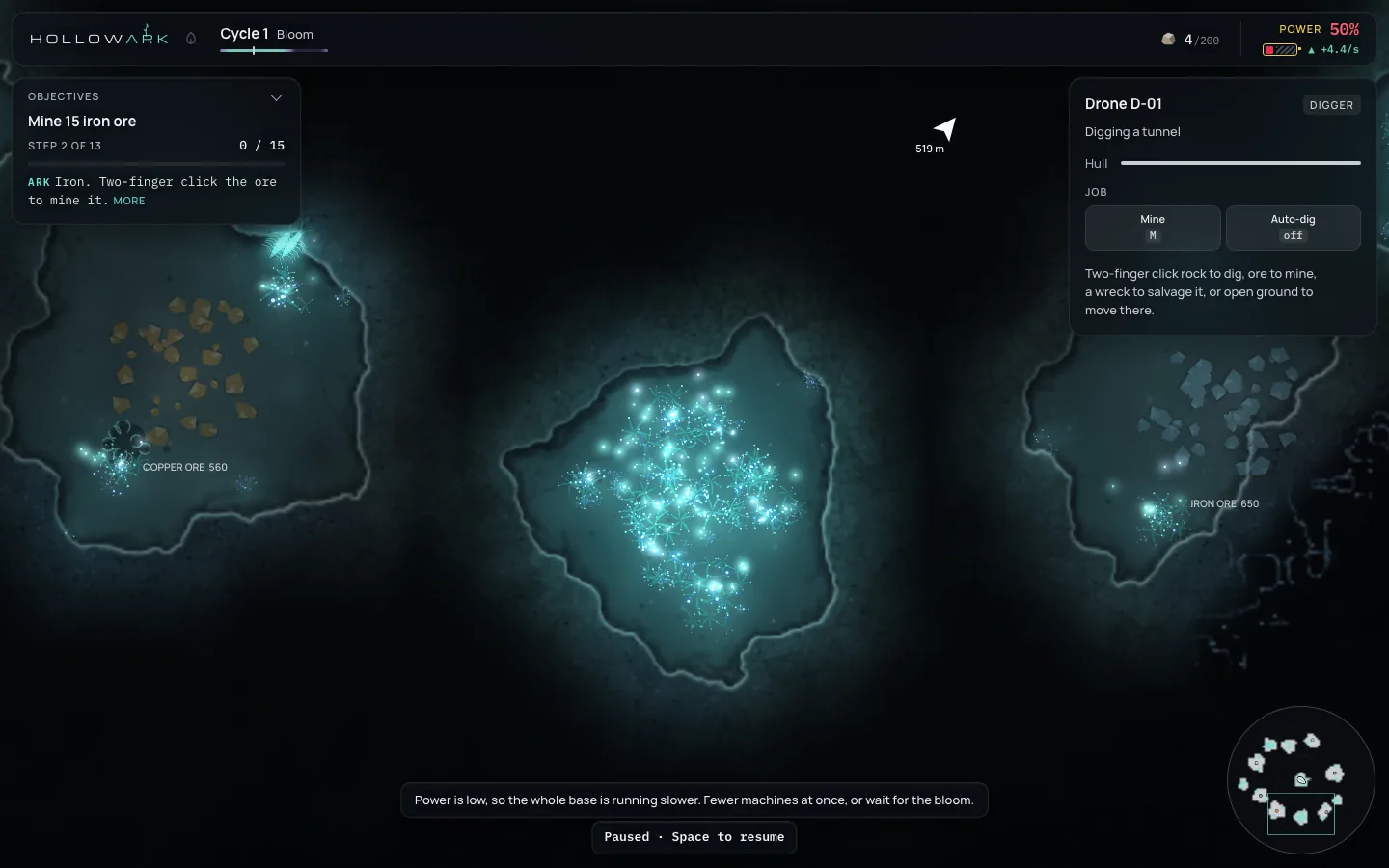 (open full size)
A cave garden in bloom: the only light underground. 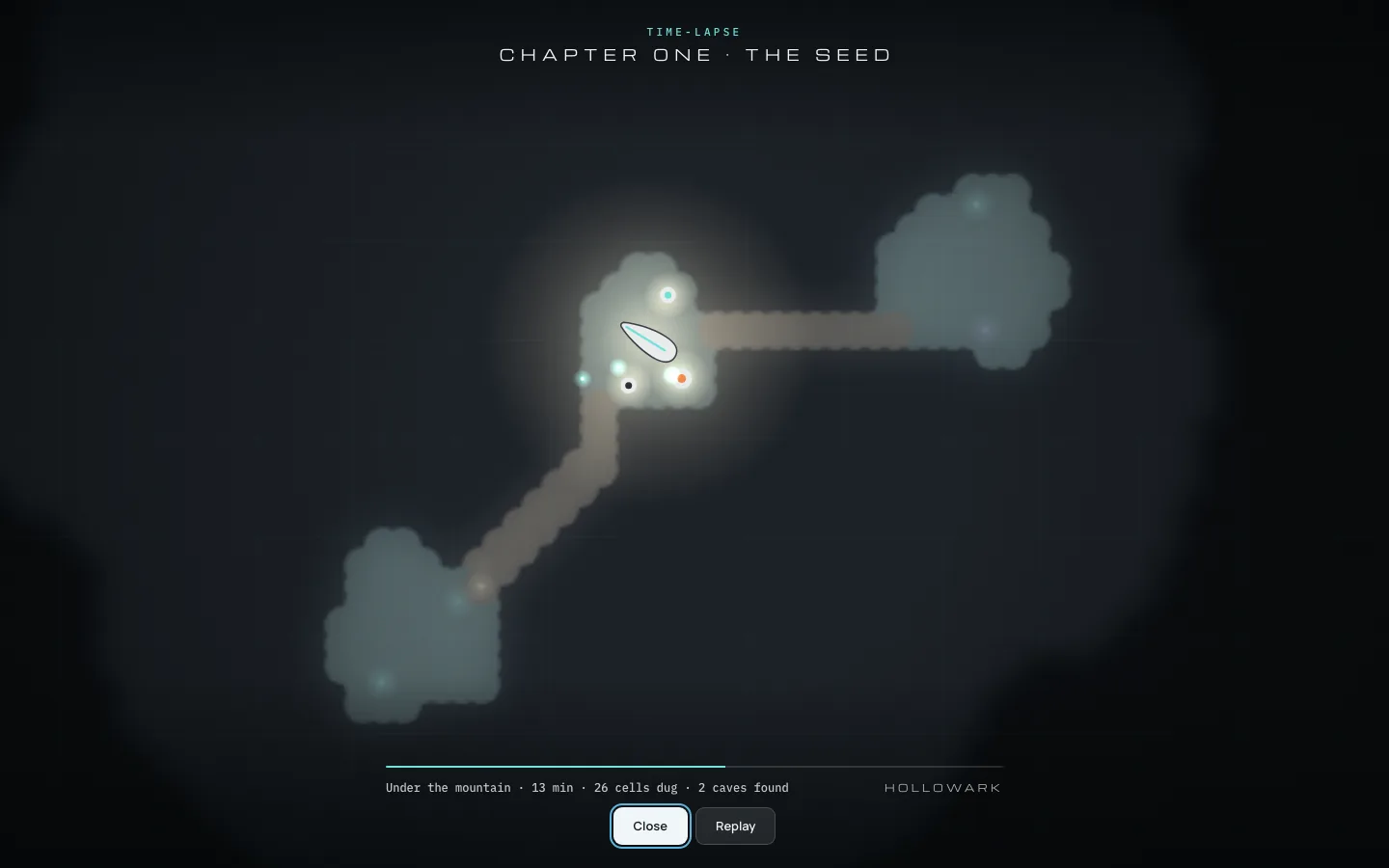 (open full size)
The chapter time-lapse, halfway through a run. 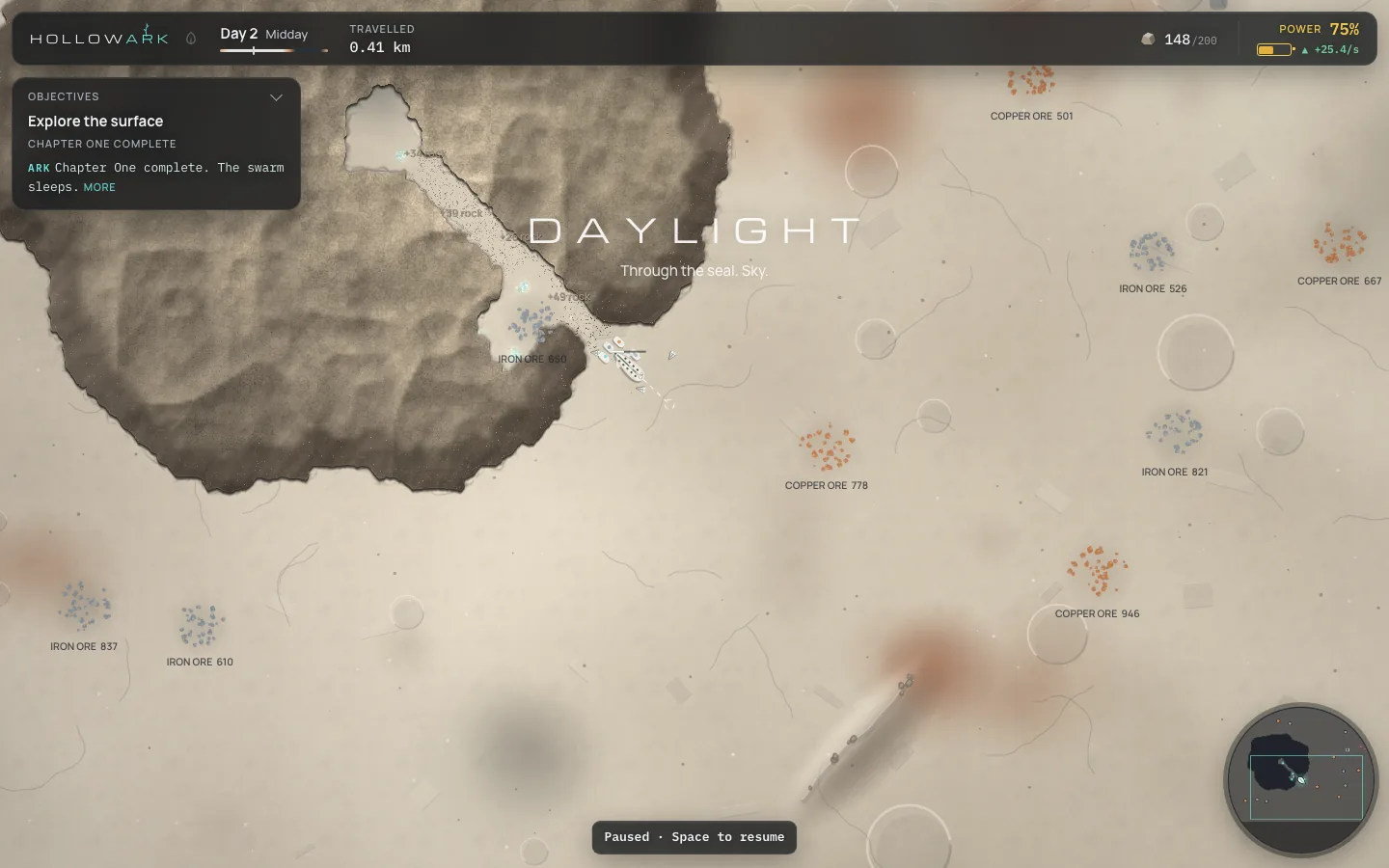 (open full size)
Daylight: the bone-and-amber surface. Published as “v71 Phase 4”
Play the build
It runs in the browser on a computer, with a trackpad or mouse and a keyboard. It's an early build: it changes every day and saves can reset between versions. Tell me what felt good and what didn't.