Auto Claude: two AI routines run my inbox, calendar and files
Two Claude routines now file my email, keep my calendar and handle my files, and bring me one list to review. How they work, and what day one taught me.
I make long films about hiking alone, about 250 of them on YouTube, and I make hiking guides from them. Around that sits a lot of desk work: email from brands and platforms, a calendar, files spread between my Mac and Google Drive, short videos for every platform. My problem has never been ideas. It's getting things shipped.
So this fall, with Claude, Anthropic's AI model, I've been building KraigOS, a small system of my own that keeps track of every project, deal, film and to-do. The idea is that Claude does the busywork and I make the decisions. On October 12 that took a big step: Auto Claude.
What I asked for
That morning I described it in chat like this: "i picture having an 'auto Claude' that runs every hour. it should try to do everything i would be doing and whatever it can. Basically instead of my having to prompt in claude, every hour it tries to be me and get work done better than i even could."
It should start with email, file what each one means, and "if there is a bottleneck or decision i need to make before it proceeds, it should place that in the list".
Before that day, a worker in my Cloudflare account handled email around the clock, and a Claude task on my Mac worked through a to-do list every couple of hours. Both were switched off that morning, and I wanted the new version to start with me reviewing everything: "i want to get back into a review period. i want to review most everything, especially email before you move forward. i want to trust that your next step on auto is actually correct."
Two routines, one list
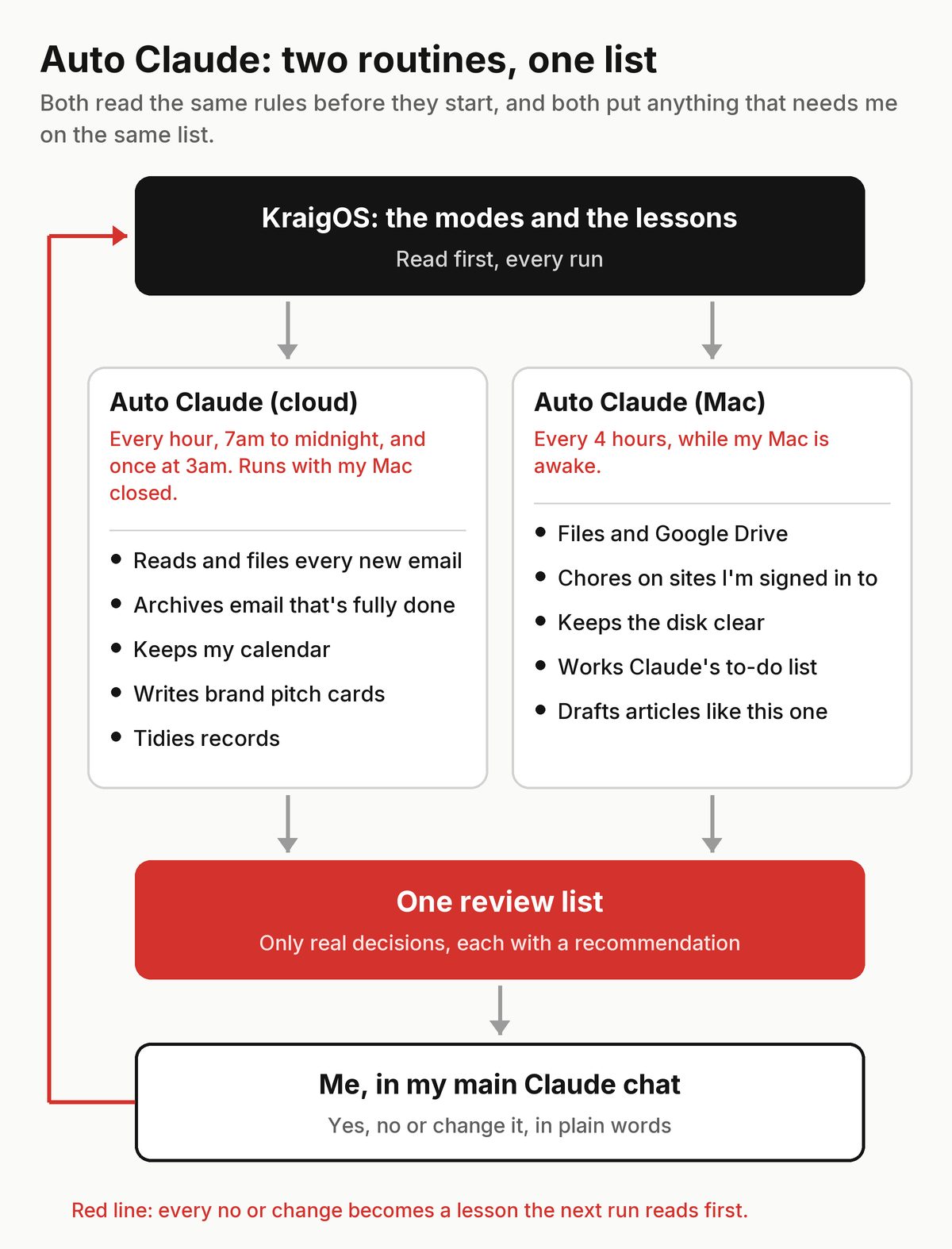
- Auto Claude (cloud) is a Claude routine on my Claude account. It runs every hour from 7am to midnight, plus once at 3am, whether my Mac is open or not. It handles everything that goes through a connector: email, my calendar, the records in KraigOS and brand pitches.
- Auto Claude (Mac) is a scheduled task in the Claude app on my Mac. It runs every 4 hours while the Mac is awake and does what needs files or my signed-in browser: Google Drive, chores on sites I already use, keeping the disk clear, and drafting articles.
Each part of the work belongs to exactly one routine, so they never step on each other. I said why I wanted the cloud half: "it would be nice for the cloud session to always be running for situations like when i'm transporting the mac."
Every run starts fresh. Before it does anything, it reads two records in KraigOS: the modes (what it may do on its own) and the lessons (my corrections so far). Then it works, and anything that needs me goes on one shared review list.
Autopilot, review or paused
Every part of the work has a mode. On autopilot it acts, then lists what it did and how to undo it. In review it proposes, and nothing happens until I say yes. Paused means it does nothing.
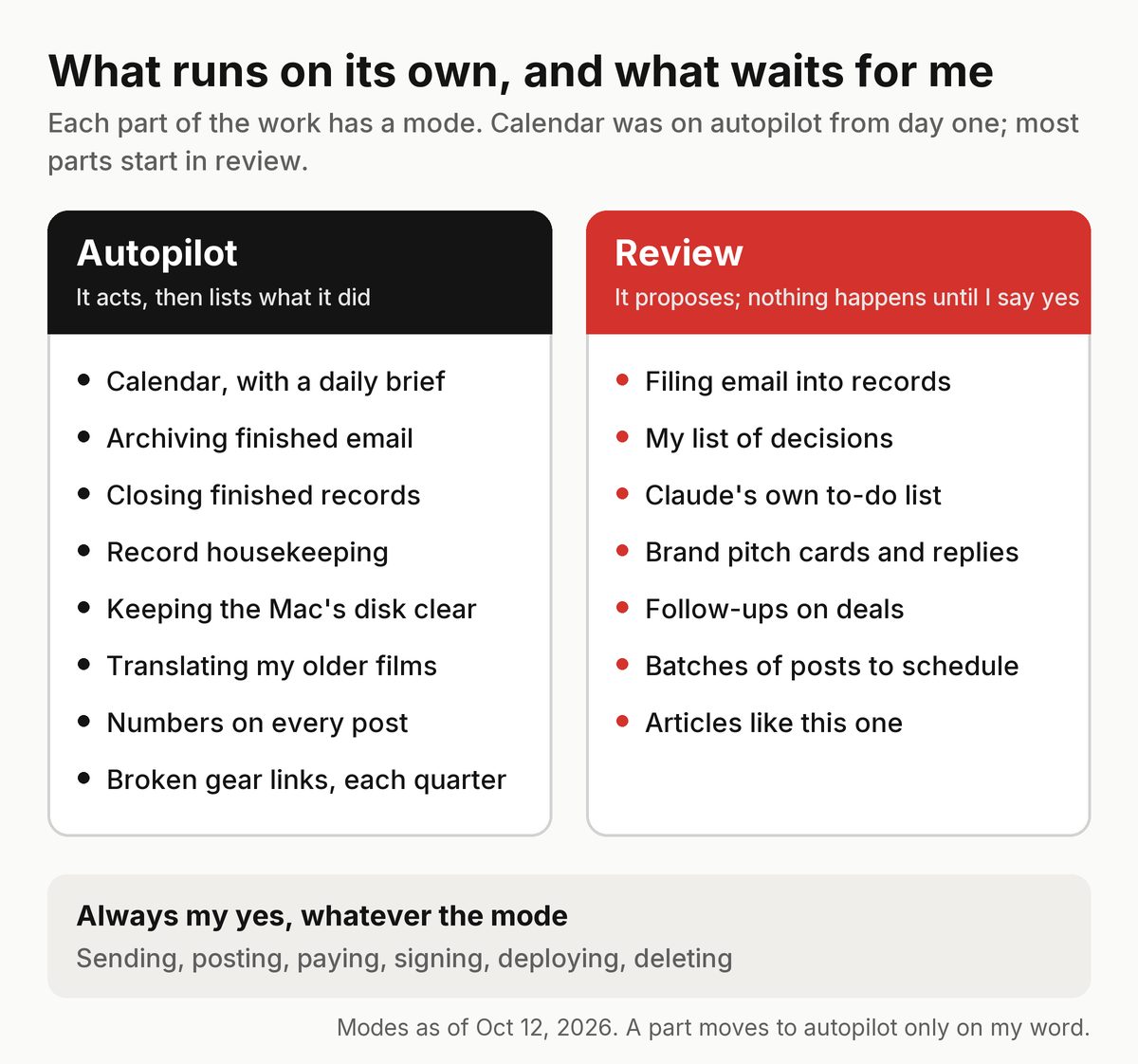
The calendar went on autopilot from the start. I never want to type in it: "i might reference it on my phone time to time but i'll usually interface the cal through claude chats here." Why that part first: "cal is less risk so that's why it's enabled to be on auto pilot now."
Email is the opposite. Filing it stays in review, and sending is paused completely. The goal is the same as the calendar, just later: "i'd rather always interface email through claude but that's eventual and requires more trust to become auto pilot, that's why we're manual for now."
How much steering a task needs depends on what a mistake would cost. Text and records are cheap to redo, so my general direction is enough. Video work is not: "if we start doing like video editing work, it would take a lot of compute energy, time, and money. And if we go in the wrong direction, it could cost us a lot." So big jobs start with a small sample for my yes.
How I answer it
There's one current list, never a backlog. Each item says what Claude saw, what it would do and why, and its recommendation. I answer with "yes", "no" or "change it", or in shorthand like "1 y, 2 n, 3 steer: shorter". I went through the first list on my phone during a walk.
There are no command words. As I put it: "i'll just use plain language in chat to give feedback or instructions probably." Saying "pause everything" or "undo that" in my main chat sets the mode, and both routines read it on their next run.
Day one
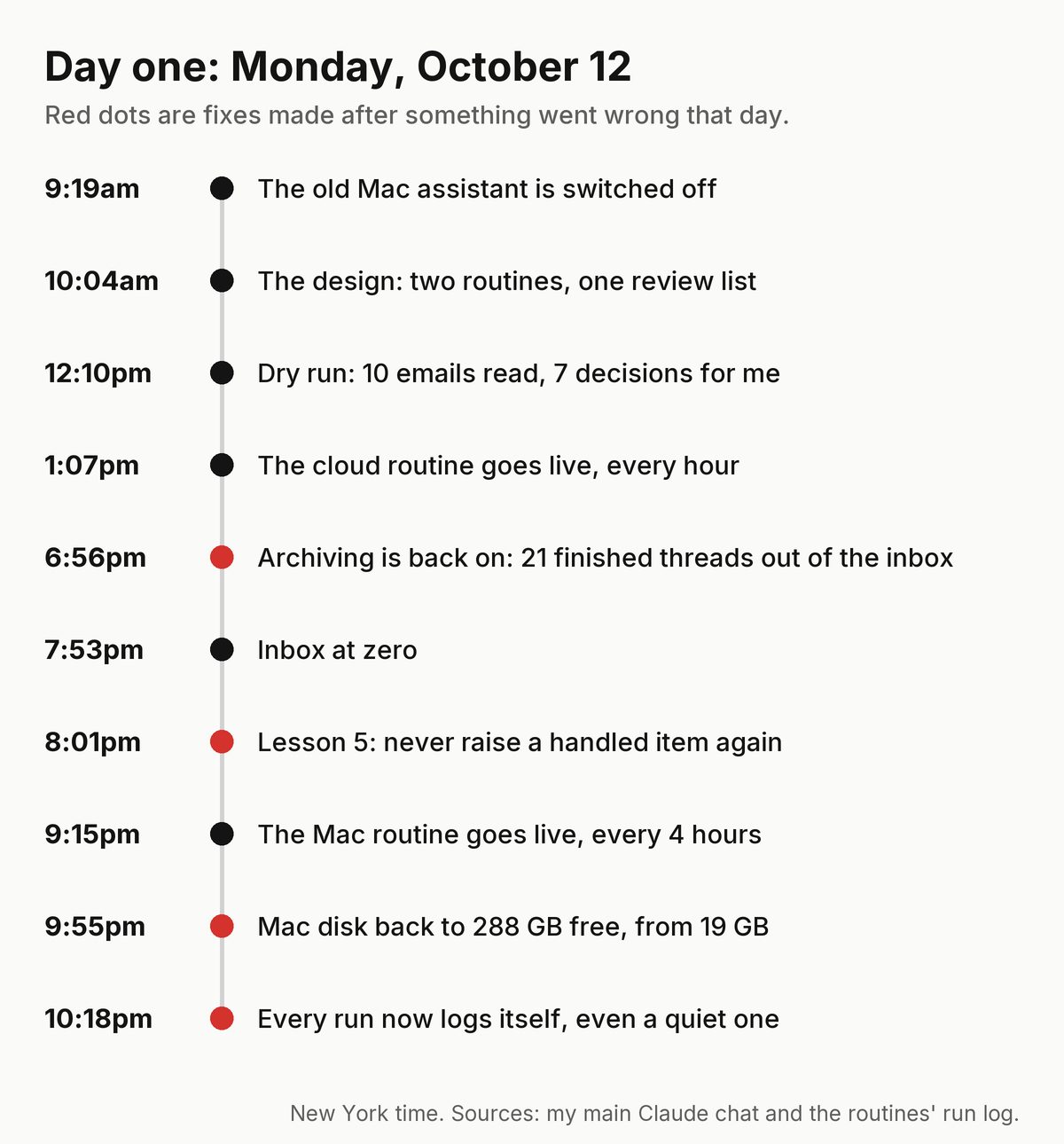
The cloud routine went live at 1:07pm and ran every hour after that. It read each new email as it came in, filed what mattered in KraigOS and sent nothing. The Mac routine had a dry run at 8:28pm that read everything and changed nothing. It found four small jobs it was ready to do, like adding each film's Drive folder to the media index in KraigOS. When Claude asked me to start it by hand, I said: "just do it yourself." It went live at 9:15pm, every 4 hours.
What went wrong, and the fix for each
Day one wasn't clean. Each problem became a rule.
- Brand pitches piled up. I had paused automatic archiving that morning, so the routine filed every email but left all of them in my inbox. By the evening I said: "There are still a lot of emails in inbox." Archiving finished threads went back on autopilot, and brand pitches got their own rule. That evening is its own article: Inbox zero with AI.
- A question I'd already answered came back. I'd dealt with it in my main chat, but the routine's list still had it open. The fix is lesson 5: before raising anything, check it wasn't already handled. Both routines now share one list with a Handled section.
- Bookkeeping on my list. An early list asked me to approve record housekeeping. My reaction: "I don't know, fully understand what you're waiting for me to decide here now. Like, what am I reviewing?" Lesson 1: housekeeping is Claude's job, and the list holds only real decisions.
- Choices instead of drafts. Claude asked me to choose between two story arcs for a photo post, described only in words. I asked: "Why can't you just draft up the entire post so I can review what the slides look like or caption looks like or whatever?" Lesson 4: show the real draft, then let me react.
- Quiet runs left no trace. A run that found nothing skipped its log line. I said "fix it now", and now every run ends the same way, even a quiet one.
- My Mac filled up. It was down to 19 GB free. The old setup backed files up to Drive but almost never removed the local copies, and I said so: "it seems like it's been doing a bad job of getting rid of files that we might not need anymore." By 9:55pm it was at 288 GB free. Now the Mac routine keeps it above 300 GB, never starts a big job that would drop it under 100 GB, and only moves safe copies to the Trash, which I empty myself.
The lessons list
The corrections live in one KraigOS record that every run reads first. After day one it had five:
- Don't put bookkeeping in front of me. Do it and list it.
- Risk decides how much steering a task needs.
- Brand and deal decisions need the full picture before a draft reply.
- For creative work, show the thing, not abstract choices.
- Never raise something already handled.
Keeping each run small
Claude measured the old setup: before doing any work, each run read about 24,000 words of rules and notes. Now a run starts with a short brief of about 1,500 words, a note for each part it works on, and the two records. A check warns when a file grows past its budget. I wanted that fixed for good: "it might get bad again in a week or month so we need to fix this problem once and for all right?"
Claude also manages how often each routine runs, so the week's work fits my plan's limit. My words: "help me do better work for less money. claude should help me do this all efficently. i don't want to waste money or compute".
What's next: the October 19 scorecard
On Monday, October 19, I get one short card per part: what it handled, what I corrected, and what it would have done on its own. Then a yes or no on moving each part to autopilot. Before Claude even asks, a part takes a test: it replays past cases it hasn't seen and gets scored against the answers I already gave.
Articles are part of it too. Auto Claude drafts any good story from my work, and each one waits for my yes, no or changes before it goes up. More on the whole system on the KraigOS page.
FAQ
What is Auto Claude?
Two Claude routines that do my desk work on a schedule: one in the cloud every hour, one on my Mac every 4 hours. Both work from KraigOS, my own database, and bring me one review list.
Does it send emails on its own?
No. Sending is paused. A reply goes out only after I say yes to the exact text in my main chat.
What does it do without asking?
My calendar, archiving email that's fully done, closing finished records, record housekeeping, keeping my Mac's disk clear, translating older films and reading the numbers on my posts. Each action is listed with how to undo it.
How does it learn from mistakes?
Every no or change I give becomes a short lesson in KraigOS, and every run reads the lessons before it starts.
Do you need a Mac for this?
Not for the cloud routine. It runs on my Claude account with my Mac closed. The Mac routine is only for work that needs files or my signed-in browser.