Inbox zero with AI: brand pitches sorted, quoted and filed
How Claude takes my inbox to zero without deleting anything: every email filed in KraigOS first, brand pitches sorted, and nothing sent without my yes.
I make hiking films for YouTube and hiking guides built from them, and most of my email is about that work: brands asking for sponsored videos, platforms, music licensing, receipts, notices. None of it is hard. There's just a lot of it, and every email I read myself is time I'm not making things.
So email runs through KraigOS, the system Claude and I built to run my work. The goal is simple: every email that matters leaves its mark in KraigOS, its deal, date, person or promise, so I never have to read it to know. Then it can leave my inbox.
Why save first, archive second
In September a worker in my Cloudflare account sorted my email around the clock. Early on, one email was archived before what it said had been saved anywhere. I called a system that lets that happen "a huge problem". What I pictured instead: "I picture emails being archived once we complete the task."
That became the rule, and it still is. When we checked that worker's decisions at the end of September, about 79% of some 285 were right. Good, not good enough to run without me looking.
On October 12 I rebuilt the whole setup as Auto Claude, two Claude routines that work on a schedule (the Auto Claude article explains them). Email went to the cloud routine, which runs every hour, and it started in review.
How one email is handled
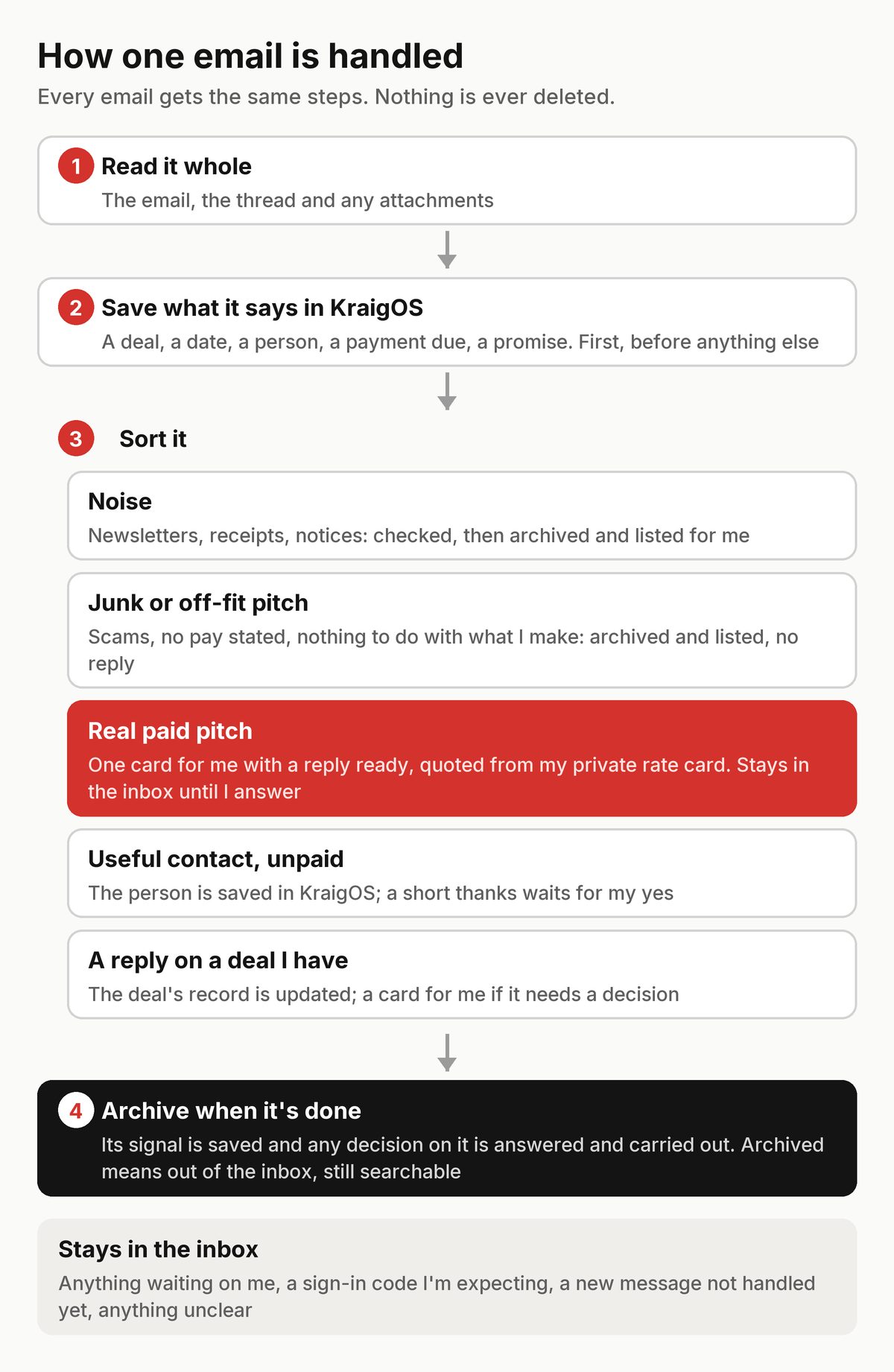
- Read it whole. The thread and any attachments, not just the subject line.
- Save what it says. A deal, a date, a person, a payment due, a promise, each saved on the right record in KraigOS. My sent mail counts too: what I wrote or agreed to updates the records.
- Sort it. Noise, a junk pitch, a real paid pitch, a useful contact, or a reply on a deal I already have.
- Archive it when it's done. Its signal is saved and any decision on it is answered and carried out. Archived means out of the inbox, still in my mail and searchable. Every archived thread is listed in the routine's report, so I can pull one back.
What stays in the inbox: anything waiting on me, a sign-in code I'm expecting, a new message nobody has handled, anything unclear.
Emails I send to myself get their own handling. When I forward myself an article or a video, Claude sorts it as something to learn from, an improvement to my setup, a show to watch, or an idea, and saves it where it belongs.
What went wrong first
That morning, before any of this was rebuilt, I said: "i want to put a pause on auto reply or auto archive all emails for now." So the routine went live read-only. Every hour it read the new mail, filed what mattered and left everything in the inbox.
Filing worked. The inbox didn't. By the evening I said: "There are still a lot of emails in inbox." Then: "We need to start archiving emails out of inbox once they're done."
Archiving came back on autopilot at 6:56pm. Sending stayed paused. Claude archived 21 threads I'd already dealt with right away: deal threads already answered, claim and dispute notices, sign-in emails, receipts and promos.
28 to zero
Half an hour later, 28 threads were still sitting there.
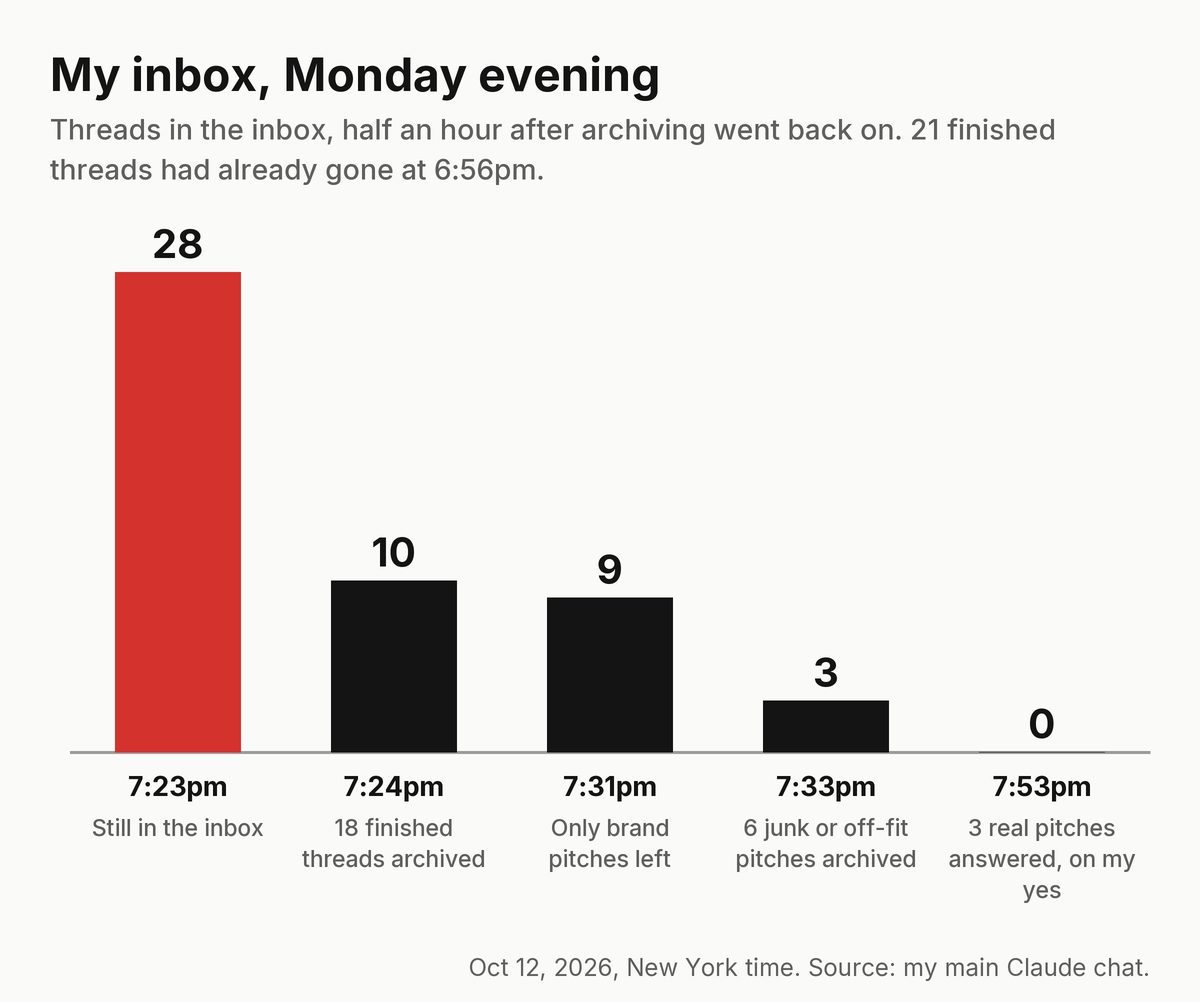
- 28 to 10. Eighteen threads were done but still in the inbox. Several were music licensing emails: copyright claims on my films being lifted, saved on each film's record. One service asked for a detail added to my account, which became a task Claude can do itself.
- 10 to 9. One more claim notice, cleared the same evening.
- 9 to 3. Everything left was a brand pitch. Six were junk or off-fit, like an app that had nothing to do with hiking and a creator-platform invite with no stated pay. Claude archived them without replying.
- 3 to 0. Three real pitches, one card each.
The pitch card
Earlier that day I'd told Claude what I need before deciding on any brand: "I need to know if it's something I would actually use, what my audience would think of if I started promoting it, and like, what is the content? What is the deal?"
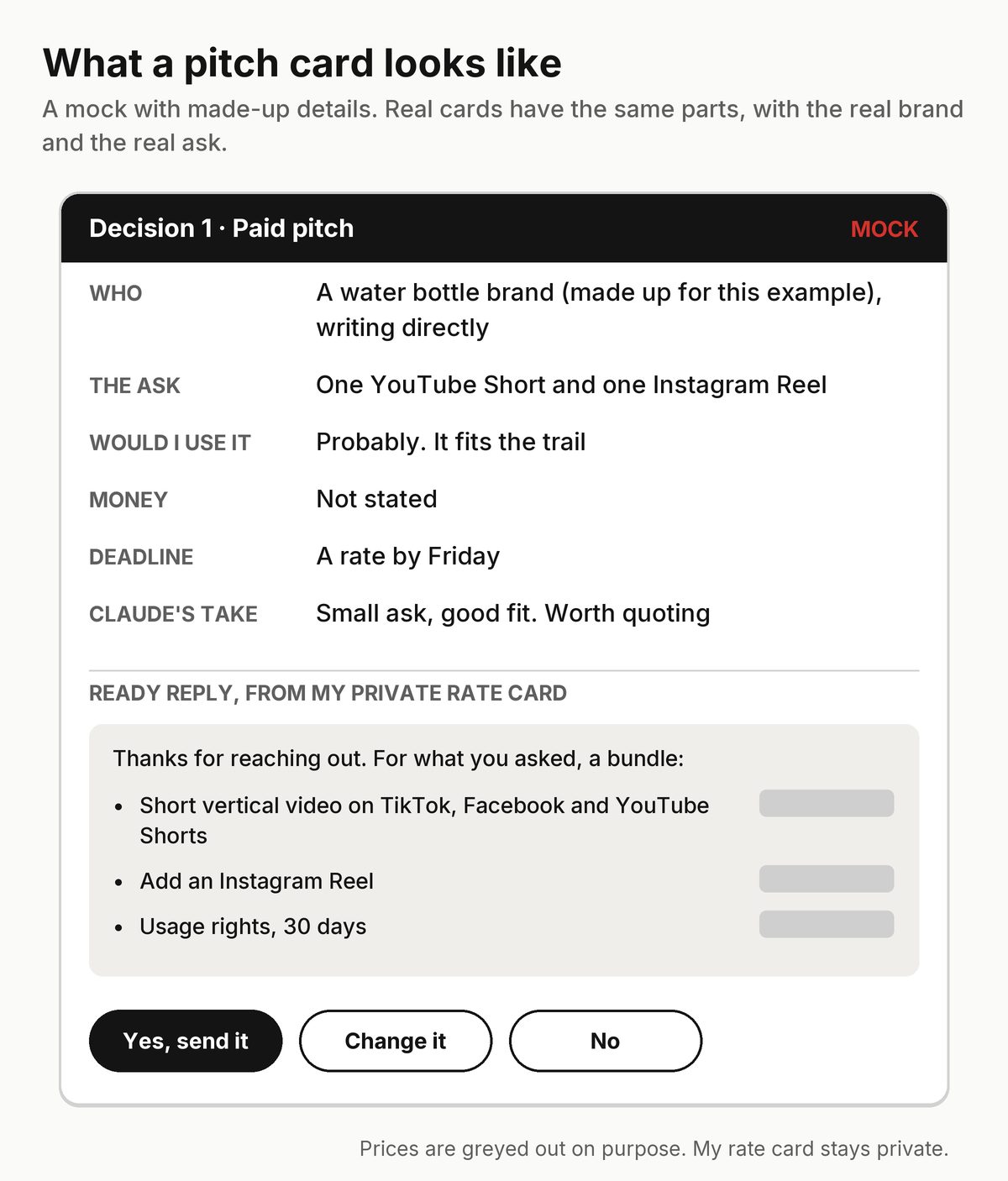
So every real pitch now comes as one card: who the company is, the actual product, whether I'd use it, what content and time they want, the money or that it's missing, the deadline, and Claude's honest take with the pros and cons. The draft reply comes last.
The three that night:
- A tripod brand, through an agency. A paid spot in one of my YouTube films. No budget stated. I asked to see the actual tripod. My answer: "I could actually use that." I asked for short videos and a dedicated video to be added to the quote, and the reply went out on my yes.
- A camera-audio brand, through an agency. A short video on Instagram, a link in my bio and an ad code, with a TikTok post they hoped would come free. The reply priced everything they asked for as one bundle, nothing free.
- A trekking company. No money: if I film there again, they'd cover a licensed guide, permits and logistics. My take: "It's a light pitch, so there's not much we can do with it other than just save it. And if we do end up going to that area of the world again, it would be good to have this person saved." A short thanks went out, and the contact is saved in KraigOS.
A private rate card that makes bundles
Quoting the camera-audio brand is where my rate card came from. I said: "I also think we should be including our other platforms and formats. So like a photo carousel, a video carousel on Instagram, photo and video carousel on Facebook page, as well as horizontal upload to Facebook and TikTok in addition to YouTube. So there's just like a lot of different formats and platforms that we can post the ads and bundle them and increase the prices, upsells and add-ons."
So now there's one menu in KraigOS. A short vertical video on TikTok, Facebook and YouTube Shorts is the base. Instagram formats, Facebook carousels and horizontal uploads are add-ons. YouTube integrations and dedicated videos are priced on their own, and ad codes and usage rights go on top. Each pitch gets a bundle for exactly what they asked, with the add-ons offered.
The card stays private. Claude drafted a version for my website, and I said no: "no public rate card just kraigos". Prices never go on the site.
The rule it follows now
By 7:58pm the evening had become a rule the hourly routine reads first:
- Junk or off-fit pitches: a one-line note, archived, listed in the report. No reply.
- Real paid pitches: a card in my review list with a ready reply from the rate card. The thread stays in the inbox until I answer.
- Useful unpaid contacts: the person saved in KraigOS, a short thanks ready for my yes.
- A brand replying on a deal I already have: the record updated, a card if it needs me.
Nothing is ever sent without my yes on the exact text.
What I learned, and what's next
Saving the signal was never the hard part. Archiving what's finished is what actually empties the inbox, and it only works because the saving comes first.
Next, archiving keeps running on its own every hour, and on October 19 I decide whether filing email moves to autopilot too. Replies stay manual for now. Long term, I want what I already have with my calendar: "i'd rather always interface email through claude but that's eventual and requires more trust to become auto pilot, that's why we're manual for now". How the whole system fits together is on the KraigOS page.
FAQ
Does the AI delete my emails?
No. It only archives, which takes a thread out of the inbox. Everything stays in my mail and searchable, and every archived thread is listed so I can pull one back.
Does it reply to brands on its own?
No. Claude drafts the reply on the pitch card, and it goes out only after I say yes to the exact text.
What happens to junk pitches?
They're saved as one line in KraigOS, archived and listed in the report. They get no reply.
Where do the prices in a quote come from?
From a private rate card in KraigOS: a base short video, add-ons for each extra platform and format, and ad codes and usage rights on top. It never goes on my website.
What does Claude use to read my email?
The Gmail connector in Claude, plus the KraigOS connector to save what each email says. It runs as a Claude routine every hour.