Which one is really me? An AI voice clone blind test
The same passage read four ways. One is me, three are AI copies of my voice. Listen and guess, then see which voice I'm using now and why.
I make long films about hiking alone, about 250 of them over ten years on YouTube. This fall, with Claude, Anthropic's AI model, and KraigOS, the system Claude and I built to run my work, I'm turning them into short videos and narrated versions of films that never had a voice. A lot of that narration is an AI copy of my voice. How I cloned it is its own article, and it ended with a promise: a blind test. Here it is.
Listen first: which one is really me?
All four read the same words at the same volume. One is me on my studio mic. Three are AI. Headphones help. Make your pick before you scroll past the last one.
The words. They come from my film Hiking Alone in Kyrgyzstan, lightly rewritten as a script for reading out loud: "So how do you even get to Kyrgyzstan? For me, it was a ten-hour flight from New York to Istanbul. I spent over twelve dollars on a single cappuccino in the Istanbul airport, which is insane. Then another five hours to Bishkek. I landed at five in the morning, tired and jet-lagged. A local subscriber had messaged me on Instagram and offered me a ride from the airport. He was a great guy, and the first Russian I'd ever met, so we talked about that over breakfast. I know it might seem strange to trust people from the internet while you're traveling alone, but some of my best experiences on the road have come from subscribers who offer to meet up and hang out."
Got your pick? The answers are right below.
The answers
- A is AI: my ElevenLabs clone on Eleven v4, the newer of the two ElevenLabs models in this test.
- B is AI: the same ElevenLabs clone on Eleven Multilingual v2, the model ElevenLabs recommends for it.
- C is me: a real take from September 29 on my Rode VideoMic NTG. The only edit is one cut where I stumbled and reread a sentence.
- D is AI: KraigVO, my Artlist clone, running MiniMax's Speech 02 HD model. It narrated my route-map videos, like K2 Base Camp.
If you picked C, you might have heard the room. My recording has a faint hiss between words. The clones are dead silent there.
The two tools, in plain words
ElevenLabs is an AI voice company. You give it your own recordings, at least 30 minutes, and it trains a Professional Voice Clone: a private copy of your voice that reads any text you type. Mine was trained on about 31 minutes of narration from one mic. The whole story is in How I cloned my voice with AI.
Artlist is where creators get music, stock footage and, lately, AI tools for images, video and voice. It's also a sponsor of my YouTube channel, and that's how I ended up with an Artlist voice clone. My plan comes with 42,500 AI credits a month, far more than I use. Making KraigVO took 500 credits, and this 40-second read took 66. So my Artlist voice cost me nothing extra. Artlist does offer ElevenLabs voices too, but when I checked in September, not for a cloned voice.
Free still lost. After this test I'm paying for ElevenLabs instead.
What each voice costs
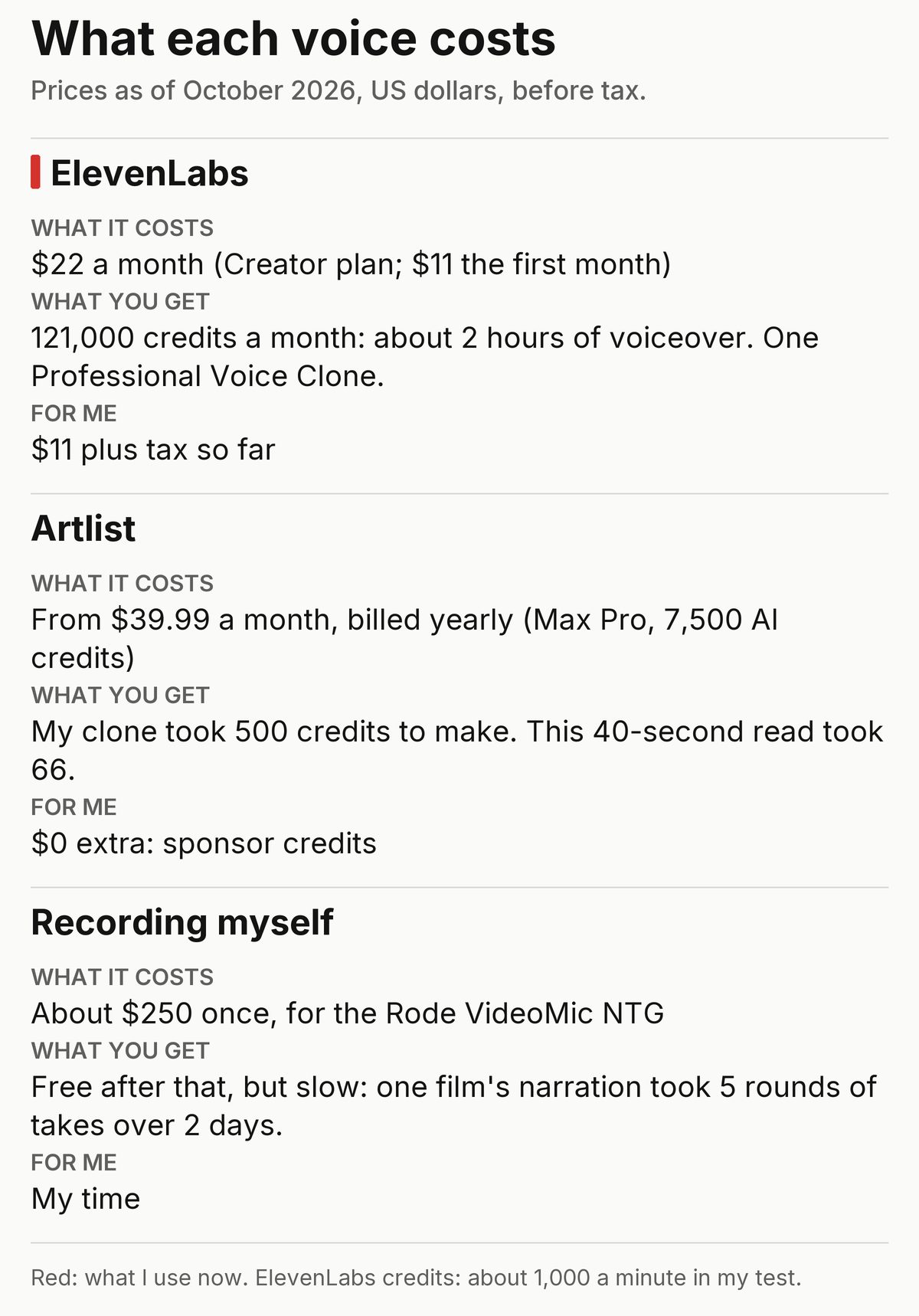
- ElevenLabs: $22 a month for the Creator plan, which includes one Professional Voice Clone and 121,000 credits. My first month was half price, $11 plus tax. In my test a minute of speech used about 1,000 credits, so that's roughly two hours of voiceover a month.
- Artlist: paid plans with AI credits start at $39.99 a month, billed yearly, for 7,500 credits. At 66 credits per 40 seconds, that's about 75 minutes of voice, if you spend the credits on nothing else. For me: nothing extra.
- Recording myself: the mic is a one-time cost, about $250 for the Rode. The real cost is time. For one film's narration in July I did five rounds of takes over two days, about 40 minutes of raw recording, and every take still needs the retakes and stumbles cut out.
How the test was set up
Claude ran it on October 12 and kept it as fair as it could:
- Same words, with the numbers written out so every voice read them the same way.
- First take only. Claude can't hear audio, so it couldn't have picked a favorite anyway.
- Default settings on ElevenLabs; on Artlist, the settings I'd been using for my videos.
- Same volume, same silence. Every clip was set to the same loudness with ffmpeg and trimmed to the same silence at both ends.
- Shuffled. The letters here were drawn at random. I wasn't blind when I listened: my files had their names on.
What I heard, in my own words
ElevenLabs, the older model (B). It sounds pretty similar to me, and it works pretty well.
ElevenLabs v4 (A). It's just like an improvement on that. I think it's really good. It sounds better than even I could record it. It sounds more like optimistic and nicer.
Artlist (D). I think it's Artlist using like an old model, and it sounds really bad. I don't want to use that anymore. It's not worth being able to use it for free. I think it's worth starting to pay for ElevenLabs, especially for the v4 model.
The real me (C). It's real and it sounds like me, and I'm used to what I sound like. But honestly, I think the v4 ElevenLabs is like a better version of whatever I could do, because sometimes I'm tired, sometimes I don't pronounce things correctly, sometimes I just don't consistently give the best performance through a reading.
To be fair to Artlist: the voice model behind its clone comes from another company, MiniMax, and that clone learned from about 3 minutes of my voice, against about 31 for the ElevenLabs one. Artlist is still where my music comes from.
What a computer heard
Claude can't listen, so it measured instead.
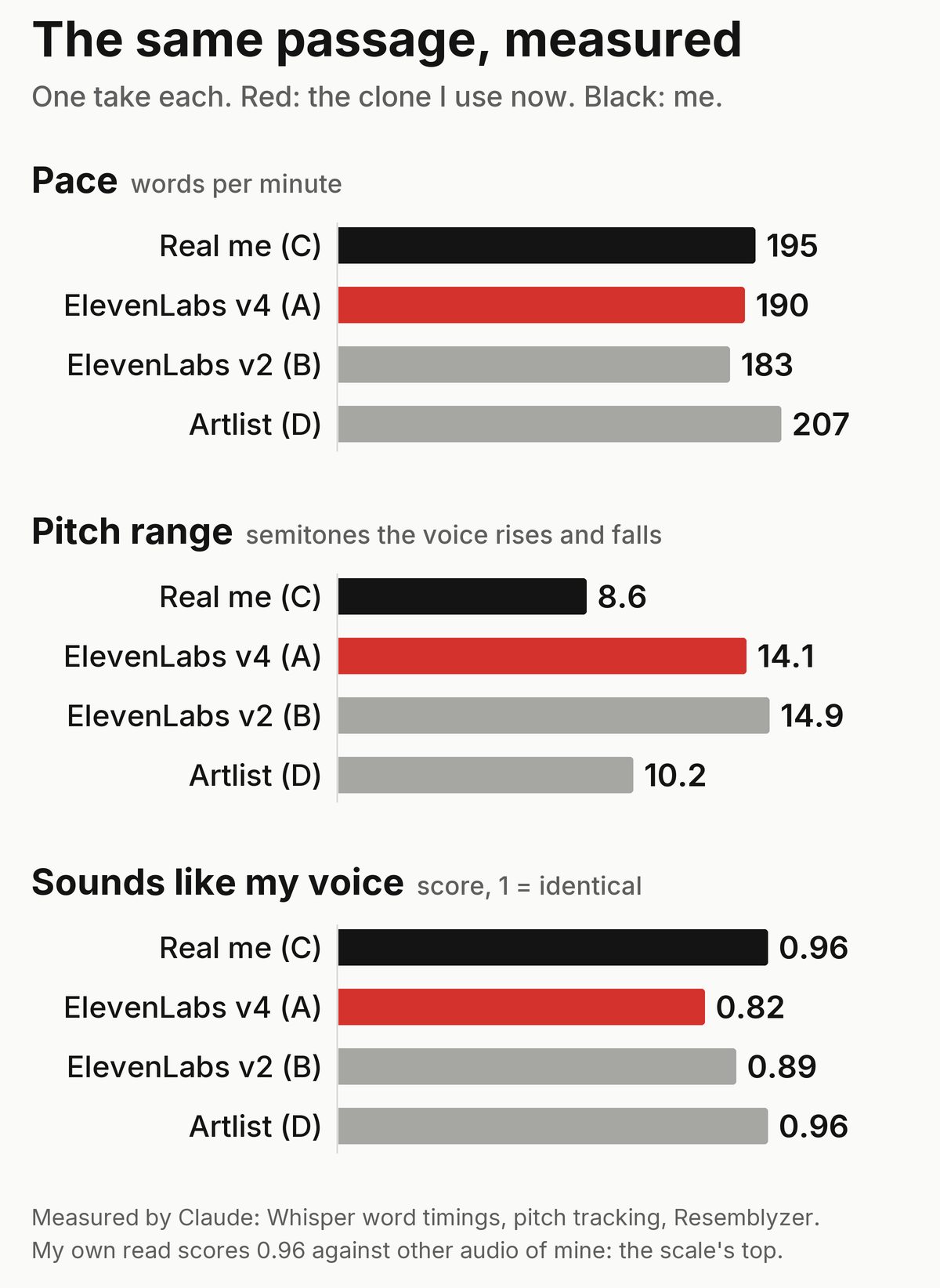
- My real read is the flattest. It rises and falls over about 9 semitones. Both ElevenLabs takes cover about 14. That livelier delivery may be the "more optimistic" I heard.
- ElevenLabs sits a little deeper. Both of its takes are about two semitones below my real voice.
- Artlist talks fastest: 207 words a minute, against my 195.
- The match score disagreed with my ears. Resemblyzer, a free speaker-recognition tool, rated the Artlist clone as close to my voice as my own recording, and v4 the furthest. It measures how much a voice's character matches mine, not whether it sounds natural. And two takes of the same clone scored 0.06 apart, so one take is a noisy sample.
- Every word right. Whisper, a speech-to-text model, heard every word correctly in all four.
The mics behind my voice
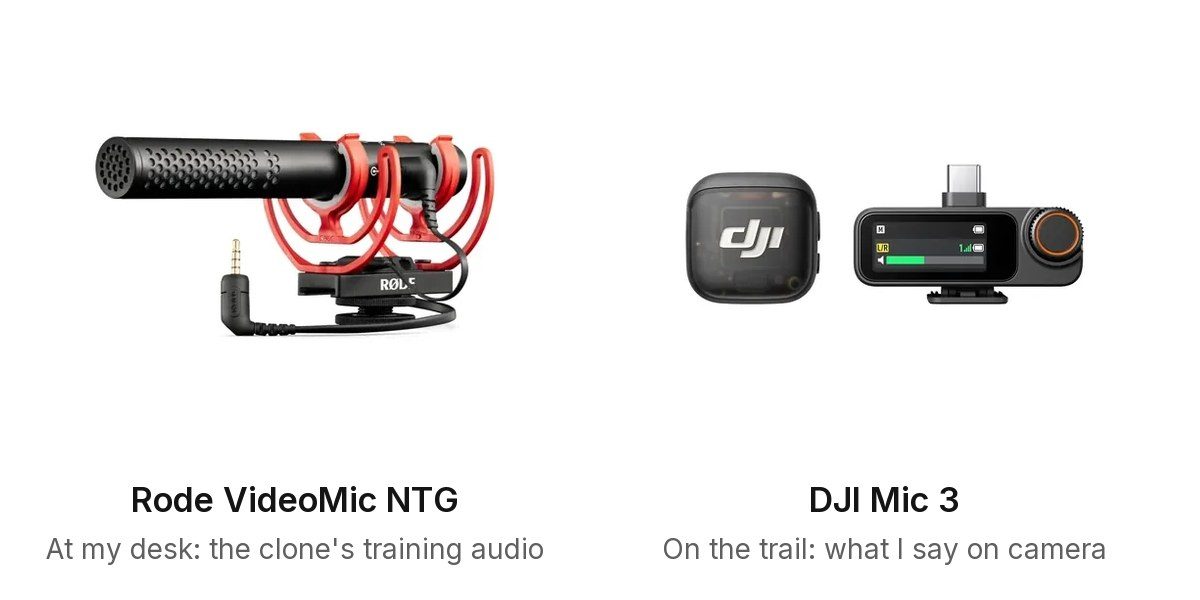
- Rode VideoMic NTG. A shotgun mic, my studio mic for voiceovers and narration. Everything the ElevenLabs clone learned from was recorded on it, and so was the real take above (C). I first carried it on Resurrection Pass in 2019.
- DJI Mic 3. A small wireless mic, my mic on the trail, paired with my camera. It sounds different from the Rode, hissier and brighter, so none of its audio went into the clone. If I ever clone that mic, it'll be a separate voice.
Different mics make different voices, so one mic for all the training audio was my rule. Some links in this article are affiliate links, including ElevenLabs and the mics: if you sign up or buy through one, I may earn a small commission.
What I'm using now
Want to try it? Try ElevenLabs and make your own voice clone. It's the tool I pay for now.
- ElevenLabs v4 for all my AI voiceover: narrated films, shorts and everything else that needs it. I'm keeping the ElevenLabs Creator plan. The Artlist clone came out of credits I already had, and it still wasn't worth using.
- My real voice when I'm already in the piece. The clone is for voiceover that stands on its own. When a video already has my real voice in it, or me on camera talking, I record the new lines myself, so the voice matches.
- Older videos stay as they are for now. The route-map videos were voiced one line per file, so they can be re-voiced line by line the next time we work on them.
- The rule from the first article stays. The voice only says things I already said, in my films, my guides or my own recordings.
The catch: this was the easy test
- The clones had heard these words. The ElevenLabs clone was trained on my whole September 29 reading, this passage included, and the Artlist clone on a 3-minute cut of the same session. This is their best case.
- One passage, one take, one listener. And I knew which was which.
- The real test is new words. A fairer version uses a passage neither clone has heard, with a real recording of me reading it too.
FAQ
Which AI voice clone sounded best?
My ElevenLabs Professional Voice Clone on the Eleven v4 model. To my ears it sounded better than my own read, but that's one passage and one listener.
How much does an ElevenLabs voice clone cost?
I'm on the Creator plan, $22 a month as of October 2026. It includes one Professional Voice Clone and 121,000 credits a month, about two hours of voiceover in my test.
Was the AI trained on the same words it read?
Yes, and that's the big caveat: both clones learned from the session this passage comes from. New words are the harder test.
What microphone did you use to train your voice clone?
A Rode VideoMic NTG at my desk. All of the training audio came from that one mic.
Do you still record your own voiceovers?
Yes, whenever a video already has my real voice in it or me on camera. Voiceover that stands on its own gets the clone.